
广义 Born 隐式溶剂模型无法重现设计的 Glu/Lys 肽的二级结构。
Generalized Born Implicit Solvent Models Do Not Reproduce Secondary Structures of Designed Glu/Lys Peptides.
机构信息
Centre for Computational Chemistry, School of Chemistry, University of Bristol, Cantock's Close, Bristol BS8 1TS, U.K.
School of Chemistry, University of Bristol, Cantock's Close, Bristol BS8 1TS, U.K.
出版信息
J Chem Theory Comput. 2022 Jul 12;18(7):4070-4076. doi: 10.1021/acs.jctc.1c01172. Epub 2022 Jun 10.
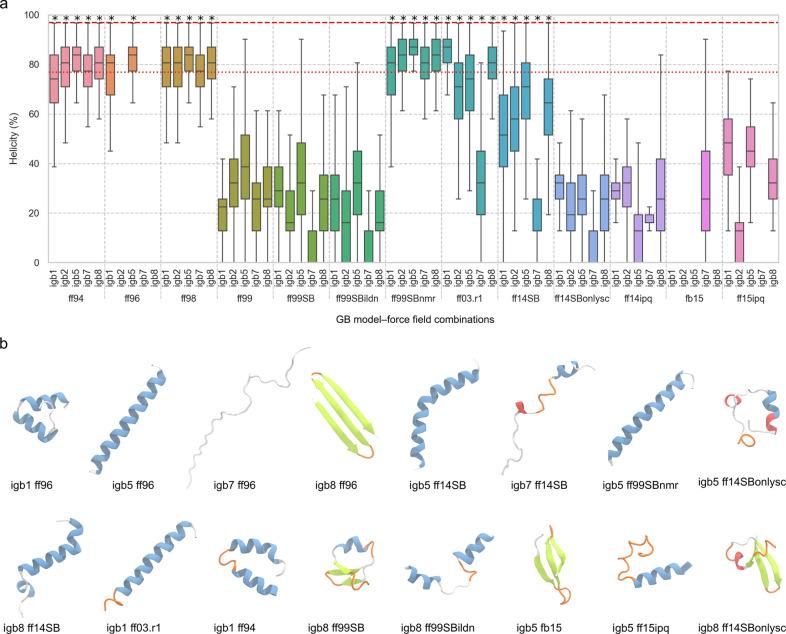
We test a range of standard generalized Born (GB) models and protein force fields for a set of five experimentally characterized, designed peptides comprising alternating blocks of glutamate and lysine, which have been shown to differ significantly in α-helical content. Sixty-five combinations of force fields and GB models are evaluated in >800 μs of molecular dynamics simulations. GB models generally do not reproduce the experimentally observed α-helical content, and none perform well for all five peptides. These results illustrate that these models are not usefully predictive in this context. These peptides provide a useful test set for simulation methods.
我们测试了一系列标准的广义 Born(GB)模型和蛋白质力场,这些模型和力场针对由谷氨酸和赖氨酸交替组成的五个经过实验表征的设计肽进行了测试,这些设计肽在α-螺旋含量方面表现出显著差异。在超过 800 μs 的分子动力学模拟中,评估了 65 种力场和 GB 模型的组合。GB 模型通常无法再现实验观察到的α-螺旋含量,而且对于所有五个肽都没有表现出色。这些结果表明,这些模型在这种情况下没有有用的预测能力。这些肽为模拟方法提供了一个有用的测试集。

 Zotero 插件