
基于聚类分析的抗磷脂抗体患者的临床特征和预后:一项 8 年队列研究。
Clinical characteristics and prognosis of patients with antiphospholipid antibodies based on cluster analysis: an 8-year cohort study.
机构信息
Department of Rheumatology and Clinical Immunology, Chinese Academy of Medical Sciences & Peking Union Medical College, Beijing, China.
National Clinical Research Center for Dermatologic and Immunologic Diseases (NCRC-DID), Ministry of Science & Technology, Beijing, China.
出版信息
Arthritis Res Ther. 2022 Jun 11;24(1):140. doi: 10.1186/s13075-022-02814-w.
BACKGROUND
Antiphospholipid syndrome (APS) is an autoimmune disease characterized by persistent antiphospholipid antibodies (aPLs) positivity with a wide manifestation spectrum. A risk stratification is needed for management guidance and prognosis assessment. We aimed to identify phenotypes among aPL-positive patients and assess the prognosis of each phenotype.
METHODS
This was a single-center, prospective cohort study of aPL-positive patients presented to Peking Union Medical College Hospital from 2012 to 2020. Demographic characteristics, aPL-related manifestations, cardiovascular risk factors, and antibodies profiles were recorded. The primary endpoint was defined as a combination of newly onset thrombosis, major bleeding events, non-criteria manifestations, and all-cause death. Hierarchical cluster analysis and Kaplan-Meier survival analysis were performed.
RESULTS
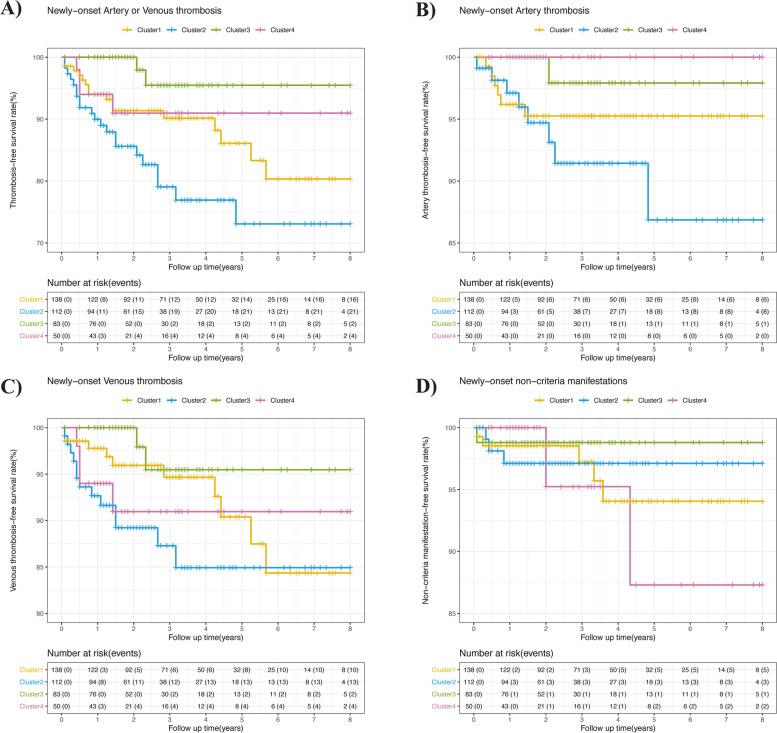
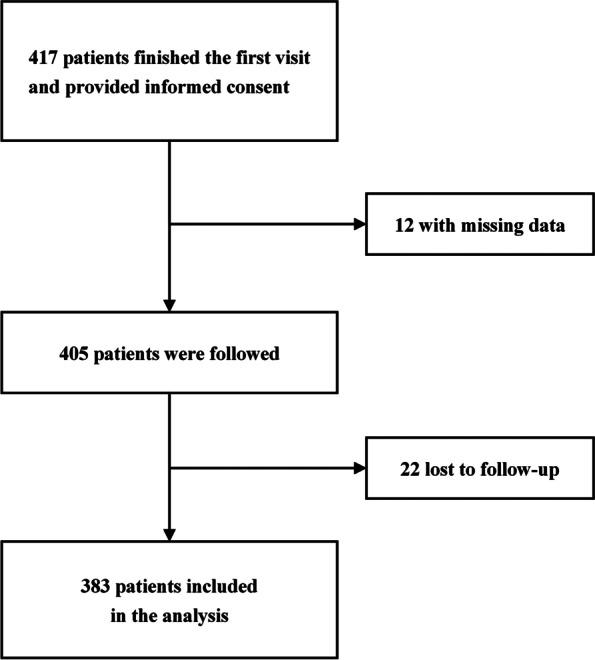
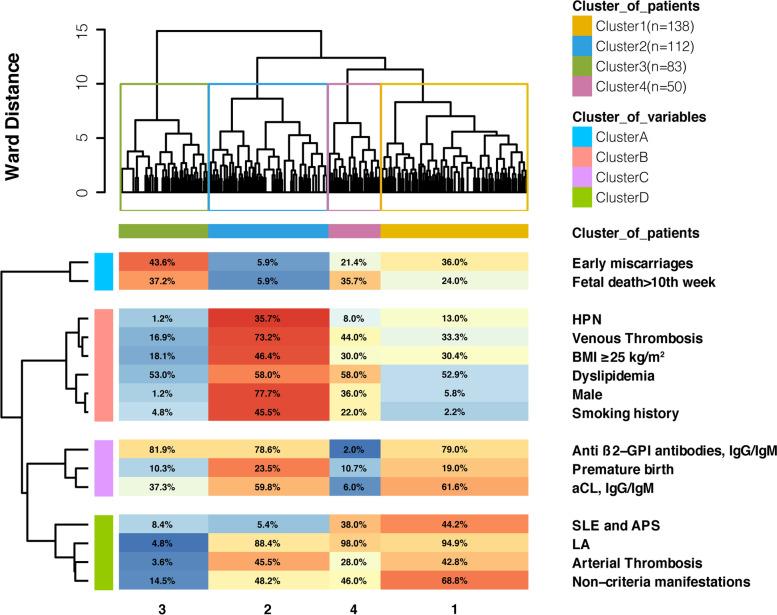
Four clusters among 383 patients (70.2% female; mean age 37.7 years) were identified. Cluster 1 (n = 138): patients with systemic lupus erythematosus (SLE) and non-criteria manifestations; cluster 2 (n = 112): patients with multiple cardiovascular risk factors; cluster 3 (n = 83): female patients with obstetric morbidity; cluster 4 (n = 50): patients with isolated lupus anticoagulant (LA) positivity. Non-criteria manifestations were found aggregated with SLE from cluster analysis of variables. Cluster 3 showed the best outcome, while cluster 2 suffered highest frenquency of newly onset arterial thrombosis.
CONCLUSIONS
We identified 4 clinical phenotypes of aPL-positive patients. Non-criteria manifestations may indicate underlying SLE, for which immunosuppressive therapy besides anticoagulation may be necessary. Patients with isolated LA positivity suffered similar risks with secondary APS and patients with multiple cardiovascular risk factors. Attention should be paid to male patients, and the screening of cardiovascular risk factors should never be ignored.
背景
抗磷脂综合征(APS)是一种自身免疫性疾病,其特征为持续存在抗磷脂抗体(aPL)阳性,并具有广泛的表现谱。需要进行风险分层以指导管理和评估预后。我们旨在确定 aPL 阳性患者中的表型,并评估每种表型的预后。
方法
这是一项针对 2012 年至 2020 年期间在北京协和医院就诊的 aPL 阳性患者的单中心前瞻性队列研究。记录了人口统计学特征、与 aPL 相关的表现、心血管危险因素和抗体谱。主要终点定义为新发血栓形成、大出血事件、非标准表现和全因死亡的组合。进行了层次聚类分析和 Kaplan-Meier 生存分析。
结果
在 383 例患者中(70.2%为女性;平均年龄 37.7 岁)确定了 4 个聚类。聚类 1(n=138):患有系统性红斑狼疮(SLE)和非标准表现的患者;聚类 2(n=112):患有多种心血管危险因素的患者;聚类 3(n=83):患有产科并发症的女性患者;聚类 4(n=50):患有孤立性狼疮抗凝剂(LA)阳性的患者。通过变量聚类分析发现非标准表现与 SLE 相关。聚类 3 表现出最佳结局,而聚类 2 发生新发动脉血栓形成的频率最高。
结论
我们确定了 4 种 aPL 阳性患者的临床表型。非标准表现可能表明存在潜在的 SLE,除抗凝治疗外,可能还需要免疫抑制治疗。孤立性 LA 阳性的患者与继发性 APS 具有相似的风险,而患有多种心血管危险因素的患者也需要引起重视。应关注男性患者,且不能忽视心血管危险因素的筛查。

 Zotero 插件