
迁移会影响 ASD 和 ADHD 的患病率:系统评价和荟萃分析。
Migration modulates the prevalence of ASD and ADHD: a systematic review and meta-analysis.
机构信息
Department of Child & Adolescent Psychiatry, Peking University Sixth Hospital (Institute of Mental Health), National Clinical Research Center for Mental Disorders and NHC Key Laboratory of Mental Health (Peking University Sixth Hospital), 51, Huayuan Bei Road, Haidian District, Beijing, 100191, PR China.
Department of Public Health and Preventive Medicine, School of Medicine, Jinan University, No.601 Huangpu Road West, Guangzhou, 510632, Guangdong, PR China.
出版信息
BMC Psychiatry. 2022 Jun 13;22(1):395. doi: 10.1186/s12888-022-04037-4.
BACKGROUND
Migration has been implicated as a risk factor for autism spectrum disorder (ASD) and attention-deficit/hyperactivity disorder (ADHD), but evidence is still limited and inconsistent. We aim to investigate the relationship between migration status and risk of ASD and ADHD.
METHODS
Electronic databases including PubMed, EMBASE, Web of Science, and PsychINFO were searched to identify observational studies on this topic, from inception to February 2021. Random-effects meta-analysis models were used to pool the summary odds ratio (OR) and 95% confidence interval (95% CI), and subgroup analyses were conducted to detect possible discrepancies in associations. Certainty of evidence was assessed as per the Grading of Recommendations, Assessment, Development and Evaluations (GRADE) guidelines.
RESULTS
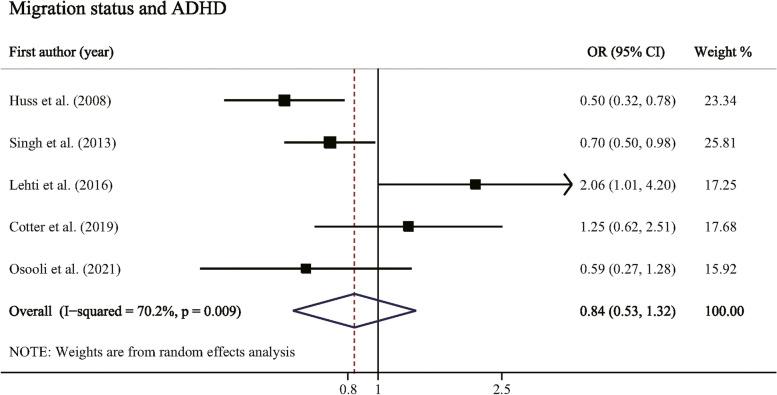
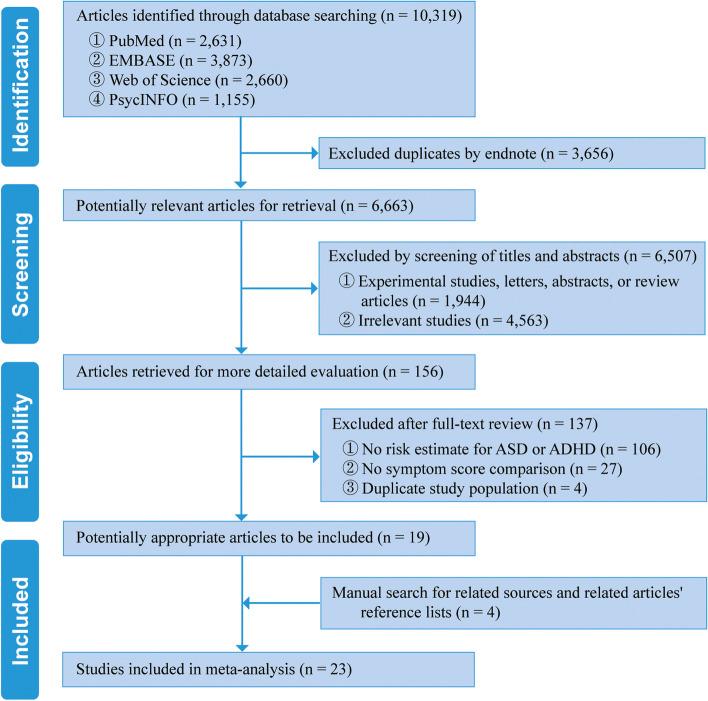
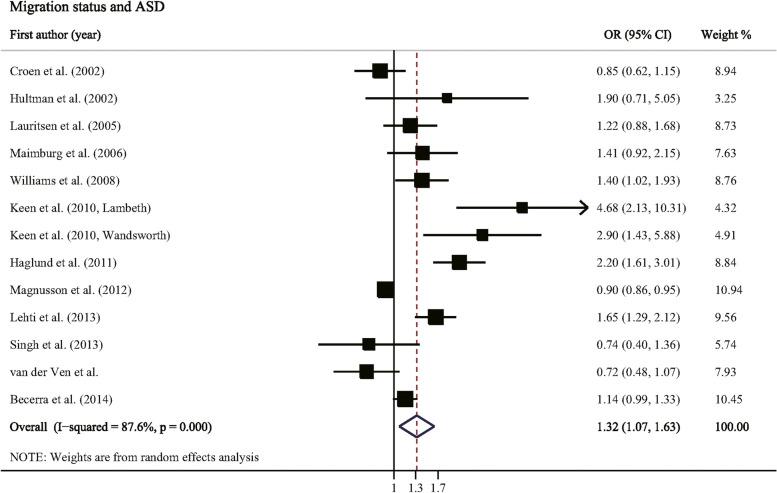
A total of 13 studies (6,532,546 participants) for ASD, five studies (2,875,070 participants) for ADHD, and six studies (31,158 participants) for hyperactivity were included. Overall, the pooled results indicated that migration was associated with increased risk of ASD (pooled OR: 1.32; 95% CI: 1.07-1.63; P for Z test = 0.010), but no association was found between migration and ADHD (pooled OR: 0.84; 95% CI: 0.53-1.32; P for Z test = 0.452) or hyperactivity (pooled standardized mean difference: -0.073; 95% CIs: - 0.383-0.236; P for Z test = 0.642). Subgroup analyses further demonstrated that maternal migration was ASD risk factor (pooled OR: 1.49; 95% CI: 1.19-1.87), and migrant children were more likely to develop ASD with comorbid intellectual disability (ID) (pooled OR: 1.21, P for interaction = 0.006) than ASD without ID. After standardized the origin of migrants, European migrant children from Americas were at higher risk of ASD and ADHD (pooled OR were 4.13 and 1.26), and increased ASD risk was also observed in African children (pooled OR: 2.72). The GRADE of evidence was very low.
CONCLUSIONS
Maternal migration is a risk factor for ASD, and migrant ASD children are more likely comorbid ID. The role of migration on ADHD remains controversial, more studies are needed to assess the association between migration status and ADHD. Health care practitioners should consider screening and providing extra resources for migrant children.
背景
移民已被认为是自闭症谱系障碍(ASD)和注意缺陷多动障碍(ADHD)的一个风险因素,但证据仍然有限且不一致。我们旨在研究移民身份与 ASD 和 ADHD 风险之间的关系。
方法
从数据库建立到 2021 年 2 月,我们在 PubMed、EMBASE、Web of Science 和 PsychINFO 等电子数据库中搜索了关于该主题的观察性研究。使用随机效应荟萃分析模型汇总了汇总优势比(OR)和 95%置信区间(95%CI),并进行了亚组分析以检测关联中的差异。证据的确定性按照推荐、评估、发展和评估(GRADE)指南进行评估。
结果
共纳入 13 项 ASD 研究(6532546 名参与者)、5 项 ADHD 研究(2875070 名参与者)和 6 项多动研究(31158 名参与者)。总体而言,汇总结果表明,移民与 ASD 风险增加相关(汇总 OR:1.32;95%CI:1.07-1.63;Z 检验 P 值=0.010),但移民与 ADHD 之间无关联(汇总 OR:0.84;95%CI:0.53-1.32;Z 检验 P 值=0.452)或多动(汇总标准化均数差值:-0.073;95%CI:-0.383-0.236;Z 检验 P 值=0.642)。亚组分析进一步表明,母亲移民是 ASD 的一个风险因素(汇总 OR:1.49;95%CI:1.19-1.87),患有共病智力障碍(ID)的移民儿童更有可能发展为 ASD(汇总 OR:1.21,交互 P 值=0.006),而无 ID 的 ASD 儿童则不然。在标准化移民原籍国后,来自美洲的欧洲移民儿童患 ASD 和 ADHD 的风险更高(汇总 OR 分别为 4.13 和 1.26),非洲儿童患 ASD 的风险也有所增加(汇总 OR:2.72)。证据的 GRADE 等级非常低。
结论
母亲移民是 ASD 的一个风险因素,患有 ASD 的移民儿童更有可能共患 ID。移民对 ADHD 的作用仍存在争议,需要更多的研究来评估移民身份与 ADHD 之间的关联。医疗保健从业者应考虑对移民儿童进行筛查并提供额外资源。
 Zotero 插件