
男性接受睾酮治疗期间的心血管不良事件和死亡率:个体患者和汇总数据分析。
Adverse cardiovascular events and mortality in men during testosterone treatment: an individual patient and aggregate data meta-analysis.
机构信息
Health Services Research Unit, University of Aberdeen, Aberdeen, UK.
Translational and Clinical Research Institute, University of Newcastle-on-Tyne, Newcastle Upon Tyne, UK.
出版信息
Lancet Healthy Longev. 2022 Jun;3(6):e381-e393. doi: 10.1016/S2666-7568(22)00096-4.
BACKGROUND
Testosterone is the standard treatment for male hypogonadism, but there is uncertainty about its cardiovascular safety due to inconsistent findings. We aimed to provide the most extensive individual participant dataset (IPD) of testosterone trials available, to analyse subtypes of all cardiovascular events observed during treatment, and to investigate the effect of incorporating data from trials that did not provide IPD.
METHODS
We did a systematic review and meta-analysis of randomised controlled trials including IPD. We searched MEDLINE, MEDLINE In-Process & Other Non-Indexed Citations, MEDLINE Epub Ahead of Print, Embase, Science Citation Index, the Cochrane Controlled Trials Register, Cochrane Database of Systematic Reviews, and Database of Abstracts of Review of Effects for literature from 1992 onwards (date of search, Aug 27, 2018). The following inclusion criteria were applied: (1) men aged 18 years and older with a screening testosterone concentration of 12 nmol/L (350 ng/dL) or less; (2) the intervention of interest was treatment with any testosterone formulation, dose frequency, and route of administration, for a minimum duration of 3 months; (3) a comparator of placebo treatment; and (4) studies assessing the pre-specified primary or secondary outcomes of interest. Details of study design, interventions, participants, and outcome measures were extracted from published articles and anonymised IPD was requested from investigators of all identified trials. Primary outcomes were mortality, cardiovascular, and cerebrovascular events at any time during follow-up. The risk of bias was assessed using the Cochrane Risk of Bias tool. We did a one-stage meta-analysis using IPD, and a two-stage meta-analysis integrating IPD with data from studies not providing IPD. The study is registered with PROSPERO, CRD42018111005.
FINDINGS
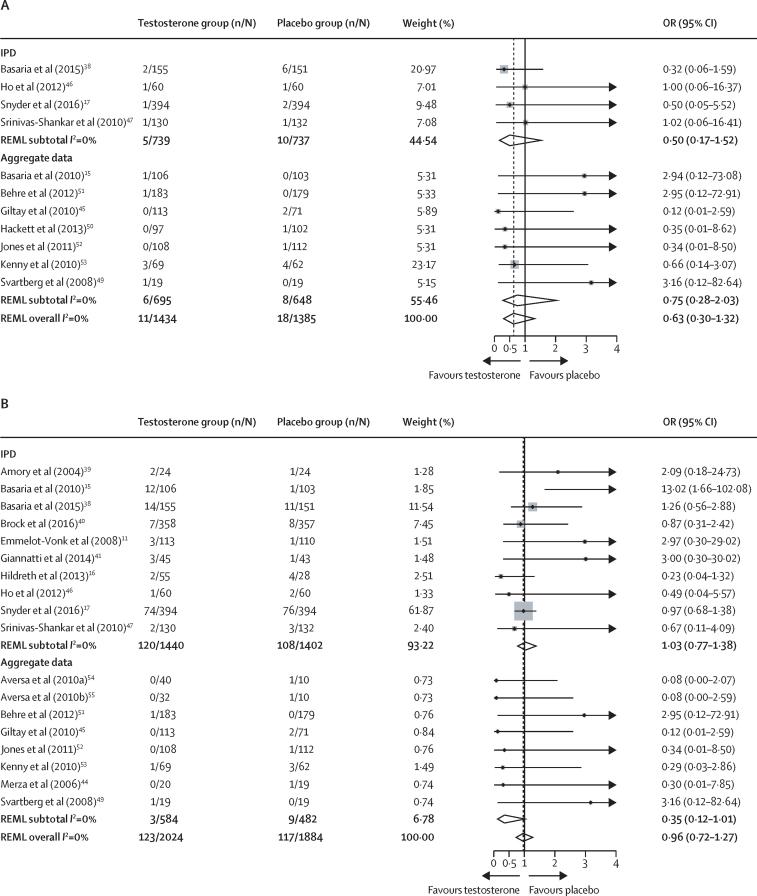
9871 citations were identified through database searches and after exclusion of duplicates and of irrelevant citations, 225 study reports were retrieved for full-text screening. 116 studies were subsequently excluded for not meeting the inclusion criteria in terms of study design and characteristics of intervention, and 35 primary studies (5601 participants, mean age 65 years, [SD 11]) reported in 109 peer-reviewed publications were deemed suitable for inclusion. Of these, 17 studies (49%) provided IPD (3431 participants, mean duration 9·5 months) from nine different countries while 18 did not provide IPD data. Risk of bias was judged to be low in most IPD studies (71%). Fewer deaths occurred with testosterone treatment (six [0·4%] of 1621) than placebo (12 [0·8%] of 1537) without significant differences between groups (odds ratio [OR] 0·46 [95% CI 0·17-1·24]; p=0·13). Cardiovascular risk was similar during testosterone treatment (120 [7·5%] of 1601 events) and placebo treatment (110 [7·2%] of 1519 events; OR 1·07 [95% CI 0·81-1·42]; p=0·62). Frequently occurring cardiovascular events included arrhythmia (52 of 166 47 of 176), coronary heart disease (33 of 166 33 of 176), heart failure (22 of 166 28 of 176), and myocardial infarction (10 of 166 16 of 176). Overall, patient age (interaction 0·97 [99% CI 0·92-1·03]; p=0·17), baseline testosterone (interaction 0·97 [0·82-1·15]; p=0·69), smoking status (interaction 1·68 [0·41-6·88]; p=0.35), or diabetes status (interaction 2·08 [0·89-4·82; p=0·025) were not associated with cardiovascular risk.
INTERPRETATION
We found no evidence that testosterone increased short-term to medium-term cardiovascular risks in men with hypogonadism, but there is a paucity of data evaluating its long-term safety. Long-term data are needed to fully evaluate the safety of testosterone.
FUNDING
National Institute for Health Research Health Technology Assessment Programme.
背景
睾酮是治疗男性性腺功能减退症的标准治疗方法,但由于结果不一致,其心血管安全性仍存在不确定性。我们旨在提供可用的睾酮试验中最广泛的个体参与者数据集(IPD),分析治疗期间观察到的所有心血管事件的亚型,并研究纳入未提供 IPD 的试验数据的效果。
方法
我们对包括 IPD 的随机对照试验进行了系统评价和荟萃分析。我们检索了 MEDLINE、MEDLINE In-Process & Other Non-Indexed Citations、MEDLINE Epub Ahead of Print、Embase、Science Citation Index、Cochrane 对照试验登记册、Cochrane 系统评价数据库和效果摘要数据库,以获取自 1992 年以来的文献(搜索日期为 2018 年 8 月 27 日)。纳入标准为:(1)年龄在 18 岁及以上,筛选时睾酮浓度为 12 nmol/L(350ng/dL)或更低;(2)感兴趣的干预措施为任何睾酮制剂、剂量频率和给药途径治疗,至少持续 3 个月;(3)使用安慰剂治疗作为对照;(4)评估预先指定的主要或次要结局的研究。从已发表的文章中提取研究设计、干预措施、参与者和结局测量的详细信息,并向所有确定试验的研究人员请求匿名化的 IPD。主要结局为随访期间任何时间的死亡率、心血管和脑血管事件。使用 Cochrane 风险偏倚工具评估风险偏倚。我们使用 IPD 进行了一次性荟萃分析,使用 IPD 与未提供 IPD 的研究的数据进行了二次荟萃分析。该研究在 PROSPERO 注册,注册号为 CRD42018111005。
结果
通过数据库搜索确定了 9871 条引用,排除重复和不相关的引用后,检索到 225 篇研究报告进行全文筛选。随后,由于研究设计和干预措施特征不符合纳入标准,有 116 项研究被排除在外,35 项主要研究(5601 名参与者,平均年龄 65 岁,[标准差 11])在 109 篇同行评议的出版物中报道,被认为适合纳入。其中,17 项研究(49%)来自 9 个不同国家,提供了 IPD(3431 名参与者,平均持续时间 9.5 个月),而其余 18 项研究未提供 IPD 数据。大多数 IPD 研究的风险偏倚被认为较低(71%)。与安慰剂组(1537 名,12 名[0.8%])相比,睾酮治疗组(1621 名,6 名[0.4%])死亡人数较少,但两组之间无显著差异(比值比[OR]0.46[95%CI0.17-1.24];p=0.13)。在睾酮治疗组(1601 例事件中 120 例[7.5%])和安慰剂治疗组(1519 例事件中 110 例[7.2%])的心血管风险相似(OR1.07[95%CI0.81-1.42];p=0.62)。常见的心血管事件包括心律失常(166 例中的 52 例[47%],176 例中的 47 例[47%])、冠心病(166 例中的 33 例[46%],176 例中的 33 例[46%])、心力衰竭(166 例中的 22 例[46%],176 例中的 28 例[46%])和心肌梗死(166 例中的 10 例[46%],176 例中的 16 例[46%])。总体而言,患者年龄(交互作用 0.97[99%CI0.92-1.03];p=0.17)、基线睾酮(交互作用 0.97[0.82-1.15];p=0.69)、吸烟状况(交互作用 1.68[0.41-6.88];p=0.35)或糖尿病状况(交互作用 2.08[0.89-4.82;p=0.025])与心血管风险无关。
解释
我们没有发现睾酮会增加男性性腺功能减退症患者短期至中期的心血管风险,但评估其长期安全性的数据很少。需要长期数据来全面评估睾酮的安全性。
资金
英国国家卫生研究院卫生技术评估计划。

 Zotero 插件