
一项关于家庭在支持痴呆症患者沟通方面作用的定性系统评价。
A qualitative systematic review of the role of families in supporting communication in people with dementia.
机构信息
Betsi Cadwaladr University Health Board, Wrexham, Bangor, UK.
School of Medical and Health Sciences, Bangor University, Bangor, UK.
出版信息
Int J Lang Commun Disord. 2022 Sep;57(5):1130-1153. doi: 10.1111/1460-6984.12738. Epub 2022 Jun 17.
BACKGROUND
Cognitive-communication difficulties are often associated with dementia and can impact a person's ability to participate in meaningful conversations. This can create challenges to families, reflecting the reality that people living with dementia rarely have just one regular conversation partner, but interact with multiple family members. To date, there is limited evidence of the impact of changes in communication patterns in families. A family systems approach, with foundations in psychology, can be used to explore the impact of communication difficulties on multiple different family members, including the person living with dementia and potential coping strategies used by individuals, together with the family as a whole.
METHODS & PROCEDURES: A systematic review of primary qualitative research was conducted to identify and examine research exploring communication and interaction within families living with dementia. Studies were identified through a comprehensive search of major databases and the full-text articles were subject to a quality appraisal. We conducted a thematic analysis on the literature identified to consider the role of families in supporting communication for people with dementia.
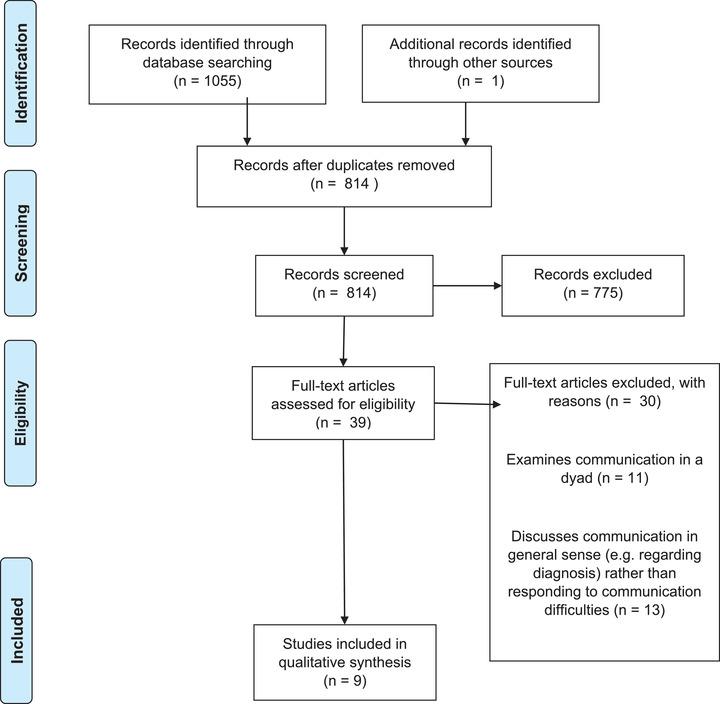
OUTCOMES & RESULTS: The searches identified 814 possible articles for screening against the eligibility criteria. Nine articles were included in the final review. Three major themes emerged from the analysis of the included studies: (1) 'identities changing' reflected how interactions within the family systems impacted on identities; (2) 'loss' reflected the grief experienced by families due to changes in communication; and (3) 'developing communication strategies' highlighted strategies and approaches that families affected by dementia may use organically to engage in meaningful interactions and maintain connection. Only one study explicitly used a family systems approach to understand how families manage the changes in interaction resulting from dementia.
CONCLUSIONS & IMPLICATIONS: The findings may usefully inform the clinical practice of speech and language therapists in terms of communication strategies and coping mechanisms that may be advised to facilitate connection in families living with dementia. Further research using a family systems approach to exploring communication in dementia may help to support the implementation of family-centred practice as recommended in policy.
WHAT THIS PAPER ADDS
What is already known on the subject There is increasing recognition of the impact of dementia on whole families and the need for family-centred interventions to enhance quality of life. However, much of the research to date that explores communication within families affected by dementia examines interaction between dyads, largely overlooking the roles and skills of other familial communication partners. To the authors' knowledge, there has been no previous review of the literature using a family systems approach, which has the potential to inform clinical practice of those working in dementia care. What this paper adds to existing knowledge The review examines and understands what is known about the approaches used by families affected by communication changes resulting from dementia to preserve connection. It collates the evidence from qualitative studies examining approaches and strategies used by individual conversation partners, including people with dementia, as well as the family system as a whole, to facilitate meaningful interactions, and proposes recommendations for clinicians working in this field. Furthermore, we consider the potential benefits of using a family systems approach to understand the context of people living with dementia and how this could enhance communication, personhood and well-being. What are the potential or actual clinical implications of this work? This review highlights practical conversation strategies and interactional approaches that may serve to enhance communication and preserve relationships between people with dementia and their family members. Such techniques have the potential to be advised by Speech and Language Therapists working in dementia care as part of tailored, relationship-centred care and support that they provide.
背景
认知-沟通困难通常与痴呆症有关,并会影响一个人参与有意义对话的能力。这会给家庭带来挑战,反映出一个事实,即患有痴呆症的人很少只有一个固定的谈话伙伴,而是与多个家庭成员互动。迄今为止,关于家庭沟通模式变化的影响的证据有限。家庭系统方法以心理学为基础,可以用来探索沟通困难对多个不同家庭成员的影响,包括患有痴呆症的人和个人可能使用的潜在应对策略,以及整个家庭。
方法和程序
对原发性定性研究进行了系统回顾,以确定和研究探索痴呆症家庭中的沟通和互动。通过对主要数据库的全面搜索来确定研究,并对全文文章进行了质量评估。我们对确定的文献进行了主题分析,以考虑家庭在支持痴呆症患者沟通方面的作用。
结果和结论
搜索确定了 814 篇可能符合资格标准的文章进行筛选。最终综述纳入了 9 篇文章。分析纳入的研究得出了三个主要主题:(1)“身份变化”反映了家庭系统内部的相互作用如何影响身份;(2)“丧失”反映了家庭因沟通变化而经历的悲伤;(3)“发展沟通策略”强调了受痴呆症影响的家庭可能有机地使用的策略和方法,以进行有意义的互动并保持联系。只有一项研究明确使用家庭系统方法来了解家庭如何管理由痴呆症引起的互动变化。
结论和意义
这些发现可能有助于言语和语言治疗师在沟通策略和应对机制方面的临床实践,以促进与痴呆症患者的家庭建立联系。使用家庭系统方法进一步探索痴呆症中的沟通可能有助于支持政策中建议的以家庭为中心的实践的实施。
本文的贡献
关于这个主题已经知道的内容
越来越认识到痴呆症对整个家庭的影响,以及需要以家庭为中心的干预措施来提高生活质量。然而,迄今为止,大多数研究痴呆症家庭内部沟通的研究都检查了双体之间的相互作用,在很大程度上忽略了其他家庭沟通伙伴的作用和技能。据作者所知,以前没有使用家庭系统方法对文献进行综述,该方法有可能为痴呆症护理领域的工作者提供临床实践信息。
本文对现有知识的贡献
该综述检查并了解了受痴呆症引起的沟通变化影响的家庭为保持联系而采用的方法。它汇集了关于个体对话伙伴(包括痴呆症患者)以及整个家庭系统使用的方法和策略的定性研究的证据,以促进有意义的互动,并为在这一领域工作的临床医生提出建议。此外,我们考虑了使用家庭系统方法来理解痴呆症患者生活背景的潜在好处,以及这如何增强沟通、个性和幸福感。
这项工作的潜在或实际临床意义是什么?本综述强调了实用的对话策略和互动方法,这些策略可能有助于增强痴呆症患者及其家庭成员之间的沟通和关系。言语和语言治疗师在痴呆症护理方面提供的个性化、以关系为中心的护理和支持中,可以建议使用这些技术。

 Zotero 插件