
基于 CRISPR/Cas12a 的诊断平台准确检测靶向新型种属特异性基因。
CRISPR/Cas12a-Based Diagnostic Platform Accurately Detects Targeting a Novel Species-Specific Gene.
机构信息
State Key Laboratory for Infectious Disease Prevention and Control, National Institute for Communicable Disease Control and Prevention, Chinese Center for Disease Control and Prevention, Beijing, China.
School of Laboratory Medicine and Life Sciences, Wenzhou Medical University, Wenzhou, China.
出版信息
Front Cell Infect Microbiol. 2022 May 27;12:884411. doi: 10.3389/fcimb.2022.884411. eCollection 2022.
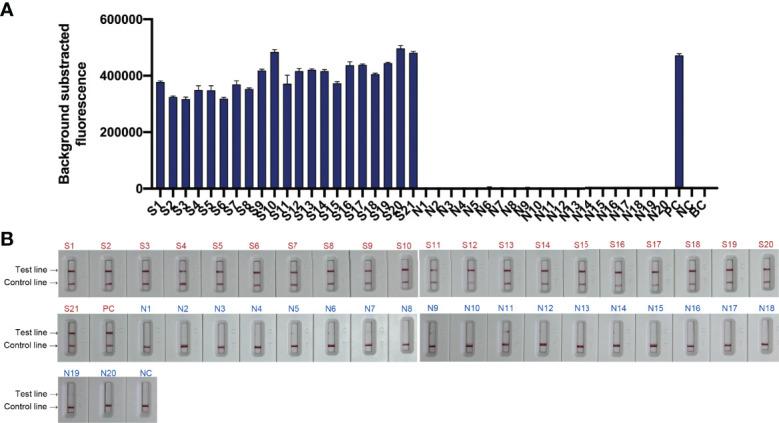
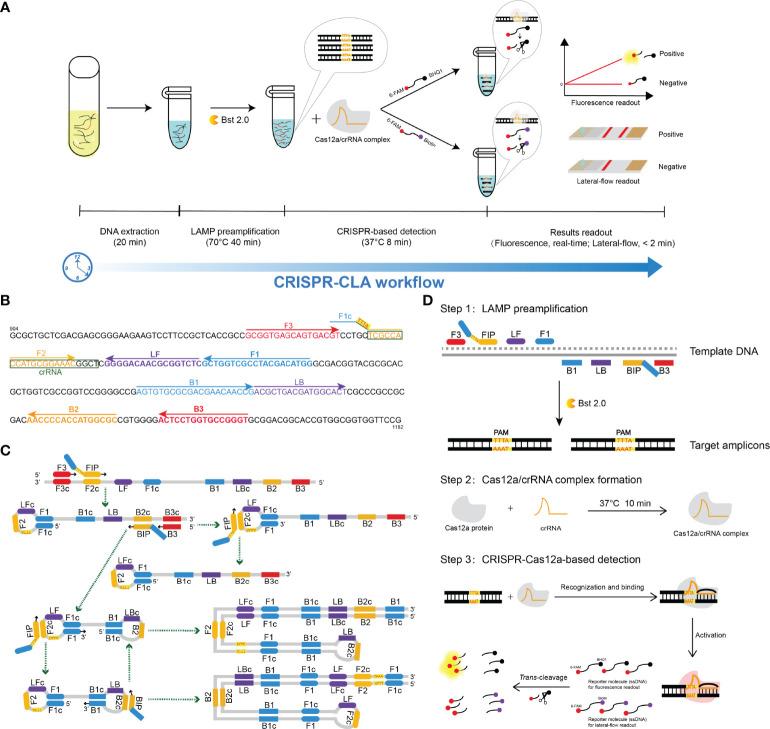
Under the COVID-19 pandemic background, nucleic acid detection has become the gold standard to rapidly diagnose the infectious disease. A rapid, low cost, reliable nucleic acid detection platform will be the key to control next potential pandemic. In this study, a nucleic acid detection platform, which combined CRISPR/Cas12a-based detection with loop-mediated isothermal amplification (LAMP), was developed and termed CRISPR-CLA. In the CRISPR-CLA system, LAMP preamplification was employed, and CRISPR/Cas12a-based detection was used to monitor the preamplicons. The forward inner primer (FIP) was engineered with a protospacer adjacent motif (PAM) site TTTA of Cas12a effector at the linker region; thus, the CRISPR-CLA platform can detect any sequence as long as the primer design meets the requirement of LAMP. To demonstrate the validity of the CRISPR-CLA system, it was applied for the molecular diagnosis of nocardiosis caused by (). A highly conserved and species-specific gene of , which was first reported in this study, was used as the target of detection. A set of LAMP primers targeting a fragment of of the reference strain IFM 10152 was designed according to the principle of CRISPR-CLA. Three CRISPR RNAs (crRNAs) with different lengths were designed, and the most efficient crRNA was screened out. Additionally, three single-strand DNA (ssDNA) probes were tested to further optimize the detection system. As a result, the CRISPR-CLA assay was established, and the whole detection process, including DNA extraction (20 min), LAMP preamplification (70°C, 40 min), and CRISPR/Cas12a-mediated detection (37°C, 8 min), can be completed within 70 min. A fluorescence reader (for fluorescence CRISPR-CLA) or a lateral flow biosensor (for lateral-flow CRISPR-CLA) can be the media of the result readout. Up to 132 strains were used to examine the specificity of CRISPR-CLA assay, and no cross-reaction was observed with non- templates. The limit of detection (LoD) of the CRISPR-CLA assay was 100 fg double-strand DNA per reaction. was detected accurately in 41 sputum specimens using the CRISPR-CLA assay, which showed higher specificity than a real-time qPCR method. Hence, the CRISPR-CLA assay is a rapid, economic and accurate method to diagnose infection.
在 COVID-19 大流行背景下,核酸检测已成为快速诊断传染病的金标准。一个快速、低成本、可靠的核酸检测平台将是控制下一次潜在大流行的关键。在本研究中,开发了一种将基于 CRISPR/Cas12a 的检测与环介导等温扩增(LAMP)相结合的核酸检测平台,命名为 CRISPR-CLA。在 CRISPR-CLA 系统中,采用 LAMP 预扩增,基于 CRISPR/Cas12a 的检测用于监测预扩增子。正向内引物(FIP)在连接区带有 Cas12a 效应物的原间隔基序(PAM)位点 TTTA;因此,只要引物设计符合 LAMP 的要求,CRISPR-CLA 平台就可以检测任何序列。为了证明 CRISPR-CLA 系统的有效性,将其应用于由引起的诺卡氏菌病的分子诊断。使用本研究中首次报道的高度保守和种特异性基因作为检测靶标。根据 CRISPR-CLA 的原理,设计了一组针对参考菌株 IFM 10152 的 的 LAMP 引物。设计了三条不同长度的 CRISPR RNA(crRNA),并筛选出最有效的 crRNA。此外,还测试了三条单链 DNA(ssDNA)探针以进一步优化检测系统。结果建立了 CRISPR-CLA 检测方法,整个检测过程包括 DNA 提取(20 分钟)、LAMP 预扩增(70°C,40 分钟)和 CRISPR/Cas12a 介导的检测(37°C,8 分钟),可在 70 分钟内完成。荧光读取器(用于荧光 CRISPR-CLA)或侧向流动生物传感器(用于侧向流动 CRISPR-CLA)可作为结果读取的媒介。使用多达 132 株菌株来检查 CRISPR-CLA 检测方法的特异性,并且未观察到与非模板的交叉反应。该 CRISPR-CLA 检测方法的检测限(LoD)为每个反应 100 fg 双链 DNA。使用 CRISPR-CLA 检测方法准确检测了 41 份痰标本中的 ,其特异性高于实时 qPCR 方法。因此, CRISPR-CLA 检测方法是一种快速、经济、准确的诊断 感染的方法。


 Zotero 插件