
胆固醇及其衍生物:乳腺癌进展中的多面角色
Cholesterol and Its Derivatives: Multifaceted Players in Breast Cancer Progression.
作者信息
Centonze Giorgia, Natalini Dora, Piccolantonio Alessio, Salemme Vincenzo, Morellato Alessandro, Arina Pietro, Riganti Chiara, Defilippi Paola
机构信息
Department of Molecular Biotechnology and Health Sciences, University of Torino, Torino, Italy.
Interdepartmental Center of Research in Molecular Biotechnology, University of Torino, Torino, Italy.
出版信息
Front Oncol. 2022 May 26;12:906670. doi: 10.3389/fonc.2022.906670. eCollection 2022.
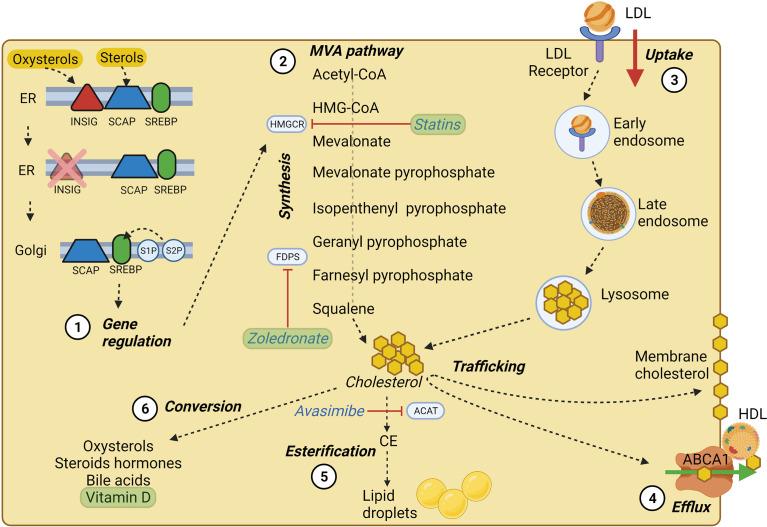
Cholesterol is an essential lipid primarily synthesized in the liver through the mevalonate pathway. Besides being a precursor of steroid hormones, bile acid, and vitamin D, it is an essential structural component of cell membranes, is enriched in membrane lipid rafts, and plays a key role in intracellular signal transduction. The lipid homeostasis is finely regulated end appears to be impaired in several types of tumors, including breast cancer. In this review, we will analyse the multifaceted roles of cholesterol and its derivatives in breast cancer progression. As an example of the bivalent role of cholesterol in the cell membrane of cancer cells, on the one hand, it reduces membrane fluidity, which has been associated with a more aggressive tumor phenotype in terms of cell motility and migration, leading to metastasis formation. On the other hand, it makes the membrane less permeable to small water-soluble molecules that would otherwise freely cross, resulting in a loss of chemotherapeutics permeability. Regarding cholesterol derivatives, a lower vitamin D is associated with an increased risk of breast cancer, while steroid hormones, coupled with the overexpression of their receptors, play a crucial role in breast cancer progression. Despite the role of cholesterol and derivatives molecules in breast cancer development is still controversial, the use of cholesterol targeting drugs like statins and zoledronic acid appears as a challenging promising tool for breast cancer treatment.
胆固醇是一种主要在肝脏中通过甲羟戊酸途径合成的必需脂质。它不仅是类固醇激素、胆汁酸和维生素D的前体,还是细胞膜的重要结构成分,在膜脂筏中富集,并在细胞内信号转导中起关键作用。脂质稳态受到精细调节,而在包括乳腺癌在内的几种肿瘤中似乎受到损害。在本综述中,我们将分析胆固醇及其衍生物在乳腺癌进展中的多方面作用。作为胆固醇在癌细胞膜中双重作用的一个例子,一方面,它降低了膜流动性,这在细胞运动性和迁移方面与更具侵袭性的肿瘤表型相关,导致转移形成。另一方面,它使膜对原本可自由穿过的小水溶性分子的通透性降低,导致化疗药物通透性丧失。关于胆固醇衍生物,维生素D水平较低与乳腺癌风险增加相关,而类固醇激素及其受体的过表达在乳腺癌进展中起关键作用。尽管胆固醇及其衍生物分子在乳腺癌发展中的作用仍存在争议,但使用他汀类药物和唑来膦酸等靶向胆固醇的药物似乎是一种具有挑战性的有前景的乳腺癌治疗工具。
 Zotero 插件