
一种新型在线动态列线图:喉鳞状细胞癌辅助决策模型的构建与验证
A New Online Dynamic Nomogram: Construction and Validation of an Assistant Decision-Making Model for Laryngeal Squamous Cell Carcinoma.
作者信息
Liu Yuchen, Han Yanxun, Chen Bangjie, Zhang Jian, Yin Siyue, Li Dapeng, Wu Yu, Jiang Yuan, Wang Xinyi, Wang Jianpeng, Fu Ziyue, Shen Hailong, Ding Zhao, Yao Kun, Tao Ye, Wu Jing, Liu Yehai
机构信息
Department of Otolaryngology, Head and Neck Surgery, The First Affiliated Hospital of Anhui Medical University, Hefei, China.
Anhui Medical University, Hefei, China.
出版信息
Front Oncol. 2022 May 26;12:829761. doi: 10.3389/fonc.2022.829761. eCollection 2022.
BACKGROUND
Laryngeal squamous cell carcinoma (LSCC) is the most common type of head and neck squamous cell carcinoma. However, there are currently no reliable biomarkers for the diagnosis and prognosis of LSCC. Thus, this study aimed to identify the independent risk factors and develop and validate a new dynamic web-based nomogram that can predict auxiliary laryngeal carcinogenesis.
METHODS
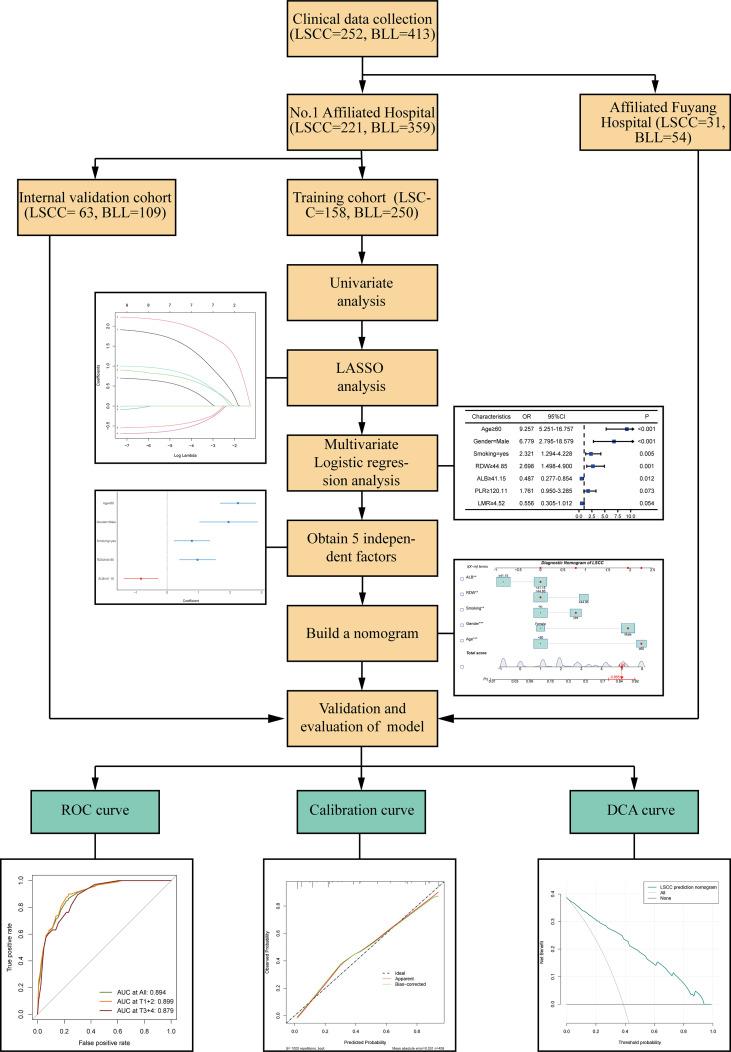
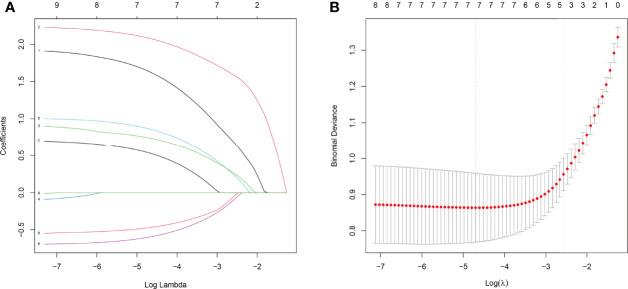
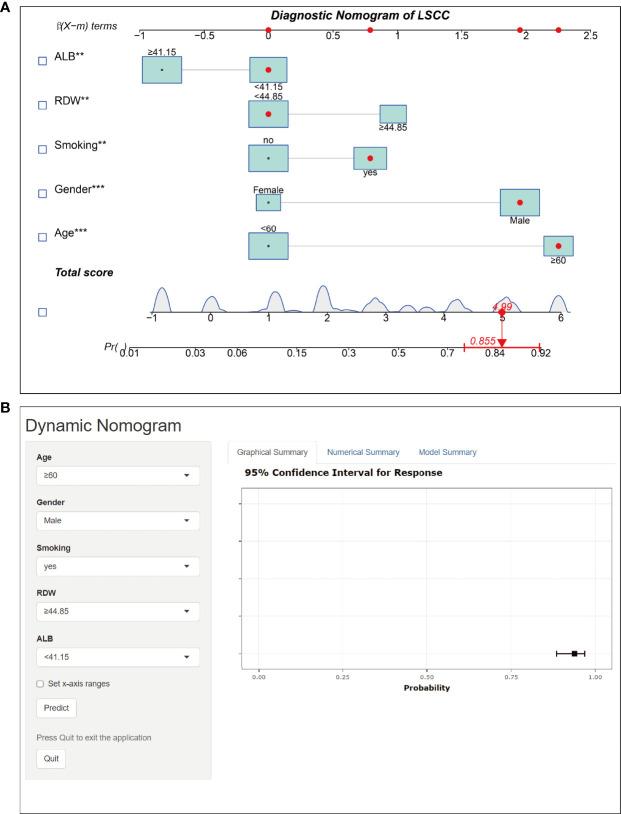
Data on the medical history of 221 patients who were recently diagnosed with LSCC and 359 who were recently diagnosed with benign laryngeal lesions (BLLs) at the First Affiliated Hospital of Anhui Medical University were retrospectively reviewed. Using the bootstrap method, 580 patients were divided in a 7:3 ratio into a training cohort (LSCC, 158 patients; BLL, 250 patients) and an internal validation cohort (LSCC, 63 patients; BLL, 109 patients). In addition, a retrospective analysis of 31 patients with LSCC and 54 patients with BLL from Fuyang Hospital affiliated with Anhui Medical University was performed as an external validation cohort. In the training cohort, the relevant indices were initially screened using univariate analysis. Then, least absolute shrinkage and selection operator logistic analysis was used to evaluate the significant potential independent risk factors (P<0.05); a dynamic online diagnostic nomogram, whose discrimination was evaluated using the area under the ROC curve (AUC), was constructed, while the consistency was evaluated using calibration plots. Its clinical application was evaluated by performing a decision curve analysis (DCA) and validated by internal validation of the training set and external validation of the validation set.
RESULTS
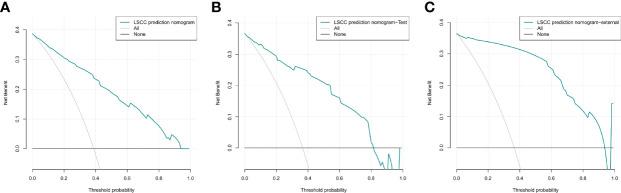
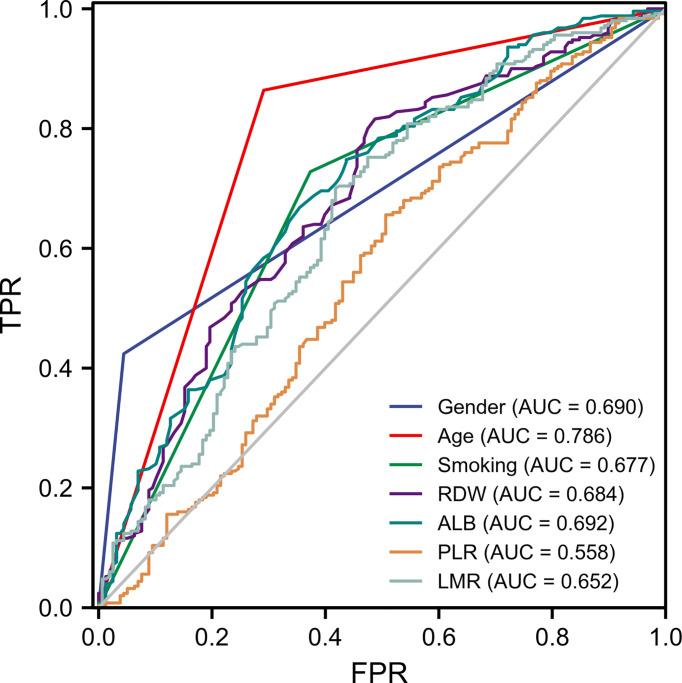
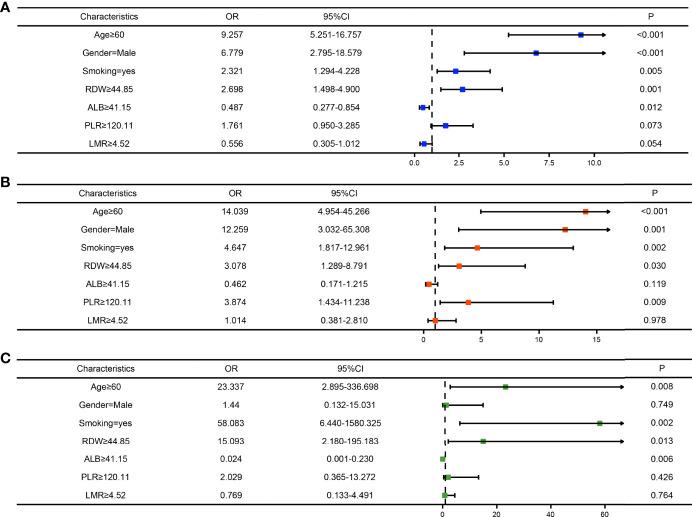
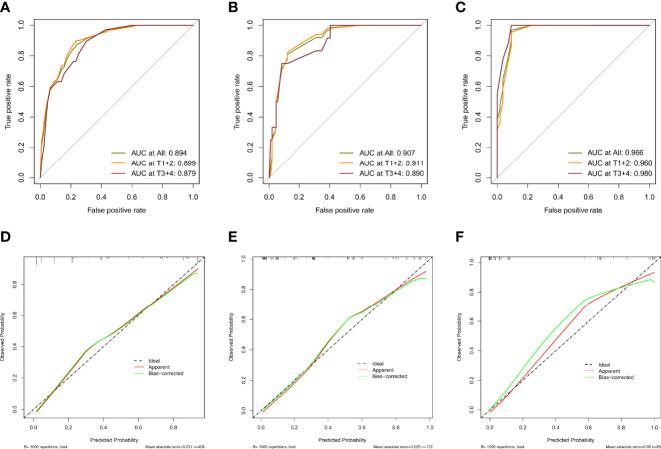
Five independent risk factors, sex (odds ratio [OR]: 6.779, P<0.001), age (OR: 9.257, P<0.001), smoking (OR: 2.321, P=0.005), red blood cell width distribution (OR: 2.698, P=0.001), albumin (OR: 0.487, P=0.012), were screened from the results of the multivariate logistic analysis of the training cohort and included in the LSCC diagnostic nomogram. The nomogram predicted LSCC with AUC values of 0.894 in the training cohort, 0.907 in the internal testing cohort, and 0.966 in the external validation cohort. The calibration curve also proved that the nomogram predicted outcomes were close to the ideal curve, the predicted outcomes were consistent with the real outcomes, and the DCA curve showed that all patients could benefit. This finding was also confirmed in the validation cohort.
CONCLUSION
An online nomogram for LSCC was constructed with good predictive performance, which can be used as a practical approach for the personalized early screening and auxiliary diagnosis of the potential risk factors and assist physicians in making a personalized diagnosis and treatment for patients.
背景
喉鳞状细胞癌(LSCC)是头颈部鳞状细胞癌最常见的类型。然而,目前尚无用于LSCC诊断和预后的可靠生物标志物。因此,本研究旨在确定独立危险因素,开发并验证一种基于网络的新型动态列线图,以预测喉癌的发生。
方法
回顾性分析安徽医科大学第一附属医院最近诊断为LSCC的221例患者和最近诊断为良性喉病变(BLL)的359例患者的病史。采用自助法,将580例患者按7:3的比例分为训练队列(LSCC,158例;BLL,250例)和内部验证队列(LSCC,63例;BLL,109例)。此外,对安徽医科大学附属阜阳医院的31例LSCC患者和54例BLL患者进行回顾性分析,作为外部验证队列。在训练队列中,首先使用单因素分析初步筛选相关指标。然后,采用最小绝对收缩和选择算子逻辑回归分析评估潜在的显著独立危险因素(P<0.05);构建动态在线诊断列线图,使用ROC曲线下面积(AUC)评估其辨别力,使用校准图评估其一致性。通过决策曲线分析(DCA)评估其临床应用,并通过训练集的内部验证和验证集的外部验证进行验证。
结果
从训练队列的多因素逻辑回归分析结果中筛选出5个独立危险因素,即性别(比值比[OR]:6.779,P<0.001)、年龄(OR:9.257,P<0.001)、吸烟(OR:2.321,P=0.005)、红细胞分布宽度(OR:2.698,P=0.001)、白蛋白(OR:0.487,P=0.012),并纳入LSCC诊断列线图。该列线图在训练队列中的AUC值为0.894,在内部测试队列中为0.907,在外部验证队列中为0.966。校准曲线也证明列线图预测结果接近理想曲线,预测结果与实际结果一致,DCA曲线显示所有患者均可受益。这一结果在验证队列中也得到了证实。
结论
构建了一种具有良好预测性能的LSCC在线列线图,可作为个性化早期筛查和潜在危险因素辅助诊断的实用方法,帮助医生为患者制定个性化的诊断和治疗方案。

 Zotero 插件