
利用新的移动医疗技术加强越南耐多药结核病管理(V-SMART 试验):一项随机对照试验方案。
Harnessing new mHealth technologies to Strengthen the Management of Multidrug-Resistant Tuberculosis in Vietnam (V-SMART trial): a protocol for a randomised controlled trial.
机构信息
Faculty of Health and Medicine, The University of Sydney, Sydney, New South Wales, Australia
The National Lung Hospital, Hanoi, Vietnam.
出版信息
BMJ Open. 2022 Jun 22;12(6):e052633. doi: 10.1136/bmjopen-2021-052633.
INTRODUCTION
Multidrug-resistant tuberculosis (MDR-TB) remains a major public health problem globally. Long, complex treatment regimens coupled with frequent adverse events have resulted in poor treatment adherence and patient outcomes. Smartphone-based mobile health (mHealth) technologies offer national TB programmes an appealing platform to improve patient care and management; however, clinical trial evidence to support their use is lacking. This trial will test the hypothesis that an mHealth intervention can improve treatment success among patients with MDR-TB and is cost-effective compared with standard practice.
METHODS AND ANALYSIS
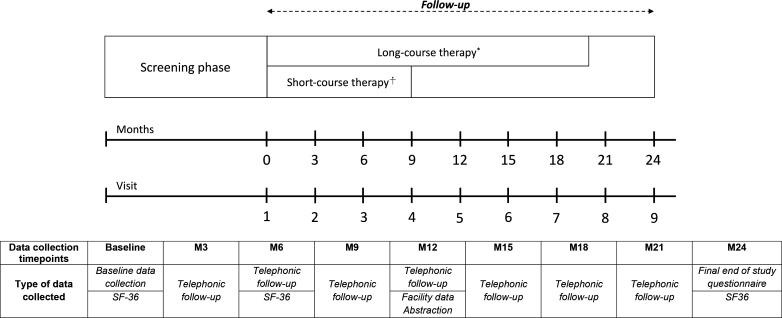
A community-based, open-label, parallel-group randomised controlled trial will be conducted among patients treated for MDR-TB in seven provinces of Vietnam. Patients commencing therapy for microbiologically confirmed rifampicin-resistant or multidrug-resistant tuberculosis within the past 30 days will be recruited to the study. Participants will be individually randomised to an intervention arm, comprising use of an mHealth application for treatment support, or a 'standard care' arm. In both arms, patients will be managed by the national TB programme according to current national treatment guidelines. The primary outcome measure of effectiveness will be the proportion of patients with treatment success (defined as treatment completion and/or bacteriological cure) after 24 months. A marginal Poisson regression model estimated via a generalised estimating equation will be used to test the effect of the intervention on treatment success. A prospective microcosting of the intervention and within-trial cost-effectiveness analysis will also be undertaken from a societal perspective. Cost-effectiveness will be presented as an incremental cost per patient successfully treated and an incremental cost per quality-adjusted life-year gained.
ETHICS
Ethical approval for the study was granted by The University of Sydney Human Research Ethics Committee (2019/676).
DISSEMINATION
Study findings will be disseminated to participants and published in peer-reviewed journals and conference proceedings.
TRIAL REGISTRATION NUMBER
ACTRN12620000681954.
简介
耐多药结核病(MDR-TB)仍然是全球主要的公共卫生问题。漫长而复杂的治疗方案加上频繁的不良反应导致治疗依从性差和患者预后不良。基于智能手机的移动医疗(mHealth)技术为国家结核病规划提供了一个有吸引力的平台,以改善患者的护理和管理;然而,缺乏支持其使用的临床试验证据。这项试验将检验以下假设:移动医疗干预可以提高耐多药结核病患者的治疗成功率,并且与标准实践相比具有成本效益。
方法和分析
将在越南七个省份开展一项基于社区的、开放性、平行组随机对照试验,纳入在过去 30 天内开始接受耐多药结核病治疗的患者。将招募正在接受新诊断为利福平耐药或耐多药结核病的患者参加研究。参与者将被单独随机分配到干预组,包括使用移动医疗应用程序进行治疗支持,或标准护理组。在两组中,患者将按照国家结核病规划根据当前国家治疗指南进行管理。有效性的主要结局指标是 24 个月后治疗成功(定义为治疗完成和/或细菌学治愈)的患者比例。将使用广义估计方程估计的边缘泊松回归模型来检验干预对治疗成功率的影响。还将从社会角度对干预措施进行前瞻性微观成本核算,并进行试验内成本效益分析。成本效益将作为每个成功治疗患者的增量成本和每个获得的质量调整生命年的增量成本来呈现。
伦理
该研究已获得悉尼大学人类研究伦理委员会的伦理批准(2019/676)。
传播
研究结果将分发给参与者,并发表在同行评议的期刊和会议论文集中。
注册号
ACTRN12620000681954。


 Zotero 插件