
中重度慢性阻塞性肺疾病患者更倾向于改善日常症状而非急性加重:一项多国患者偏好研究。
People living with moderate-to-severe COPD prefer improvement of daily symptoms over the improvement of exacerbations: a multicountry patient preference study.
作者信息
Cook Nigel S, Criner Gerard J, Burgel Pierre-Régis, Mycock Katie, Gardner Tom, Mellor Phil, Hallworth Pam, Sully Kate, Tatlock Sophi, Klein Beyza, Jones Byron, Le Rouzic Olivier, Adams Kip, Phillips Kirsten, McKevitt Mike, Toyama Kazuko, Gutzwiller Florian S
机构信息
Novartis Pharma AG, Basel, Switzerland.
Temple University, Philadelphia, PA, USA.
出版信息
ERJ Open Res. 2022 Jun 13;8(2). doi: 10.1183/23120541.00686-2021. eCollection 2022 Apr.
INTRODUCTION
This patient preference study sought to quantify the preferences of people living with COPD regarding symptom improvement in the UK, USA, France, Australia and Japan.
METHODS
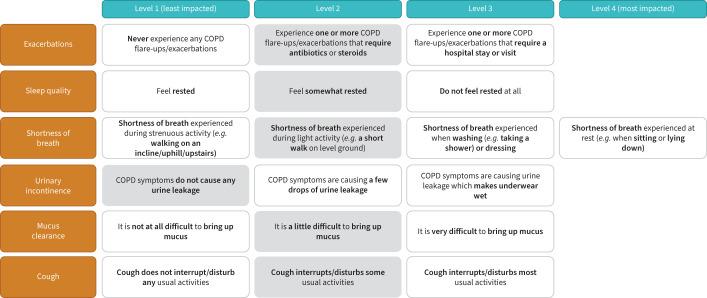
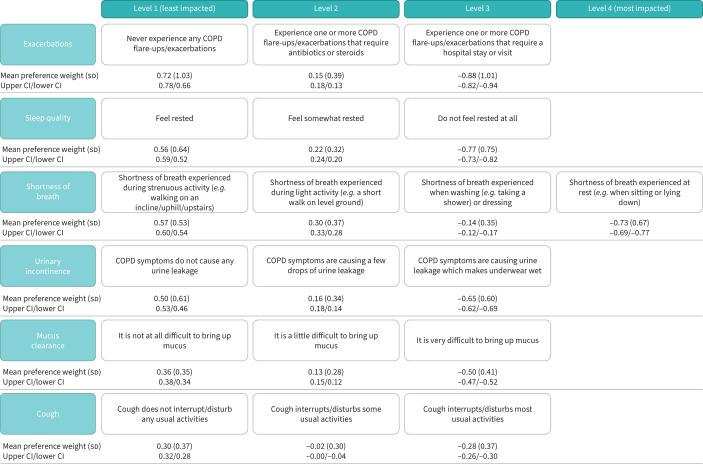
The inclusion criteria were people living with COPD aged 40 years or older who experienced ≥1 exacerbation in the previous year with daily symptoms of cough and excess mucus production. The study design included: 1) development of an attributes and levels grid through qualitative patient interviews; and 2) implementation of the main online quantitative survey, which included a discrete choice experiment (DCE) to allow assessment of attributes and levels using hypothetical health state profiles. Preference weights (utilities) were derived from the DCE using hierarchical Bayesian analysis. A preference simulator was developed that enabled different health state scenarios to be evaluated based on the predicted patient preferences.
RESULTS
1050 people living with moderate-to-severe COPD completed the survey. All attributes were considered important when patients determined their preferences in the DCE. In a health state preference simulation, two hypothetical health states (comprising attribute levels) with qualitatively equivalent improvements in A) cough and mucus and B) shortness of breath (SOB) resulted in a clear preference for cough and mucus improved profile. When comparing two profiles with C) daily symptoms improved and D) exacerbations improved, there was a clear preference for the daily symptoms improved profile.
CONCLUSIONS
People living with moderate-to-severe COPD prefer to reduce cough and mucus production together over improvement of SOB and would prefer to reduce combined daily symptoms over an improvement in exacerbations.
引言
这项患者偏好研究旨在量化英国、美国、法国、澳大利亚和日本慢性阻塞性肺疾病(COPD)患者在症状改善方面的偏好。
方法
纳入标准为年龄在40岁及以上、前一年经历过≥1次加重且有咳嗽和痰液过多等日常症状的COPD患者。研究设计包括:1)通过定性患者访谈制定属性和水平网格;2)开展主要的在线定量调查,其中包括离散选择实验(DCE),以使用假设的健康状态概况评估属性和水平。使用分层贝叶斯分析从DCE中得出偏好权重(效用)。开发了一个偏好模拟器,可根据预测的患者偏好评估不同的健康状态情景。
结果
1050名中重度COPD患者完成了调查。在DCE中患者确定偏好时,所有属性都被认为很重要。在健康状态偏好模拟中,两种假设的健康状态(包括属性水平)在A)咳嗽和痰液以及B)呼吸急促(SOB)方面有定性相同的改善,结果显示患者明显更偏好咳嗽和痰液改善的概况。当比较两种概况,C)日常症状改善和D)加重情况改善时,患者明显更偏好日常症状改善的概况。
结论
中重度COPD患者更倾向于同时减少咳嗽和痰液生成,而非改善SOB,并且更倾向于减少合并的日常症状,而非改善加重情况。


 Zotero 插件