
人源 RIPK3 C 端磷酸化对于坏死性凋亡信号通路是必需的。
Human RIPK3 C-lobe phosphorylation is essential for necroptotic signaling.
机构信息
Walter and Eliza Hall Institute of Medical Research, 1G Royal Parade, Parkville, VIC, 3052, Australia.
Department of Medical Biology, University of Melbourne, Parkville, VIC, 3052, Australia.
出版信息
Cell Death Dis. 2022 Jun 23;13(6):565. doi: 10.1038/s41419-022-05009-y.
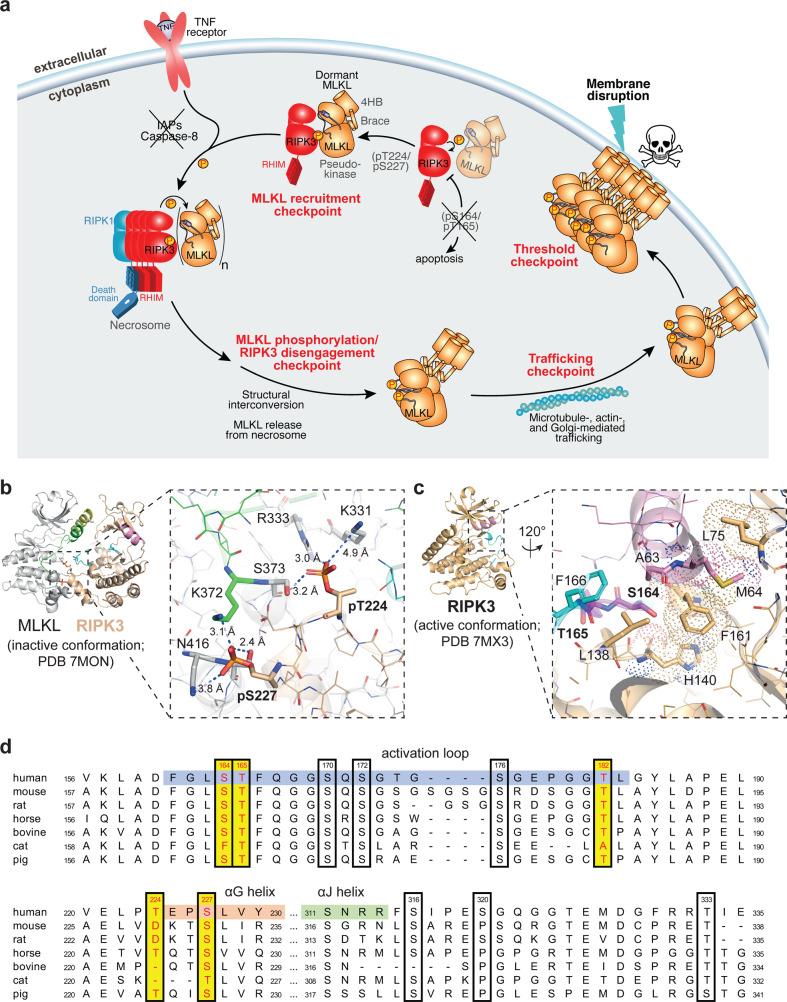
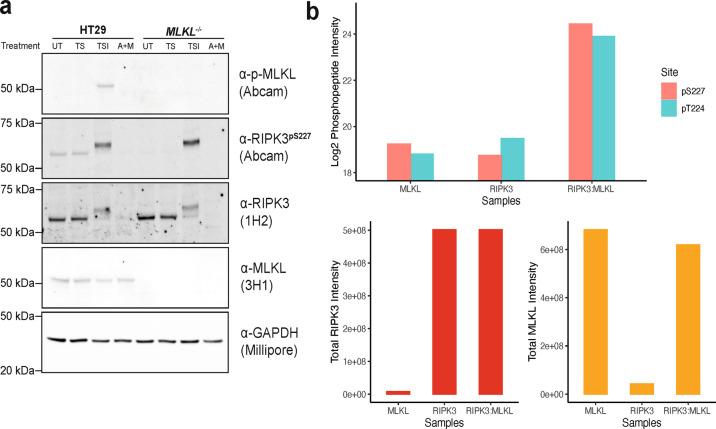
Necroptosis is a caspase-independent, pro-inflammatory mode of programmed cell death which relies on the activation of the terminal effector, MLKL, by the upstream protein kinase RIPK3. To mediate necroptosis, RIPK3 must stably interact with, and phosphorylate the pseudokinase domain of MLKL, although the precise molecular cues that provoke RIPK3 necroptotic signaling are incompletely understood. The recent finding that RIPK3 S227 phosphorylation and the occurrence of a stable RIPK3:MLKL complex in human cells prior to exposure to a necroptosis stimulus raises the possibility that additional, as-yet-unidentified phosphorylation events activate RIPK3 upon initiation of necroptosis signaling. Here, we sought to identify phosphorylation sites of RIPK3 and dissect their regulatory functions. Phosphoproteomics identified 21 phosphorylation sites in HT29 cells overexpressing human RIPK3. By comparing cells expressing wild-type and kinase-inactive D142N RIPK3, autophosphorylation sites and substrates of other cellular kinases were distinguished. Of these 21 phosphosites, mutational analyses identified only pT224 and pS227 as crucial, synergistic sites for stable interaction with MLKL to promote necroptosis, while the recently reported activation loop phosphorylation at S164/T165 negatively regulate the kinase activity of RIPK3. Despite being able to phosphorylate MLKL to a similar or higher extent than wild-type RIPK3, mutation of T224, S227, or the RHIM in RIPK3 attenuated necroptosis. This finding highlights the stable recruitment of human MLKL by RIPK3 to the necrosome as an essential checkpoint in necroptosis signaling, which is independent from and precedes the phosphorylation of MLKL.
细胞程序性坏死是一种不依赖半胱天冬酶的促炎细胞死亡方式,其依赖于上游蛋白激酶 RIPK3 对末端效应子 MLKL 的激活。为了介导细胞程序性坏死,RIPK3 必须稳定地与 MLKL 的假激酶结构域相互作用并磷酸化该结构域,尽管引发 RIPK3 细胞程序性坏死信号的精确分子线索仍不完全清楚。最近的发现表明,在受到细胞程序性坏死刺激之前,人细胞中 RIPK3 S227 磷酸化和稳定的 RIPK3:MLKL 复合物的出现,提示在细胞程序性坏死信号起始时,其他尚未确定的磷酸化事件可能激活 RIPK3。在这里,我们试图鉴定 RIPK3 的磷酸化位点并剖析其调节功能。磷酸蛋白质组学在过表达人 RIPK3 的 HT29 细胞中鉴定到 21 个磷酸化位点。通过比较表达野生型和激酶失活 D142N RIPK3 的细胞,区分了 RIPK3 的自身磷酸化位点和其他细胞激酶的底物。在这 21 个磷酸化位点中,突变分析仅鉴定出 pT224 和 pS227 是与 MLKL 稳定相互作用以促进细胞程序性坏死的关键协同位点,而最近报道的 S164/T165 激活环磷酸化负调节 RIPK3 的激酶活性。尽管突变型 RIPK3 能够磷酸化 MLKL 的程度与野生型 RIPK3 相似或更高,但 T224、S227 或 RIPK3 的 RHIM 突变均减弱了细胞程序性坏死。这一发现强调了 RIPK3 对人 MLKL 的稳定募集作为细胞程序性坏死信号中的一个关键检查点的重要性,该检查点独立于且先于 MLKL 的磷酸化。


 Zotero 插件