
十年阿片类药物流行的药物警戒信号:用于分析向欧洲药品不良反应数据库(EudraVigilance,EV)和美国食品药品监督管理局不良事件报告系统(FAERS)报告的药物不良反应(ADR)的药物警戒数据集的数据挖掘方法
Pharmacovigilance Signals of the Opioid Epidemic over 10 Years: Data Mining Methods in the Analysis of Pharmacovigilance Datasets Collecting Adverse Drug Reactions (ADRs) Reported to EudraVigilance (EV) and the FDA Adverse Event Reporting System (FAERS).
作者信息
Chiappini Stefania, Vickers-Smith Rachel, Guirguis Amira, Corkery John M, Martinotti Giovanni, Harris Daniel R, Schifano Fabrizio
机构信息
Psychopharmacology, Drug Misuse and Novel Psychoactive Substances Research Unit, School of Life and Medical Sciences, University of Hertfordshire, Hertfordshire AL10 9EU, UK.
Department of Epidemiology, University of Kentucky College of Public Health, 111 Washington Avenue, Lexington, KY 40536, USA.
出版信息
Pharmaceuticals (Basel). 2022 May 27;15(6):675. doi: 10.3390/ph15060675.
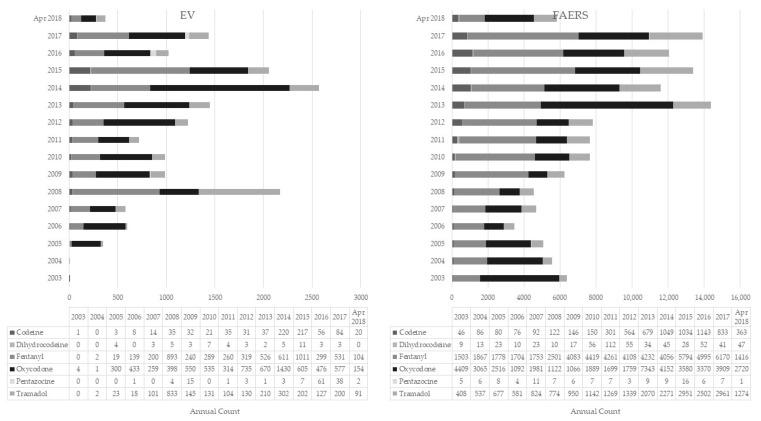
In the past twenty years, the consumption of opioid medications has reached significant proportions, leading to a rise in drug misuse and abuse and increased opioid dependence and related fatalities. Thus, the purpose of this study was to determine whether there are pharmacovigilance signals of abuse, misuse, and dependence and their nature for the following prescription opioids: codeine, dihydrocodeine, fentanyl, oxycodone, pentazocine, and tramadol. Both the pharmacovigilance datasets EudraVigilance (EV) and the FDA Adverse Events Reporting System (FAERS) were analyzed to identify and describe possible misuse-/abuse-/dependence-related issues. A descriptive analysis of the selected Adverse Drug Reactions (ADRs) was performed, and pharmacovigilance signal measures (i.e., reporting odds ratio, proportional reporting ratio, information component, and empirical Bayesian geometric mean) were computed for preferred terms (PTs) of abuse, misuse, dependence, and withdrawal, as well as PTs eventually related to them (e.g., aggression). From 2003 to 2018, there was an increase in ADR reports for the selected opioids in both datasets. Overall, 16,506 and 130,293 individual ADRs for the selected opioids were submitted to EV and FAERS, respectively. Compared with other opioids, abuse concerns were mostly recorded in relation to fentanyl and oxycodone, while tramadol and oxycodone were more strongly associated with drug dependence and withdrawal. Benzodiazepines, antidepressants, other opioids, antihistamines, recreational drugs (e.g., cocaine and alcohol), and several new psychoactive substances, including mitragynine and cathinones, were the most commonly reported concomitant drugs. ADRs reports in pharmacovigilance databases confirmed the availability of data on the abuse and dependence of prescription opioids and should be considered a resource for monitoring and preventing such issues. Psychiatrists and clinicians prescribing opioids should be aware of their misuse and dependence liability and effects that may accompany their use, especially together with concomitant drugs.
在过去二十年中,阿片类药物的消费量已达到相当大的比例,导致药物滥用和误用增加,以及阿片类药物依赖和相关死亡人数上升。因此,本研究的目的是确定以下处方阿片类药物是否存在滥用、误用和依赖的药物警戒信号及其性质:可待因、双氢可待因、芬太尼、羟考酮、喷他佐辛和曲马多。对药物警戒数据集欧洲药品不良反应数据库(EudraVigilance,EV)和美国食品药品监督管理局不良事件报告系统(FAERS)进行了分析,以识别和描述可能与误用/滥用/依赖相关的问题。对选定的药品不良反应(ADR)进行了描述性分析,并计算了药物警戒信号指标(即报告比值比、比例报告比、信息成分和经验贝叶斯几何均值),用于滥用、误用、依赖和戒断的首选术语(PT),以及最终与之相关的PT(如攻击行为)。2003年至2018年期间,两个数据集中选定阿片类药物的ADR报告均有所增加。总体而言,分别向EV和FAERS提交了16506份和130293份选定阿片类药物个体的ADR报告。与其他阿片类药物相比,滥用问题大多记录在芬太尼和羟考酮方面,而曲马多和羟考酮与药物依赖和戒断的关联更强。苯二氮䓬类药物、抗抑郁药(即其他阿片类药物)、抗组胺药、消遣性药物(如可卡因和酒精)以及几种新型精神活性物质,包括帽柱木碱和卡西酮,是最常报告的合并用药。药物警戒数据库中的ADR报告证实了有关处方阿片类药物滥用和依赖的数据的可用性,应将其视为监测和预防此类问题的一种资源。开具阿片类药物处方的精神科医生和临床医生应意识到其误用和依赖的可能性以及使用时可能伴随的影响,尤其是与合并用药一起使用时。
 Zotero 插件