
非适宜温度会增加急性心肌梗死发病的风险和负担:一项在324个中国城市进行的按小时水平开展的全国性病例交叉研究。
Non-optimum temperature increases risk and burden of acute myocardial infarction onset: A nationwide case-crossover study at hourly level in 324 Chinese cities.
作者信息
Jiang Yixuan, Hu Jialu, Peng Li, Li Huichu, Ji John S, Fang Weiyi, Yan Hongbing, Chen Jiyan, Wang Weimin, Xiang Dingcheng, Su Xi, Yu Bo, Wang Yan, Xu Yawei, Wang Lefeng, Li Chunjie, Chen Yundai, Zhao Dong, Kan Haidong, Ge Junbo, Huo Yong, Chen Renjie
机构信息
School of Public Health, Key Lab of Public Health Safety of the Ministry of Education and NHC Key Lab of Health Technology Assessment, Fudan University, Shanghai, China.
Department of Cardiology, Zhongshan Hospital, Fudan University, Shanghai Institute of Cardiovascular Diseases, Shanghai, China.
出版信息
EClinicalMedicine. 2022 Jun 17;50:101501. doi: 10.1016/j.eclinm.2022.101501. eCollection 2022 Aug.
BACKGROUND
The associations of ambient temperature with acute myocardial infarction (AMI) have seldom been examined based on the time of symptom onset.
METHODS
We conducted a time-stratified case-crossover study among 1,046,773 eligible AMI patients from 2,093 hospitals in 324 Chinese cities from January 1, 2015 to June 30, 2021, after excluding those transferred from other hospitals or having not reported the time of symptom onset. Hourly exposure to ambient temperature was calculated as multiple moving 24-h averages (days) before hourly onset of AMI symptoms. Conditional logistic regression and distributed lag non-linear models with a duration of 0-21 days were used to estimate the cumulative associations of non-optimum temperature with AMI onset and the corresponding disease burden nationally. Subgroup analyses by region and period were conducted. Specifically, cities with and without centralized heating system were classified into heating and non-heating regions, respectively. The whole year in heating region was divided into heating and non-heating periods based on the duration of centralized heating in each city.
FINDINGS
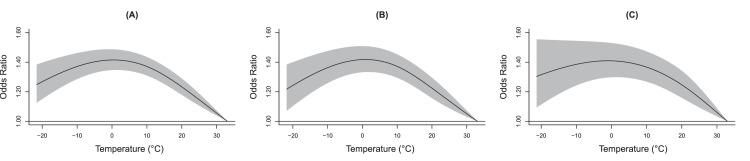
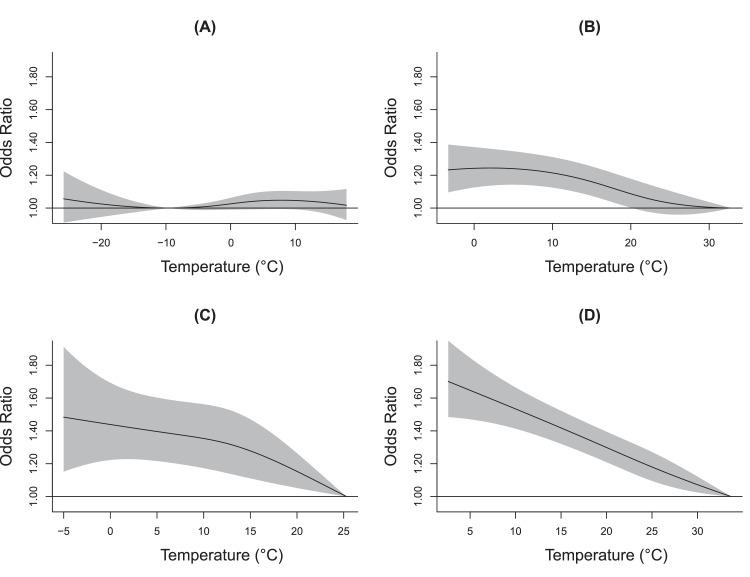
Almost monotonically increasing risks were observed for both overall AMI and its two subtypes when ambient temperature declined. The effects of extremely low temperature occurred immediately on the concurrent day, and lasted up to almost 3 weeks. The excess risks of AMI onset associated with non-optimum ambient temperatures were observed during the whole year in the non-heating region and non-heating period in the heating region, but not during heating period. Specifically, odds ratios of AMI onset associated with extremely low temperature cumulated over 0-21 days were 1.24 (95% CI: 1.13-1.37), 1.46 (95% CI: 1.20-1.76), and 1.62 (95% CI: 1.46-1.81) in the heating region during non-heating period, in the non-heating region during winter and non-winter period, respectively. The heat effects on AMI onset were very modest and transient. Totally, 13.26% of AMI cases could be attributable to non-optimum temperatures nationally. The burden of AMI attributable to non-optimum temperature was much smaller in heating region than in non-heating region. Somewhat stronger effects were observed in females and patients aged older than 65.
INTERPRETATION
This nationwide study provided robust evidence that non-optimum ambient temperature may significantly trigger AMI onset, and for the first time estimated the disease burden after accounting for spatial and seasonal heterogeneity. Centralized heating might substantially mitigate AMI burden due to non-optimum temperature.
FUNDING
Shanghai International Science and Technology Partnership Project, National Natural Science Foundation of China, Talent Training Program of Zhongshan Hospital, Fudan University.
背景
基于症状发作时间,环境温度与急性心肌梗死(AMI)之间的关联鲜有研究。
方法
我们对2015年1月1日至2021年6月30日期间来自中国324个城市2093家医院的1046773例符合条件的AMI患者进行了时间分层病例交叉研究,排除了从其他医院转来或未报告症状发作时间的患者。将AMI症状每小时发作前的环境温度暴露计算为多个移动24小时平均值(天数)。使用条件逻辑回归和持续时间为0 - 21天的分布滞后非线性模型来估计非最佳温度与AMI发作的累积关联以及全国相应的疾病负担。进行了按地区和时期的亚组分析。具体而言,有和没有集中供暖系统的城市分别分为供暖区和非供暖区。供暖区的全年根据每个城市的集中供暖持续时间分为供暖期和非供暖期。
结果
当环境温度下降时,总体AMI及其两种亚型的风险几乎呈单调增加。极低温度的影响在同一天立即出现,并持续长达近3周。在非供暖区全年以及供暖区的非供暖期观察到与非最佳环境温度相关的AMI发作额外风险,但在供暖期未观察到。具体而言,在供暖区非供暖期、非供暖区冬季和非冬季期间,与极低温度在0 - 21天内累积相关的AMI发作比值比分别为1.24(95%CI:1.13 - 1.37)、1.46(95%CI:1.20 - 1.76)和1.62(95%CI:1.46 - 1.81)。高温对AMI发作的影响非常轻微且短暂。在全国范围内,13.26%的AMI病例可归因于非最佳温度。非最佳温度导致的AMI负担在供暖区比非供暖区小得多。在女性和65岁以上患者中观察到的影响稍强。
解读
这项全国性研究提供了有力证据,表明非最佳环境温度可能会显著触发AMI发作,并首次在考虑空间和季节异质性后估计了疾病负担。集中供暖可能会大幅减轻因非最佳温度导致的AMI负担。
资助
上海国际科技合作项目、国家自然科学基金、复旦大学附属中山医院人才培养计划。

 Zotero 插件