
在加利福尼亚州北部广泛流行奥密克戎(B.1.1.529)和德尔塔(B.1.617.2)变种期间,不同疫苗接种水平的新冠病毒感染者出现严重临床结局的风险:一项回顾性队列研究
Risk of severe clinical outcomes among persons with SARS-CoV-2 infection with differing levels of vaccination during widespread Omicron (B.1.1.529) and Delta (B.1.617.2) variant circulation in Northern California: A retrospective cohort study.
作者信息
Skarbinski Jacek, Wood Mariah S, Chervo Tyler C, Schapiro Jeffrey M, Elkin Eric P, Valice Emily, Amsden Laura B, Hsiao Crystal, Quesenberry Charles, Corley Douglas A, Kushi Lawrence H
机构信息
Division of Research, Kaiser Permanente Northern California, Oakland, CA, USA.
Department of Infectious Diseases, Oakland Medical Center, Kaiser Permanente Northern California, Oakland, CA, USA.
出版信息
Lancet Reg Health Am. 2022 Aug;12:100297. doi: 10.1016/j.lana.2022.100297. Epub 2022 Jun 16.
BACKGROUND
The incidence of and risk factors for severe clinical outcomes with the Omicron (B.1.1.529) SARS-CoV-2 variant have not been well-defined.
METHODS
We conducted a retrospective cohort study to assess risks of severe clinical outcomes within 21 days after SARS-CoV-2 diagnosis in a large, diverse, integrated health system.
FINDINGS
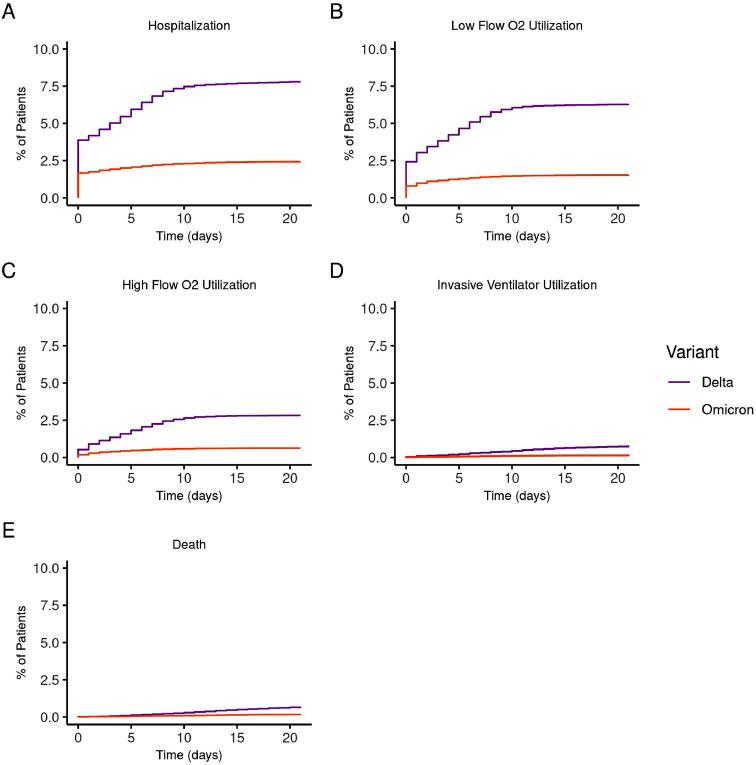
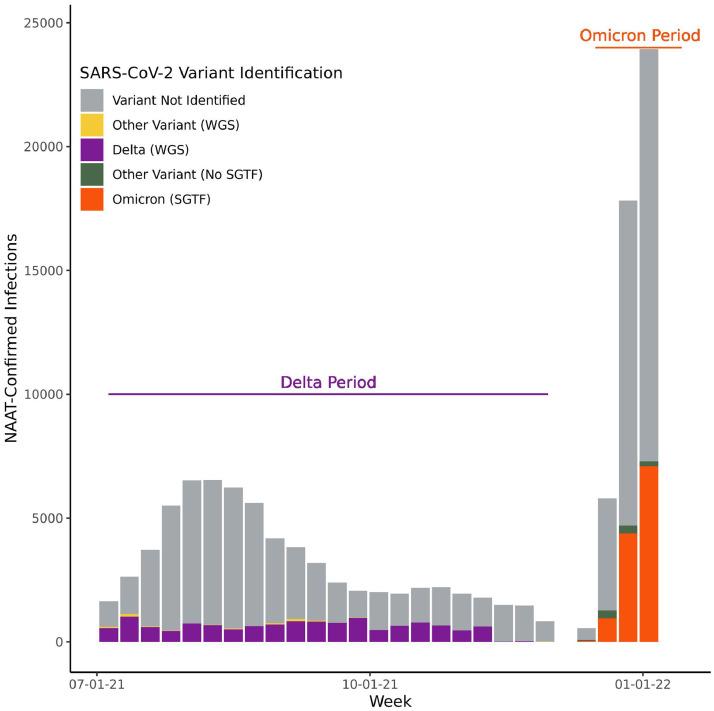
Among 118,078 persons with incident SARS-CoV-2 infection, 48,101 (41%) were during the Omicron period and 69,977 (59%) during the Delta (B.1.617.2) period. Cumulative incidence of any hospitalization (2.4% versus 7.8%; adjusted hazard ratio [aHR] 0.55; 95% confidence interval [CI] (0.51-0.59), with low-flow oxygen support (1.6% versus 6.4%; aHR 0.46; CI 0.43-0.50), with high-flow oxygen support (0.6% versus 2.8%; aHR 0.47; CI 0.41-0.54), with invasive mechanical ventilation (0.1% versus 0.7%; aHR 0.43; CI 0.33-0.56), and death (0.2% versus 0.7%; aHR 0.54; CI 0.42-0.70) were lower in the Omicron than the Delta period. The risk of hospitalization was higher among unvaccinated persons (aHR 8.34; CI 7.25-9.60) and those who completed a primary COVID-19 vaccination series (aHR 1.72; CI 1.49-1.97) compared with those who completed a primary vaccination series and an additional dose. The strongest risk factors for all severe clinical outcomes were older age, higher body mass index and select comorbidities.
INTERPRETATION
Persons with SARS-CoV-2 infection were significantly less likely to develop severe clinical outcomes during the Omicron period compared with the Delta period. COVID-19 primary vaccination and additional doses were associated with reduced risk of severe clinical outcomes among those with SARS-CoV-2 infection.
FUNDING
National Cancer Institute and The Permanente Medical Group.
背景
新型冠状病毒奥密克戎(B.1.1.529)变异株导致严重临床结局的发生率及风险因素尚未明确。
方法
我们开展了一项回顾性队列研究,以评估在一个大型、多样化的综合医疗系统中,新型冠状病毒确诊后21天内出现严重临床结局的风险。
研究结果
在118,078例新型冠状病毒感染病例中,48,101例(41%)发生在奥密克戎流行期,69,977例(59%)发生在德尔塔(B.1.617.2)流行期。奥密克戎流行期的任何住院累积发生率(2.4%对7.8%;调整后风险比[aHR]0.55;95%置信区间[CI](0.51 - 0.59))、接受低流量氧疗(1.6%对6.4%;aHR 0.46;CI 0.43 - 0.50)、接受高流量氧疗(0.6%对2.8%;aHR 0.47;CI 0.41 - 0.54)、接受有创机械通气(0.1%对0.7%;aHR 0.43;CI 0.33 - 0.56)及死亡(0.2%对0.7%;aHR 0.54;CI 0.42 - 0.70)均低于德尔塔流行期。与完成基础新冠疫苗接种系列并接种一剂加强针的人群相比,未接种疫苗者(aHR 8.34;CI 7.25 - 9.60)及完成基础新冠疫苗接种系列者(aHR 1.72;CI 1.49 - 1.97)的住院风险更高。所有严重临床结局的最强风险因素为年龄较大、体重指数较高及某些合并症。
解读
与德尔塔流行期相比,新型冠状病毒感染患者在奥密克戎流行期发生严重临床结局的可能性显著降低。新冠疫苗基础接种及加强针接种与降低新型冠状病毒感染患者发生严重临床结局的风险相关。
资助
美国国立癌症研究所和永久医疗集团。
 Zotero 插件