
维生素E涂层透析器可缓解终末期肾病血液透析患者的红细胞变形性功能障碍。
Vitamin E-coated dialyzer alleviates erythrocyte deformability dysfunction in patients with end-stage renal disease undergoing hemodialysis.
作者信息
Zhang Ying, Gao Wei, Li Xia
机构信息
Department of Blood Dialysis Room, Yantai Hospital of Traditional Chinese Medicine, Yantai, Shandong 264001, P.R. China.
出版信息
Exp Ther Med. 2022 Jun 1;24(1):480. doi: 10.3892/etm.2022.11407. eCollection 2022 Jul.
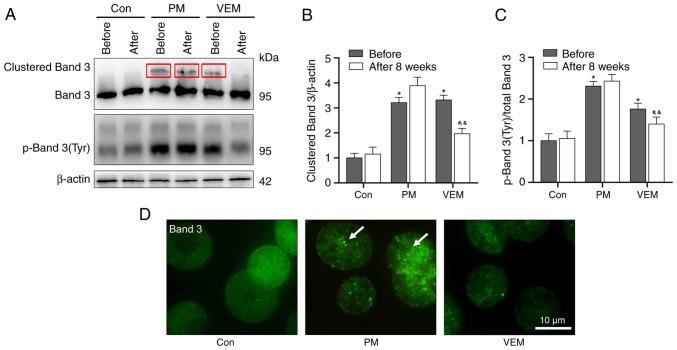
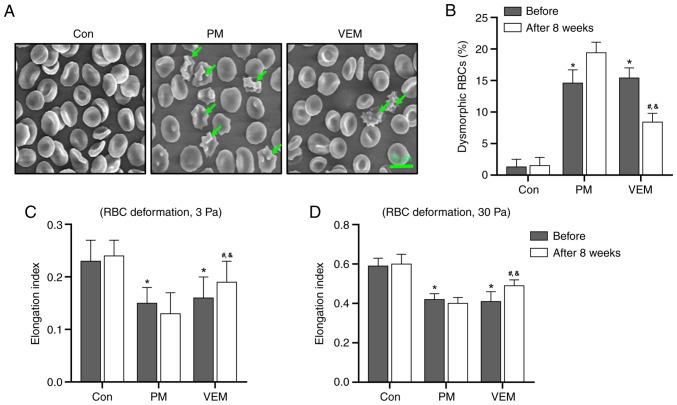
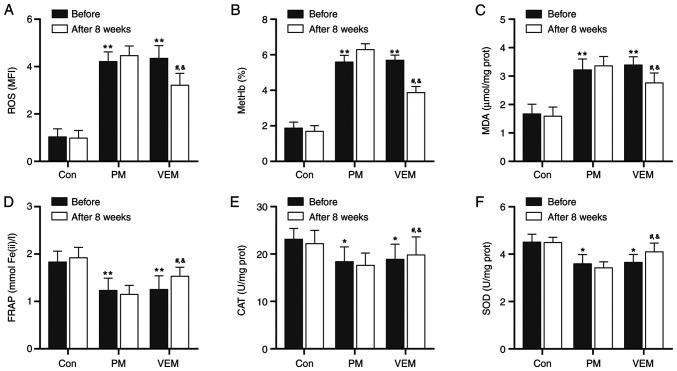
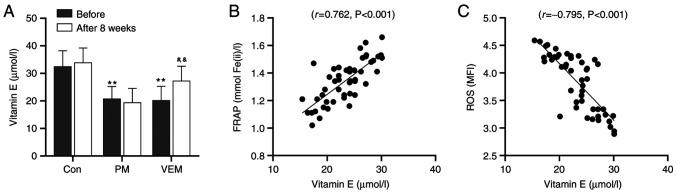
Patients with end-stage renal disease (ESRD) are characterized by augmented oxidative stress (OS) due to the imbalance between the generation of increased concentrations of oxidative molecules and decreased antioxidant capacity. Vitamin E-coated dialyzer membranes (VEMs) have previously been reported to alleviate the imbalance of redox metabolism in patients with ESRD undergoing hemodialysis (HD); however, their effect on the deformability of red blood cells (RBCs) remains unknown. In the present study, 48 patients with ESRD undergoing HD were enrolled and randomly assigned into two groups: HD with VEMs (VEM group; n=24) and HD with polysulfone dialyzer membranes (PM group; n=24), and another 24 healthy volunteers served as the control group. The present study investigated the morphological changes and deformability of RBCs in patients with ESRD and healthy volunteers. The concentration of serum vitamin E, the parameters of antioxidant stress and OS, and the degree of oxidative phosphorylation and clustering of anion exchanger 1 (Band 3) in RBCs were measured. The results obtained suggested that VEM treatment markedly ameliorated the abnormalities of RBC morphology and deformability in patients with ESRD undergoing HD. Mechanistic studies showed that VEM treatment led to a marked improvement in the concentration of serum vitamin E, which was positively associated with the restored antioxidant capacity, and decreased oxidative phosphorylation and clustering of Band 3 in RBCs of patients with ESRD undergoing HD. Taken together, the results of the present study have demonstrated that VEM treatment effectively restored the imbalance of redox metabolism, and improved the oxidative phosphorylation and clustering of Band 3 in RBCs of patients with ESRD undergoing HD via delivering vitamin E, which may alleviate the abnormal morphological and mechanical properties of RBCs. These findings are anticipated to be useful with respect to improving the nursing care and cure rate of patients with ESRD.
终末期肾病(ESRD)患者的特征是氧化应激(OS)增强,这是由于氧化分子浓度升高和抗氧化能力下降之间的不平衡所致。此前有报道称,维生素E涂层透析器膜(VEMs)可缓解接受血液透析(HD)的ESRD患者氧化还原代谢的不平衡;然而,它们对红细胞(RBCs)变形性的影响仍不清楚。在本研究中,48例接受HD的ESRD患者被纳入并随机分为两组:使用VEMs进行HD治疗的组(VEM组;n = 24)和使用聚砜透析器膜进行HD治疗的组(PM组;n = 24),另外24名健康志愿者作为对照组。本研究调查了ESRD患者和健康志愿者红细胞的形态变化和变形性。测量了血清维生素E浓度、抗氧化应激和OS参数,以及红细胞中阴离子交换蛋白1(带3)的氧化磷酸化程度和聚集情况。所得结果表明,VEM治疗显著改善了接受HD的ESRD患者红细胞形态和变形性的异常。机制研究表明,VEM治疗使血清维生素E浓度显著提高,这与抗氧化能力的恢复呈正相关,并降低了接受HD的ESRD患者红细胞中带3的氧化磷酸化和聚集。综上所述,本研究结果表明,VEM治疗通过递送维生素E有效恢复了氧化还原代谢的不平衡,并改善了接受HD的ESRD患者红细胞中带3的氧化磷酸化和聚集,这可能减轻了红细胞异常的形态和力学特性。这些发现有望对改善ESRD患者的护理和治愈率有所帮助。
 Zotero 插件