
牙周组织工程与骨再生的当前及未来趋势
Current and future trends in periodontal tissue engineering and bone regeneration.
作者信息
Galli Matthew, Yao Yao, Giannobile William V, Wang Hom-Lay
机构信息
Department of Periodontics and Oral Medicine, University of Michigan School of Dentistry, Ann Arbor, MI 48109, USA.
Biointerfaces Institute, North Campus Research Complex, University of Michigan School of Dentistry, Ann Arbor, MI 48109, USA.
出版信息
Plast Aesthet Res. 2021;8. doi: 10.20517/2347-9264.2020.176. Epub 2021 Jan 8.
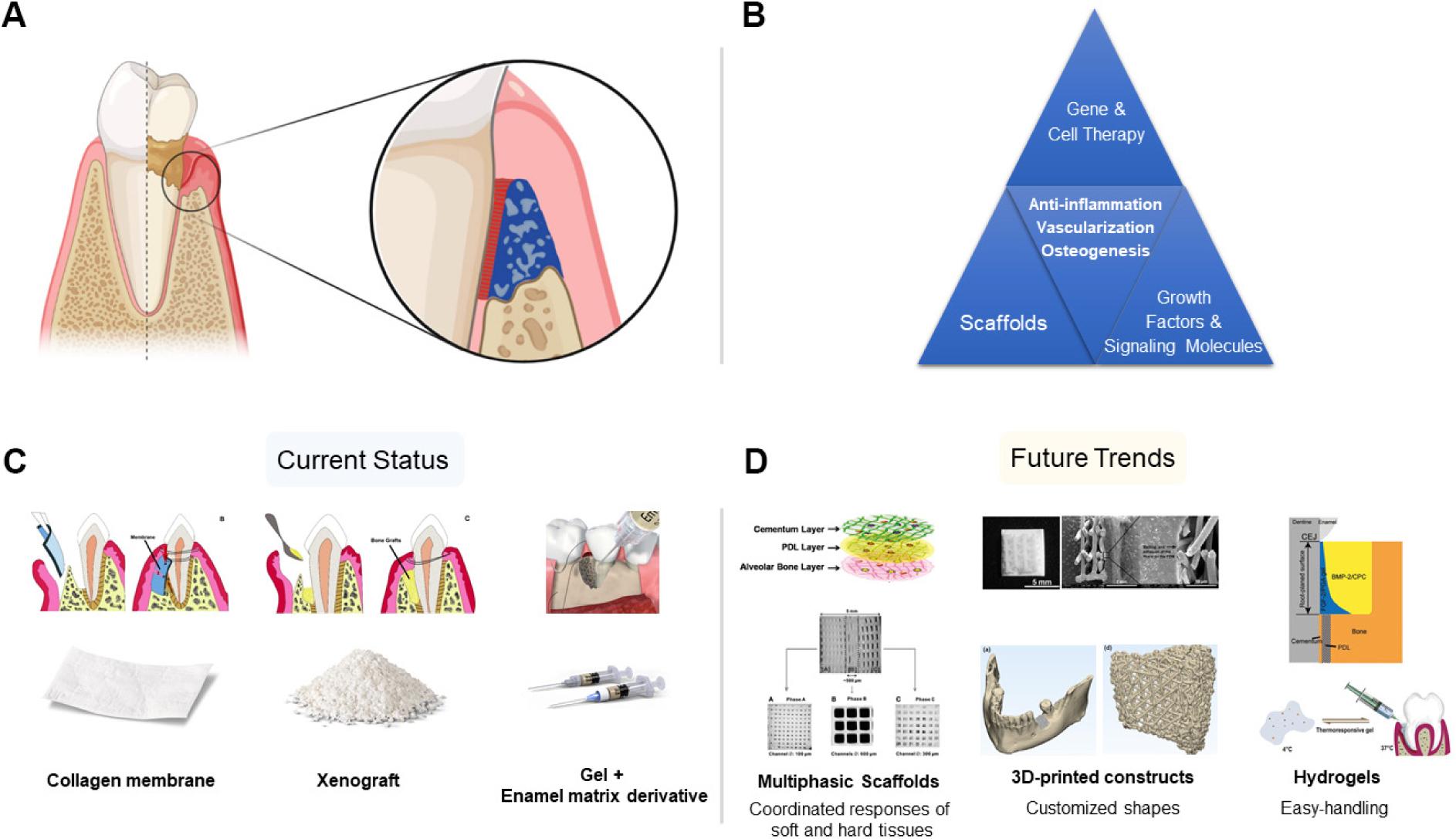
Periodontal tissue engineering involves a multi-disciplinary approach towards the regeneration of periodontal ligament, cementum and alveolar bone surrounding teeth, whereas bone regeneration specifically applies to ridge reconstruction in preparation for future implant placement, sinus floor augmentation and regeneration of peri-implant osseous defects. Successful periodontal regeneration is based on verifiable cementogenesis on the root surface, oblique insertion of periodontal ligament fibers and formation of new and vital supporting bone. Ultimately, regenerated periodontal and peri-implant support must be able to interface with surrounding host tissues in an integrated manner, withstand biomechanical forces resulting from mastication, and restore normal function and structure. Current regenerative approaches utilized in everyday clinical practice are mainly guided tissue/bone regeneration-based. Although these approaches have shown positive outcomes for small and medium-sized defects, predictability of clinical outcomes is heavily dependent on the defect morphology and clinical case selection. In many cases, it is still challenging to achieve predictable regenerative outcomes utilizing current approaches. Periodontal tissue engineering and bone regeneration (PTEBR) aims to improve the state of patient care by promoting reconstitution of damaged and lost tissues through the use of growth factors and signaling molecules, scaffolds, cells and gene therapy. The present narrative review discusses key advancements in PTEBR including current and future trends in preclinical and clinical research, as well as the potential for clinical translatability.
牙周组织工程涉及一种多学科方法,用于牙周韧带、牙骨质和牙齿周围牙槽骨的再生,而骨再生具体适用于为未来种植体植入做准备的牙槽嵴重建、上颌窦底提升以及种植体周围骨缺损的再生。成功的牙周再生基于牙根表面可验证的牙骨质生成、牙周韧带纤维的倾斜插入以及新的有活力的支持性骨的形成。最终,再生的牙周组织和种植体周围支持组织必须能够以整合的方式与周围宿主组织相接,承受咀嚼产生的生物力学力,并恢复正常功能和结构。日常临床实践中目前使用的再生方法主要基于引导组织/骨再生。尽管这些方法已显示出对中小型缺损有积极效果,但临床结果的可预测性在很大程度上取决于缺损形态和临床病例选择。在许多情况下,利用当前方法实现可预测的再生结果仍然具有挑战性。牙周组织工程与骨再生(PTEBR)旨在通过使用生长因子、信号分子、支架、细胞和基因疗法促进受损和缺失组织的重建,从而改善患者护理状况。本叙述性综述讨论了PTEBR的关键进展,包括临床前和临床研究的当前及未来趋势,以及临床可转化性的潜力。
 Zotero 插件