
血小板与淋巴细胞比值及中性粒细胞与淋巴细胞比值与Ⅲ/Ⅳ期非小细胞肺癌免疫治疗的疗效相关。
Platelet-to-lymphocyte and neutrophil-to-lymphocyte ratios are associated with the efficacy of immunotherapy in stage III/IV non-small cell lung cancer.
作者信息
Lu Xiaojuan, Wan Junyan, Shi Huaqiu
机构信息
First Clinical Medical College, Gannan Medical University, Ganzhou, Jiangxi 341000, P.R. China.
Department of Urology, People's Hospital of Leshan, Leshan, Sichuan 614000, P.R. China.
出版信息
Oncol Lett. 2022 Jun 17;24(2):266. doi: 10.3892/ol.2022.13386. eCollection 2022 Aug.
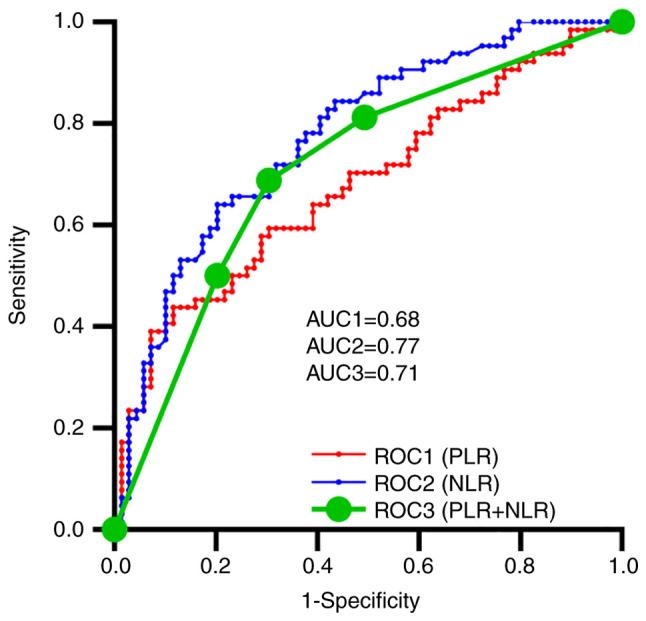
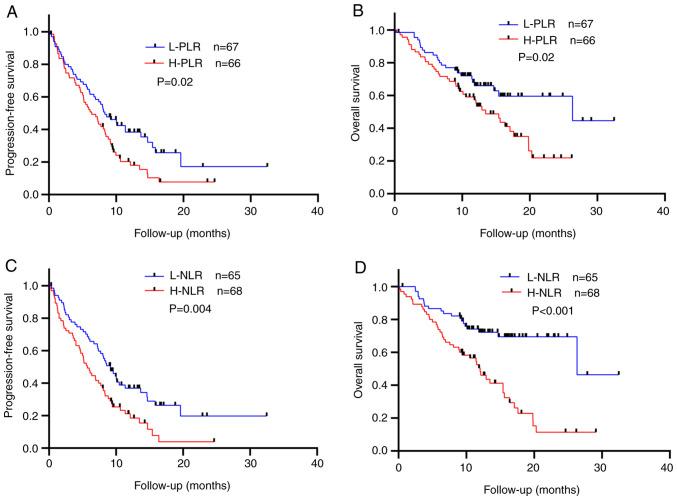
Peripheral serological indicators are novel markers associated with prognosis in multiple malignant tumors. In the present study, platelet-to-lymphocyte ratio (PLR) and neutrophil-to-lymphocyte ratio (NLR) were selected to construct a model that predicts long-term survival of patients with stage IIIB-IV non-small cell lung cancer (NSCLC) who received treatment with an anti-programmed cell death protein-1 (PD-1) monoclonal antibody. A total of 133 patients were eligible for the present retrospective study (January 2019-February 2021). The area under the receiver operating characteristic curve was used to compare the diagnostic value of PLR and NLR, and combined PLR and NLR. The objective response rate and disease control rate of each group were obtained and the differences were compared using the χ test. The prognostic value of these indicators was assessed using the Kaplan-Meier method. Cox regression analysis was used to evaluate risk factors associated with long-term survival. Statistically significant parameters were included in the nomogram. Based on the median PLR and NLR values, the patients were divided into high PLR (H-PLR) (PLR >200.00, 67 patients) and low PLR (L-PLR) (PLR ≤200.00, 66 patients), and high NLR (H-NLR) (NLR >3.56, 65 patients) and low NLR (L-NLR) (NLR ≤3.56, 68 patients) groups. Immune-related adverse events (irAEs) occurred in 22 patients (16.5%) during the observation period, including 18 grade 2-3 irAEs and 4 grade 4 cases. H-NLR and H-PLR were associated with poor progression-free (PFS) and overall survival (OS) in the present study. NLR was an independent prognostic factor for PFS [hazard ratio (HR): 0.201, 95% confidence interval (CI): 0.060-0.670; P=0.009) and OS (HR: 0.413, 95% CI: 0.226-0.754; P=0.004) in this patient group. Therefore, NLR may be used in the prognostication of patients with stage IIIB-IV NSCLC treated with PD-1 inhibitors. These serological markers may be used in combination with established immunomarkers to help predict outcomes.
外周血清学指标是与多种恶性肿瘤预后相关的新型标志物。在本研究中,选择血小板与淋巴细胞比值(PLR)和中性粒细胞与淋巴细胞比值(NLR)构建一个模型,以预测接受抗程序性细胞死亡蛋白1(PD-1)单克隆抗体治疗的IIIB-IV期非小细胞肺癌(NSCLC)患者的长期生存情况。共有133例患者符合本回顾性研究的条件(2019年1月至2021年2月)。采用受试者工作特征曲线下面积比较PLR、NLR及两者联合的诊断价值。获得每组的客观缓解率和疾病控制率,并采用χ检验比较差异。采用Kaplan-Meier法评估这些指标的预后价值。采用Cox回归分析评估与长期生存相关的危险因素。将具有统计学意义的参数纳入列线图。根据PLR和NLR的中位数,将患者分为高PLR(H-PLR)组(PLR>200.00,67例)和低PLR(L-PLR)组(PLR≤200.


 Zotero 插件