
心血管代谢指数与高血压合并阻塞性睡眠呼吸暂停患者心血管疾病风险的相关性:一项纵向队列研究的结果。
Associations of the Cardiometabolic Index with the Risk of Cardiovascular Disease in Patients with Hypertension and Obstructive Sleep Apnea: Results of a Longitudinal Cohort Study.
机构信息
Hypertension Center of People's Hospital of Xinjiang Uygur Autonomous Region, Xinjiang Hypertension Institute, National Health Committee Key Laboratory of Hypertension Clinical Research, Key Laboratory of Xinjiang Uygur Autonomous Region, Xinjiang Clinical Medical Research Center for Hypertension Diseases, Urumqi, China.
Renal Division, Peking University First Hospital, Beijing, China.
出版信息
Oxid Med Cell Longev. 2022 Jun 23;2022:4914791. doi: 10.1155/2022/4914791. eCollection 2022.
PURPOSE
We aimed to explore the relationship between the cardiometabolic index (CMI) and cardiovascular disease (CVD) and its subtypes (coronary artery disease and stroke) in patients with hypertension and obstructive sleep apnea (OSA).
METHODS
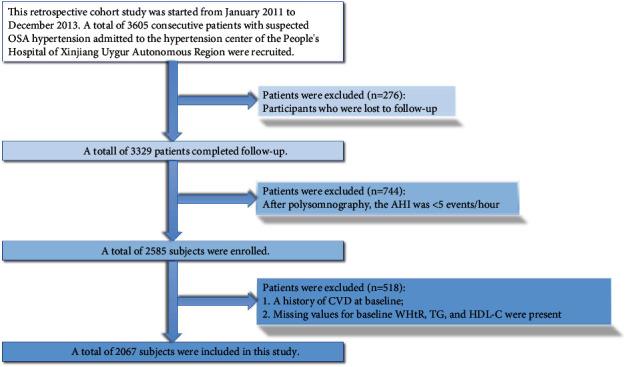
We conducted a retrospective cohort study enrolling 2067 participants from the Urumqi Research on Sleep Apnea and Hypertension study. The CMI was calculated as triglyceride to high-density lipoprotein cholesterol ratio × waist-to-height ratio. Participants were divided into three groups (T1, T2, and T3) according to the tertile of CMI. The Kaplan-Meier method helped to calculate the cumulative incidence of CVD in different groups. We assessed the association of CMI with the risk of CVD and CVD subtypes by estimating hazard ratios (HRs) and 95% confidence intervals (CIs) using Cox models.
RESULTS
During a median follow-up of 6.83 years (interquartile range: 5.92-8.00 years), 326 incident CVD were identified, including 121 incident stroke and 205 incident coronary heart disease (CHD). Overall, after adjusting for confounding variables, CMI was positively associated with the risk of new-onset CVD (per SD increment, adjusted HR: 1.31; 95% CI: 1.20, 1.43), new-onset CHD (per SD increment, adjusted HR: 1.33; 95% CI: 1.20, 1.48), and new-onset stroke (per SD increment, adjusted HR: 1.27; 95% CI: 1.10, 1.47). Similar results were obtained in various subgroup and sensitivity analyses. Adding CMI to the baseline risk model for CVD improved the -index ( < 0.001), continuous net reclassification improvement ( < 0.001), and integrated discrimination index ( < 0.001). Similar results were observed for CHD and stroke.
CONCLUSION
There was a positive association between CMI levels and the risk of new-onset CVD in patients with hypertension and OSA. This finding suggests that CMI may help identify people at high risk of developing CVD.
目的
本研究旨在探讨合并阻塞性睡眠呼吸暂停(OSA)的高血压患者中心血管代谢指数(CMI)与心血管疾病(CVD)及其亚型(冠心病和中风)之间的关系。
方法
我们进行了一项回顾性队列研究,共纳入 2067 名来自乌鲁木齐睡眠呼吸暂停与高血压研究的参与者。CMI 计算方法为三酰甘油/高密度脂蛋白胆固醇比值×腰围身高比。参与者根据 CMI 的三分位将其分为三组(T1、T2 和 T3)。Kaplan-Meier 法计算不同组 CVD 的累积发生率。我们使用 Cox 模型估计危险比(HR)和 95%置信区间(CI)来评估 CMI 与 CVD 和 CVD 亚型风险的相关性。
结果
在中位随访 6.83 年(四分位间距:5.92-8.00 年)期间,共确定了 326 例新发 CVD,包括 121 例中风和 205 例冠心病(CHD)。总体而言,在调整混杂因素后,CMI 与新发 CVD(每增加 1 个标准差,调整后的 HR:1.31;95%CI:1.20,1.43)、新发 CHD(每增加 1 个标准差,调整后的 HR:1.33;95%CI:1.20,1.48)和新发中风(每增加 1 个标准差,调整后的 HR:1.27;95%CI:1.10,1.47)的风险呈正相关。在各种亚组和敏感性分析中也得到了相似的结果。将 CMI 纳入 CVD 的基线风险模型可改善 -指数(<0.001)、连续净重新分类改善(<0.001)和综合鉴别指数(<0.001)。CHD 和中风也观察到类似的结果。
结论
在合并 OSA 的高血压患者中,CMI 水平与新发 CVD 风险呈正相关。这一发现表明,CMI 可能有助于识别发生 CVD 风险较高的人群。



 Zotero 插件