
非典型环二鸟苷酸信号对于牙龈卟啉单胞菌的生长以及细胞包膜动态平衡和毒力的调控是必不可少的。
Atypical cyclic di-AMP signaling is essential for Porphyromonas gingivalis growth and regulation of cell envelope homeostasis and virulence.
机构信息
Department of Oral Immunology and Infectious Diseases, University of Louisville, School of Dentistry, Louisville, KY, USA.
Research Core Unit Metabolomics, Hannover Medical School, Hanover, Germany.
出版信息
NPJ Biofilms Microbiomes. 2022 Jul 6;8(1):53. doi: 10.1038/s41522-022-00316-w.
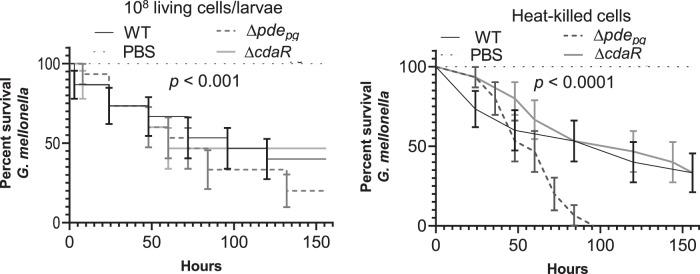
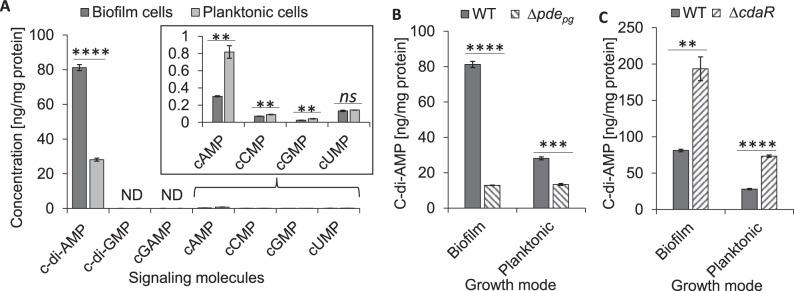
Microbial pathogens employ signaling systems through cyclic (di-) nucleotide monophosphates serving as second messengers to increase fitness during pathogenesis. However, signaling schemes via second messengers in Porphyromonas gingivalis, a key Gram-negative anaerobic oral pathogen, remain unknown. Here, we report that among various ubiquitous second messengers, P. gingivalis strains predominantly synthesize bis-(3',5')-cyclic di-adenosine monophosphate (c-di-AMP), which is essential for their growth and survival. Our findings demonstrate an unusual regulation of c-di-AMP synthesis in P. gingivalis. P. gingivalis c-di-AMP phosphodiesterase (PDE) gene (pde) positively regulates c-di-AMP synthesis and impedes a decrease in c-di-AMP concentration despite encoding conserved amino acid motifs for phosphodiesterase activity. Instead, the predicted regulator gene cdaR, unrelated to the c-di-AMP PDE genes, serves as a potent negative regulator of c-di-AMP synthesis in this anaerobe. Further, our findings reveal that pde and cdaR are required to regulate the incorporation of ATP into c-di-AMP upon pyruvate utilization, leading to enhanced biofilm formation. We show that shifts in c-di-AMP signaling change the integrity and homeostasis of cell envelope, importantly, the structure and immunoreactivity of the lipopolysaccharide layer. Additionally, microbe-microbe interactions and the virulence potential of P. gingivalis were modulated by c-di-AMP. These studies provide the first glimpse into the scheme of second messenger signaling in P. gingivalis and perhaps other Bacteroidetes. Further, our findings indicate that c-di-AMP signaling promotes the fitness of the residents of the oral cavity and the development of a pathogenic community.
微生物病原体通过环(二)核苷酸单磷酸作为第二信使的信号系统来增加发病过程中的适应性。然而,在革兰氏阴性厌氧口腔病原体牙龈卟啉单胞菌中,通过第二信使的信号方案仍然未知。在这里,我们报告说,在各种普遍存在的第二信使中,牙龈卟啉单胞菌菌株主要合成双-(3',5')-环二腺苷一磷酸(c-di-AMP),这对于它们的生长和存活是必不可少的。我们的研究结果表明,在牙龈卟啉单胞菌中,c-di-AMP 的合成受到一种不寻常的调节。牙龈卟啉单胞菌 c-di-AMP 磷酸二酯酶(pde)基因(pde)正向调节 c-di-AMP 的合成,并阻止 c-di-AMP 浓度的降低,尽管其编码的磷酸二酯酶活性的保守氨基酸基序。相反,预测的调节基因 cdaR 与 c-di-AMP PDE 基因无关,在这种厌氧菌中作为 c-di-AMP 合成的有效负调节剂。此外,我们的研究结果表明,pde 和 cdaR 是调节丙酮酸利用时将 ATP 掺入 c-di-AMP 所必需的,从而增强生物膜形成。我们表明,c-di-AMP 信号的转变改变了细胞包膜的完整性和动态平衡,重要的是,改变了脂多糖层的结构和免疫反应性。此外,微生物-微生物相互作用和牙龈卟啉单胞菌的毒力潜力也受到 c-di-AMP 的调节。这些研究首次揭示了牙龈卟啉单胞菌和其他拟杆菌中第二信使信号的方案。此外,我们的研究结果表明,c-di-AMP 信号促进了口腔居民的适应性和致病性群落的发展。


 Zotero 插件