
急性创伤性脊髓损伤住院死亡率的基线预测因素:来自一级创伤中心的数据。
Baseline predictors of in-hospital mortality after acute traumatic spinal cord injury: data from a level I trauma center.
机构信息
Clinical and Experimental Spinal Cord Injury Research (Neuroparaplegiology), Department of Neurology With Experimental Neurology, Charité - Universitätsmedizin Berlin, corporate member of Freie Universität Berlin, Humboldt-Universität zu Berlin, and Berlin Institute of Health, Charitéplatz 1, 10117, Berlin, Germany.
QUEST-Center for Transforming Biomedical Research, Berlin Institute of Health (BIH), Anna-Louisa-Karsch-Str. 2, 10178, Berlin, Germany.
出版信息
Sci Rep. 2022 Jul 6;12(1):11420. doi: 10.1038/s41598-022-15469-z.
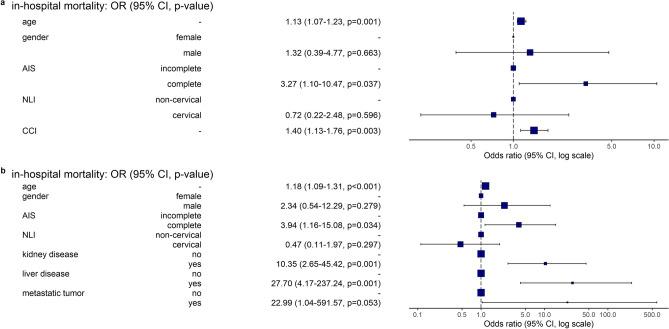
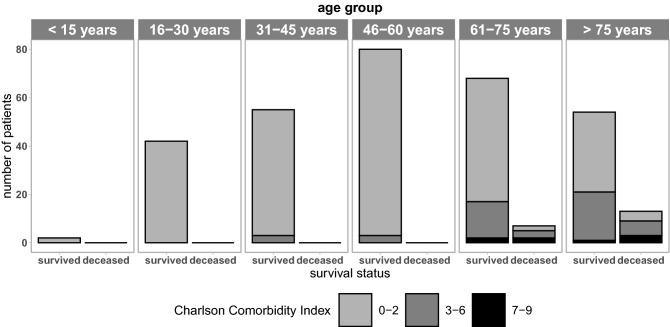
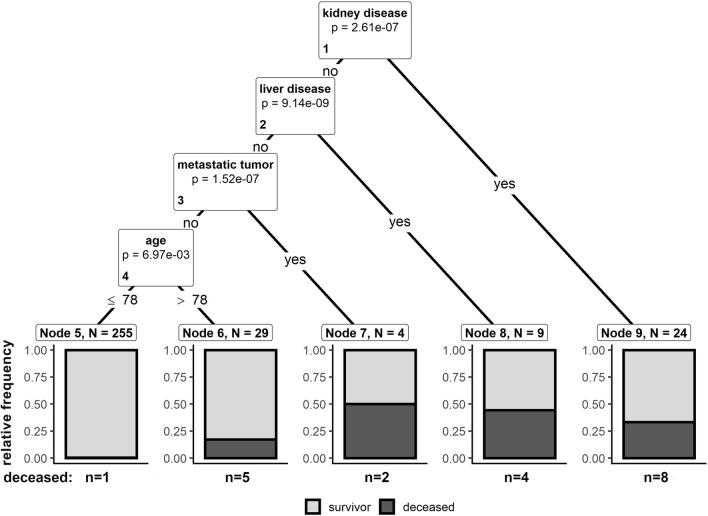
Comorbidity scores are important predictors of in-hospital mortality after traumatic spinal cord injury (tSCI), but the impact of specific pre-existing diseases is unknown. This retrospective cohort study aims at identifying relevant comorbidities and explores the influence of end-of-life decisions. In-hospital mortality of all patients admitted to the study center after acute tSCI from 2011 to 2017 was assessed. A conditional inference tree analysis including baseline data, injury characteristics, and Charlson Comorbidity Index items was used to identify crucial predictors. End-of-life decisions were recorded. Three-hundred-twenty-one patients were consecutively enrolled. The median length of stay was 95.7 days (IQR 56.8-156.0). During inpatient care, 20 patients (6.2%) died. These patients were older (median: 79.0 (IQR 74.7-83.2) vs. 55.5 (IQR 41.4-72.3) years) and had a higher Charlson Comorbidity Index score (median: 4.0 (IQR 1.75-5.50) vs. 0.0 (IQR 0.00-1.00)) compared to survivors. Pre-existing kidney or liver disease were identified as relevant predictors of in-hospital mortality. End-of-life decisions were observed in 14 (70.0%) cases. The identified impairment of kidney and liver, important for drug metabolism and elimination, points to the need of careful decisions on pharmaceutical treatment regimens after tSCI. Appropriate reporting of end-of-life decisions is required for upcoming studies.
合并症评分是外伤性脊髓损伤(tSCI)后院内死亡率的重要预测指标,但特定的既往疾病的影响尚不清楚。本回顾性队列研究旨在确定相关的合并症,并探讨临终决策的影响。评估了 2011 年至 2017 年期间急性 tSCI 后入住研究中心的所有患者的院内死亡率。使用包括基线数据、损伤特征和 Charlson 合并症指数项目的条件推理树分析来确定关键预测因素。记录了临终决策。连续纳入 321 例患者。中位住院时间为 95.7 天(IQR 56.8-156.0)。住院期间,20 例患者(6.2%)死亡。这些患者年龄较大(中位数:79.0(IQR 74.7-83.2)岁 vs. 55.5(IQR 41.4-72.3)岁),Charlson 合并症指数评分较高(中位数:4.0(IQR 1.75-5.50)分 vs. 0.0(IQR 0.00-1.00)分)。与幸存者相比,既往存在的肾脏或肝脏疾病被认为是院内死亡的相关预测因素。观察到 14 例(70.0%)患者进行了临终决策。已确定的肾脏和肝脏损伤,对药物代谢和消除很重要,这表明在 tSCI 后需要仔细考虑药物治疗方案的决策。未来的研究需要适当报告临终决策。
 Zotero 插件