
环二鸟苷酸(Cyclic-di-GMP)刺激角质形成细胞固有免疫反应,并减轻耐甲氧西林金黄色葡萄球菌(Methicillin-resistant Staphylococcus aureus)在小鼠皮肤创伤感染模型中的定植。
Cyclic-di-GMP stimulates keratinocyte innate immune responses and attenuates methicillin-resistant Staphylococcus aureus colonization in a murine skin wound infection model.
机构信息
Department of Medical Microbiology and Parasitology, and Department of Infection of the Children's Hospital, National Clinical Research Center for Child Health, School of Medicine, Zhejiang University, 866Yuhangtang Road, West Lake District, Hangzhou, 310058, China.
Department of Burns, Second Affiliated Hospital, School of Medicine, Zhejiang University, Hangzhou, China.
出版信息
BMC Microbiol. 2022 Jul 8;22(1):176. doi: 10.1186/s12866-022-02583-1.
BACKGROUND
Staphylococcus aureus is a leading cause for morbidity and mortality associated with skin and burn wound infections. Therapeutic options for methicillin-resistant S. aureus (MRSA) have dwindled and therefore alternative treatments are urgently needed. In this study, the immuno-stimulating and anti-MRSA effects of cyclic di-guanosine monophosphate (c-di-GMP), a uniquely bacterial second messenger and immuno-modulator, were investigated in HaCaT human epidermal keratinocytes and a murine skin wound infection model.
RESULTS
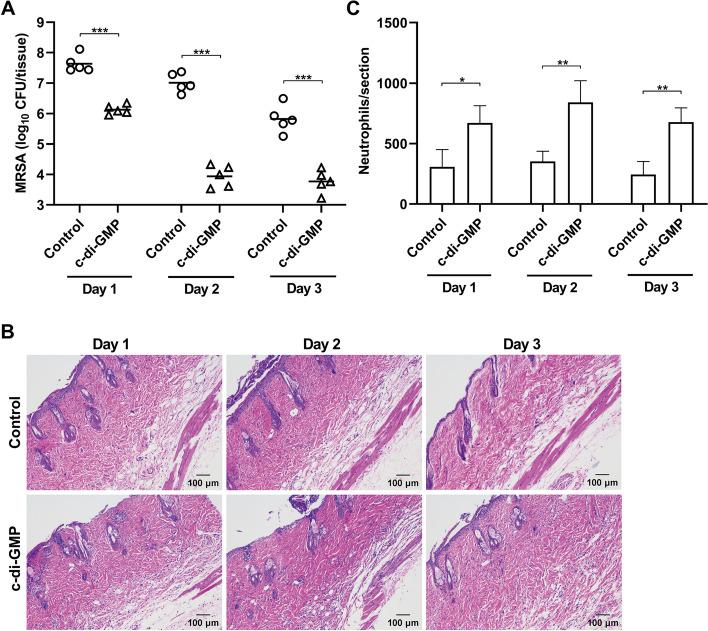
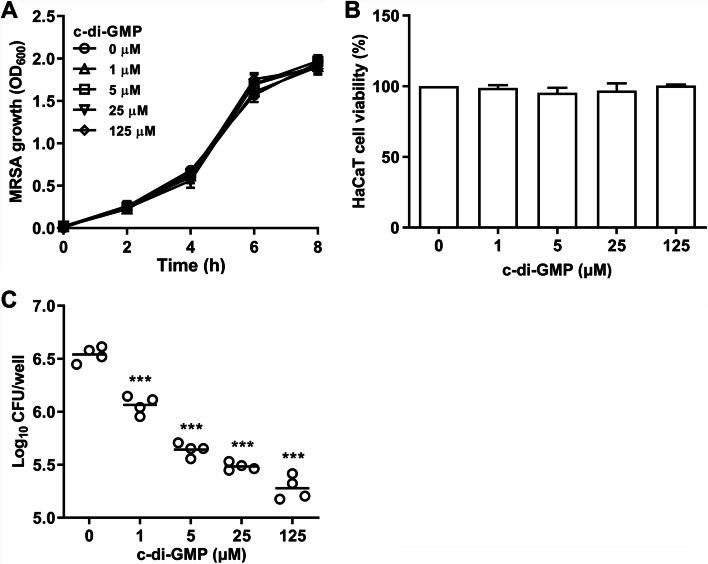
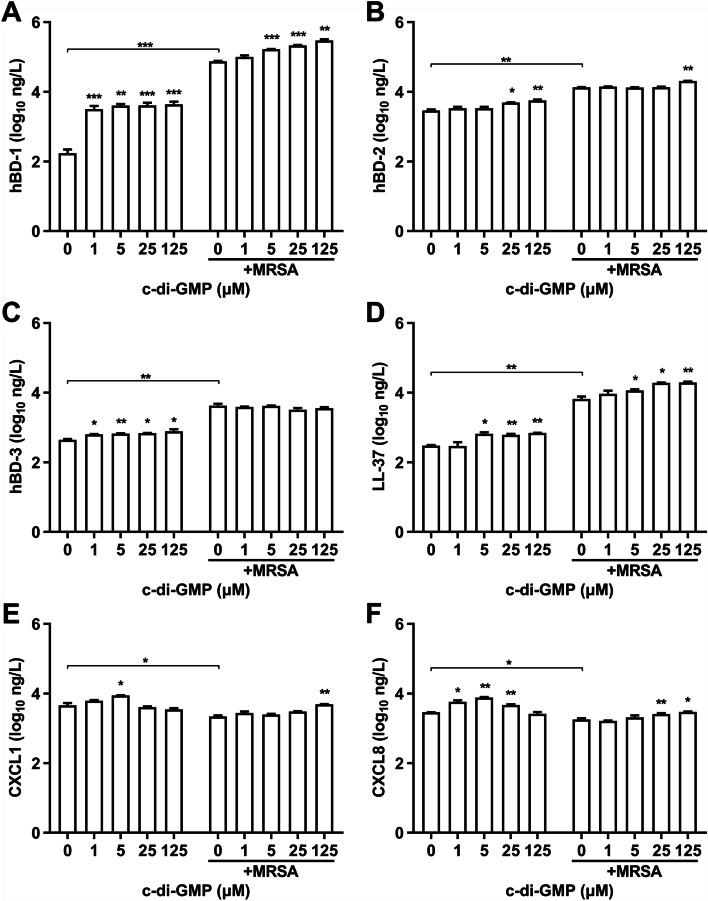
Stimulation of HaCaT cells with 125 μM c-di-GMP for 12 h prior to MRSA challenge resulted in a 20-fold reduction in bacterial colonization compared with untreated control cells, which was not the result of a direct c-di-GMP toxic effect, since bacterial viability was not affected by this dose in the absence of HaCaT cells. C-di-GMP-stimulated or MRSA-challenged HaCaT cells displayed enhanced secretion of the antimicrobial peptides human β-defensin 1 (hBD-1), hBD-2, hBD-3 and LL-37, but for hBD1 and LL-37 the responses were additive in a c-di-GMP-dose-dependent manner. Secretion of the chemokines CXCL1 and CXCL8 was also elevated after stimulation of HaCaT cells with lower c-di-GMP doses and peaked at a dose of 5 μM. Finally, pre-treatment of mice with a 200 nmol dose of c-di-GMP 24 h before a challenge with MRSA in skin wound infection model resulted in a major reduction (up to 1,100-fold by day 2) in bacterial CFU counts recovered from challenged skin tissue sections compared PBS-treated control animals. Tissue sections displayed inflammatory cell infiltration and enhanced neutrophil influx in the c-di-GMP pre-treated animals, which might account for the reduced ability of MRSA to colonize c-di-GMP pre-treated mice.
CONCLUSIONS
These results demonstrate that c-di-GMP is a potent immuno-modulator that can stimulate anti-MRSA immune responses in vivo and might therefore be a suitable alternative prophylactic or therapeutic agent for MRSA skin or burn wound infections.
背景
金黄色葡萄球菌是导致皮肤和烧伤感染相关发病率和死亡率的主要原因。耐甲氧西林金黄色葡萄球菌(MRSA)的治疗选择已经减少,因此迫切需要替代治疗方法。在这项研究中,研究了环状二鸟苷酸(c-di-GMP)作为一种独特的细菌第二信使和免疫调节剂,对 HaCaT 人表皮角质形成细胞和小鼠皮肤感染模型的免疫刺激和抗 MRSA 作用。
结果
在 MRSA 攻击前 12 小时用 125 μM c-di-GMP 刺激 HaCaT 细胞,与未处理的对照细胞相比,细菌定植减少了 20 倍,这不是 c-di-GMP 直接毒性作用的结果,因为在没有 HaCaT 细胞的情况下,该剂量不会影响细菌活力。c-di-GMP 刺激或 MRSA 攻击的 HaCaT 细胞显示出抗菌肽人β防御素 1(hBD-1)、hBD-2、hBD-3 和 LL-37 的分泌增强,但对于 hBD1 和 LL-37,反应以 c-di-GMP 剂量依赖性方式相加。较低剂量的 c-di-GMP 刺激 HaCaT 细胞后,趋化因子 CXCL1 和 CXCL8 的分泌也升高,在 5 μM 时达到峰值。最后,在皮肤感染模型中,在 MRSA 攻击前 24 小时用 200 nmol 剂量的 c-di-GMP 预处理小鼠,与 PBS 处理的对照动物相比,从受挑战皮肤组织切片中回收的细菌 CFU 计数减少了高达 1100 倍(第 2 天)。组织切片显示在 c-di-GMP 预处理动物中炎症细胞浸润和中性粒细胞浸润增加,这可能是 MRSA 定植能力降低的原因。
结论
这些结果表明,c-di-GMP 是一种有效的免疫调节剂,可在体内刺激抗 MRSA 免疫反应,因此可能是治疗 MRSA 皮肤或烧伤感染的合适替代预防或治疗药物。
 Zotero 插件