
从下到上和从认知到情绪的情绪调节:应激缓解和后续睡眠生理方面的体验性情绪调节和认知重评。
Bottom-Up and Cognitive Top-Down Emotion Regulation: Experiential Emotion Regulation and Cognitive Reappraisal on Stress Relief and Follow-Up Sleep Physiology.
机构信息
Faculty of Psychology and Educational Sciences, Vrije Universiteit Brussel, 1050 Brussels, Belgium.
Faculty of Psychological and Educational Sciences, University of Ghent, 9000 Ghent, Belgium.
出版信息
Int J Environ Res Public Health. 2022 Jun 22;19(13):7621. doi: 10.3390/ijerph19137621.
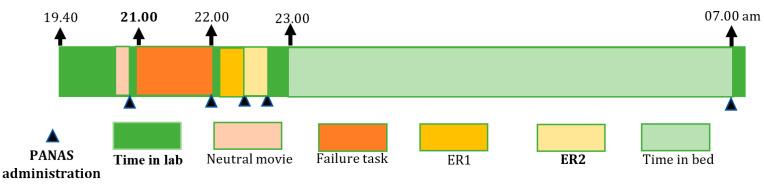
Emotional stress throughout the day is known to affect objective sleep physiology and subjective sleep quality. In the interplay between emotions and sleep, emotion regulation plays a critical role in the recovery from stressful, emotional events and subsequent sleep. While the effects of top-down emotion regulation strategies such as cognitive reappraisal on sleep have been studied before, the impact of bottom-up emotion regulation strategies such as experiential emotion regulation is understudied. Cognitive reappraisal reflects the cognitive reinterpretation of the meaning of a stressful event, while experiential emotion regulation involves an active, non-intervening, accepting, open and welcoming approach of acknowledging awareness of raw sensory affective experiences or 'experiential awareness' in a first phase and expression in a second phase. The present study aims to investigate the effects of experiential emotion regulation and cognitive reappraisal on the recovery from pre-sleep emotional stress measured by (1) negative affect and (2) sleep structure. Sleep of forty-three healthy Dutch-speaking participants (22 females, 21 males) has been assessed using EEG polysomnography. Stress was triggered using a pre-sleep emotional failure induction, after which emotion regulation by experiential emotion regulation versus cognitive reappraisal versus control was induced twice. The control condition consisted of the reallocation of attention towards the neutral aspects of the emotional event. The results indicated that recovery from negative affect of the failure experience after single or repeated deployment of experiential emotion regulation and cognitive reappraisal was not significantly different from the control condition. Moreover, after repeated deployment, sleep physiology did not significantly differ between experiential emotion regulation, cognitive reappraisal, and the control condition in the impact of the regulation of the failure experience. The implications of the distinctive impact of experiential emotion regulation and cognitive reappraisal on both the pre-sleep emotional experience and follow-up sleep physiology are discussed.
一整天的情绪压力已知会影响客观的睡眠生理和主观的睡眠质量。在情绪和睡眠的相互作用中,情绪调节在从压力和情绪事件中恢复以及随后的睡眠中起着至关重要的作用。虽然之前已经研究了自上而下的情绪调节策略(如认知重评)对睡眠的影响,但自下而上的情绪调节策略(如体验情绪调节)的影响研究较少。认知重评反映了对压力事件意义的认知重新解释,而体验情绪调节则涉及一种主动、非干预、接受、开放和欢迎的方法,即承认对原始感官情感体验或“体验意识”的意识,并在第二阶段表达。本研究旨在调查体验情绪调节和认知重评对从预睡眠情绪压力中恢复的影响,这种压力是通过(1)负性情绪和(2)睡眠结构来衡量的。使用 EEG 多导睡眠图评估了 43 名健康的荷兰语参与者(22 名女性,21 名男性)的睡眠。在睡前情绪失败诱发后,触发了压力,然后两次诱发体验情绪调节与认知重评与控制的情绪调节。控制条件包括将注意力重新分配到情绪事件的中性方面。结果表明,单次或重复使用体验情绪调节和认知重评后,从失败体验的负性情绪中恢复并不明显不同于控制条件。此外,在重复部署后,在调节失败体验的影响方面,体验情绪调节、认知重评和控制条件之间的睡眠生理并没有显著差异。讨论了体验情绪调节和认知重评对睡前情绪体验和后续睡眠生理的独特影响的意义。

 Zotero 插件