
植物代谢组学的进展及其在应激和单细胞生物学中的应用。
Advances in Plant Metabolomics and Its Applications in Stress and Single-Cell Biology.
机构信息
Department of Biological Sciences, Florida A & M University, Tallahassee, FL 32307, USA.
Department of Biology, University of Florida, Gainesville, FL 32611, USA.
出版信息
Int J Mol Sci. 2022 Jun 23;23(13):6985. doi: 10.3390/ijms23136985.
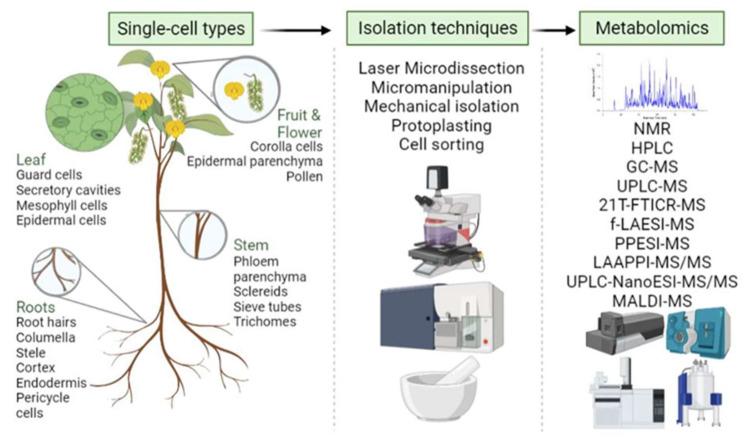
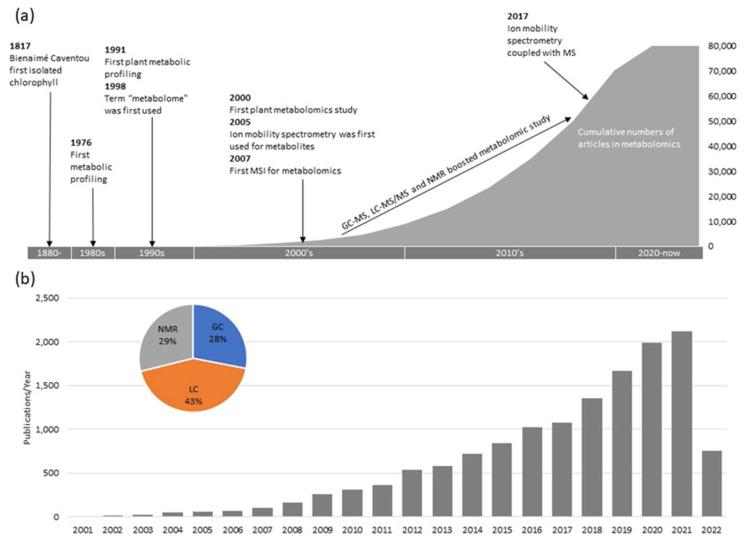
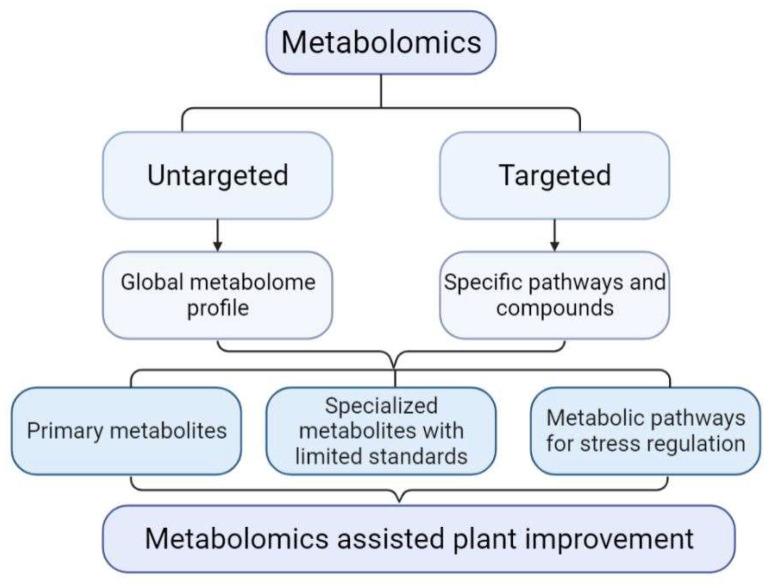
In the past two decades, the post-genomic era envisaged high-throughput technologies, resulting in more species with available genome sequences. In-depth multi-omics approaches have evolved to integrate cellular processes at various levels into a systems biology knowledge base. Metabolomics plays a crucial role in molecular networking to bridge the gaps between genotypes and phenotypes. However, the greater complexity of metabolites with diverse chemical and physical properties has limited the advances in plant metabolomics. For several years, applications of liquid/gas chromatography (LC/GC)-mass spectrometry (MS) and nuclear magnetic resonance (NMR) have been constantly developed. Recently, ion mobility spectrometry (IMS)-MS has shown utility in resolving isomeric and isobaric metabolites. Both MS and NMR combined metabolomics significantly increased the identification and quantification of metabolites in an untargeted and targeted manner. Thus, hyphenated metabolomics tools will narrow the gap between the number of metabolite features and the identified metabolites. Metabolites change in response to environmental conditions, including biotic and abiotic stress factors. The spatial distribution of metabolites across different organs, tissues, cells and cellular compartments is a trending research area in metabolomics. Herein, we review recent technological advancements in metabolomics and their applications in understanding plant stress biology and different levels of spatial organization. In addition, we discuss the opportunities and challenges in multiple stress interactions, multi-omics, and single-cell metabolomics.
在过去的二十年中,后基因组时代设想了高通量技术,从而产生了更多具有可用基因组序列的物种。深入的多组学方法已经发展到将各种水平的细胞过程整合到系统生物学知识库中。代谢组学在分子网络中起着至关重要的作用,可弥合基因型和表型之间的鸿沟。然而,由于代谢物具有多样的化学和物理性质,其复杂性更大,限制了植物代谢组学的发展。多年来,液相/气相色谱(LC/GC)-质谱(MS)和核磁共振(NMR)的应用一直在不断发展。最近,离子淌度谱(IMS)-MS 已显示出在解析异构体和等摩尔代谢物方面的有用性。MS 和 NMR 联合代谢组学显著提高了非靶向和靶向代谢物的鉴定和定量。因此,联用代谢组学工具将缩小代谢物特征数量和已鉴定代谢物之间的差距。代谢物会响应环境条件(包括生物和非生物胁迫因素)而发生变化。代谢物在不同器官、组织、细胞和细胞区室之间的空间分布是代谢组学的一个研究趋势。在此,我们综述了代谢组学的最新技术进展及其在理解植物应激生物学和不同层次的空间组织方面的应用。此外,我们还讨论了多胁迫相互作用、多组学和单细胞代谢组学中的机遇和挑战。

 Zotero 插件