
晚期肺癌免疫治疗的毒性谱:来自临床试验和药物警戒系统的安全性分析。
Toxicity spectrum of immunotherapy in advanced lung cancer: A safety analysis from clinical trials and a pharmacovigilance system.
作者信息
Yan Yi-Dan, Zhao Ying, Zhang Chi, Fu Jie, Su Ying-Jie, Cui Xiang-Li, Ma Er-Li, Liu Bing-Long, Gu Zhi-Chun, Lin Hou-Wen
机构信息
Department of Pharmacy, Ren Ji Hospital, Shanghai Jiao Tong University School of Medicine, Shanghai 200127, China.
Drug Clinical Comprehensive Evaluation Group, Shanghai Pharmaceutical Association, Shanghai 200040, China.
出版信息
EClinicalMedicine. 2022 Jul 1;50:101535. doi: 10.1016/j.eclinm.2022.101535. eCollection 2022 Aug.
BACKGROUND
With the increased use of immune checkpoint inhibitors (ICIs) in advanced lung cancer, adverse events (AEs), particularly immune-related AEs (irAEs), have garnered considerable interest. We conducted a comprehensive assessment of the toxicity profile in advanced lung cancer using multi-source medical data.
METHODS
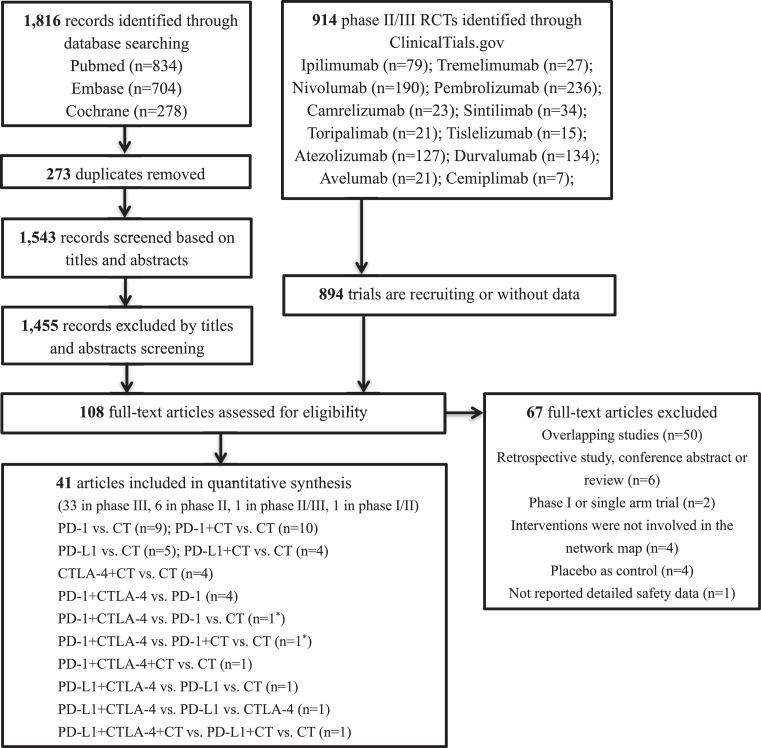
First, we systematically searched the PubMed, Embase, and Cochrane Library databases (from inception to 10 August 2021) for relevant randomised controlled trials (RCTs) involving ICI-based treatments for advanced lung cancer. The primary outcomes were treatment-related AEs and irAEs, including events that were assigned grade 1-5 and 3-5. The secondary outcomes were grade 5 AEs and irAEs (grade 1-5 and grade 3-5) in specific organs. Network comparisons were conducted for 11 treatments, including chemotherapy (CT), ICI monotherapy (three regimens: programmed death-1 receptor [PD-1] inhibitors, programmed death ligand-1 [PD-L1] inhibitors, and cytotoxic T lymphocyte-associated antigen [CTLA-4] inhibitors), dual-ICI combination therapy (two regimens), and treatment using one or two ICI drugs administered in combination with CT (five regimens). We also conducted a disproportionality analysis by extracting reports of various irAEs associated with ICIs from the FDA Adverse Event Reporting System (FAERS) database. The reporting odds ratios and fatality proportions of different irAEs were calculated and compared. PROSPERO: CRD42021268650.
FINDINGS
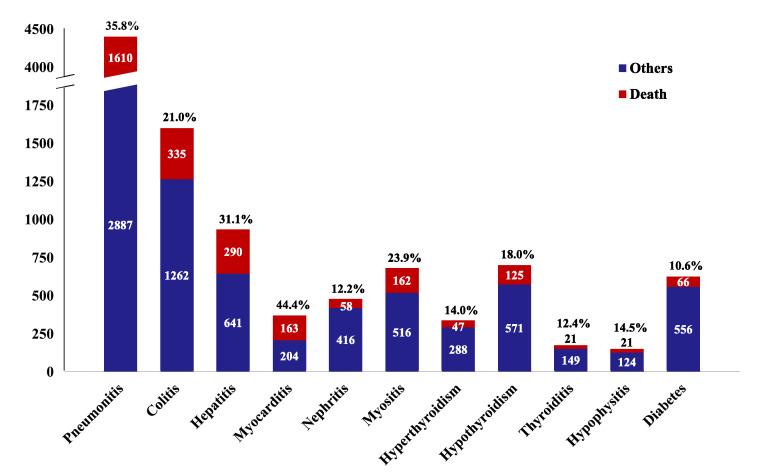
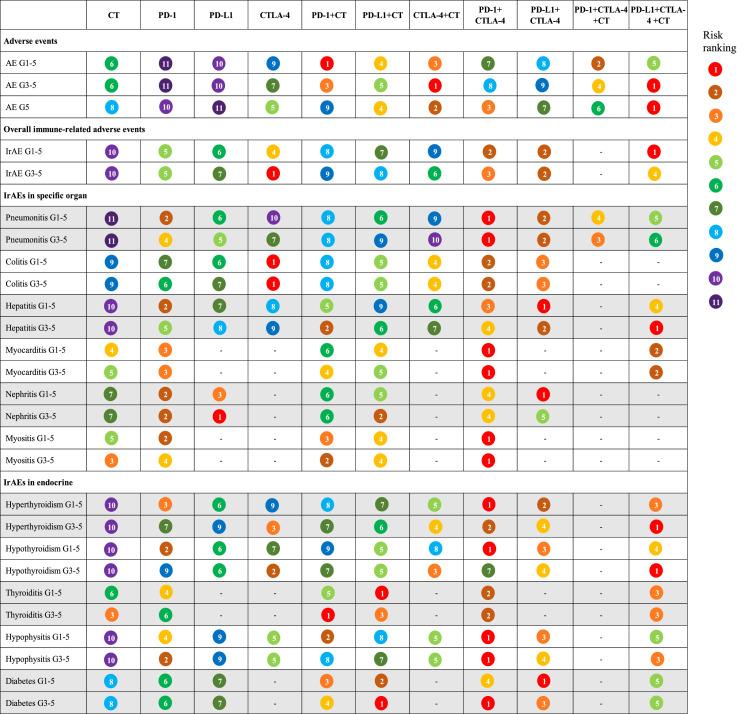
Overall, 41 RCTs involving 23,121 patients with advanced lung cancer were included. Treatments containing chemotherapy increased the risk of treatment-related AEs compared to ICI-based regimens without chemotherapy. Concerning irAEs, PD-L1 + CTLA-4 + CT was associated with the highest risk of grade 1-5 irAEs, followed by two regimens of dual ICI combination, three regimens of ICI monotherapy, and three regimens of one ICI combined with CT. For 3-5 irAEs, CTLA-4 accounted for most AEs. Detailed comparisons of ICI-based treatment options provided irAE profiles based on specific organs/systems and AE severity. Insights from the FAERS database revealed that signals corresponding to pneumonitis, colitis, thyroiditis, and hypophysitis were observed across all ICI regimens. Further analyses of the outcomes indicated that myocarditis (163 of 367, 44.4%), pneumonitis (1610 of 4497, 35.8%), and hepatitis (290 of 931, 31.1%) had high fatality rates.
INTERPRETATION
Included RCTs showed heterogeneity in a few clinical factors, and reports derived from the FAERS database might have involved inaccurate data. Our results can be used as a basis for improving clinical treatment strategies and designing preventive methods for ICI treatment in advanced lung cancer.
FUNDING
This study was supported by the Research Project of Drug Clinical Comprehensive Evaluation and Drug Treatment Pathway (SHYXH-ZP-2021-001, SHYXH-ZP-2021-006), Clinical Research Innovation and Cultivation Fund of Ren Ji Hospital (RJPY-LX-008), Ren Ji Boost Project of National Natural Science Foundation of China (RJTJ-JX-001), and Shanghai "Rising Stars of Medical Talent" Youth Development Program - Youth Medical Talents - Clinical Pharmacist Program (SHWJRS (2019) 072).
背景
随着免疫检查点抑制剂(ICI)在晚期肺癌中的使用增加,不良事件(AE),尤其是免疫相关不良事件(irAE),已引起了广泛关注。我们使用多源医学数据对晚期肺癌的毒性特征进行了全面评估。
方法
首先,我们系统检索了PubMed、Embase和Cochrane图书馆数据库(从数据库建立至2021年8月10日),以查找涉及基于ICI治疗晚期肺癌的相关随机对照试验(RCT)。主要结局是治疗相关AE和irAE,包括评定为1 - 5级和3 - 5级的事件。次要结局是特定器官的5级AE和irAE(1 - 5级和3 - 5级)。对11种治疗方法进行了网状比较,包括化疗(CT)、ICI单药治疗(三种方案:程序性死亡-1受体[PD-1]抑制剂、程序性死亡配体-1[PD-L1]抑制剂和细胞毒性T淋巴细胞相关抗原[CTLA-4]抑制剂)、双ICI联合治疗(两种方案)以及使用一种或两种ICI药物与CT联合使用的治疗方法(五种方案)。我们还通过从美国食品药品监督管理局不良事件报告系统(FAERS)数据库中提取与ICI相关的各种irAE报告进行了不成比例分析。计算并比较了不同irAE的报告比值比和致死率。国际前瞻性系统评价注册库(PROSPERO)注册号:CRD42021268650。
结果
总体而言,纳入了41项涉及23121例晚期肺癌患者的RCT。与不包含化疗的基于ICI的方案相比,包含化疗的治疗增加了治疗相关AE的风险。关于irAE,PD-L1 + CTLA-4 + CT与1 - 5级irAE的最高风险相关,其次是两种双ICI联合治疗方案、三种ICI单药治疗方案以及三种一种ICI与CT联合使用的方案。对于3 - 5级irAE,CTLA-4导致了大多数AE。基于ICI的治疗方案的详细比较提供了基于特定器官/系统和AE严重程度的irAE概况。FAERS数据库的分析结果显示,在所有ICI方案中均观察到了与肺炎、结肠炎、甲状腺炎和垂体炎相对应的信号。对结局的进一步分析表明,心肌炎(367例中的163例,44.4%)、肺炎(4497例中的1610例,35.8%)和肝炎(931例中的290例,31.1%)的致死率较高。
解读
纳入的RCT在一些临床因素上存在异质性,并且来自FAERS数据库的报告可能存在数据不准确的情况。我们的结果可作为改进晚期肺癌ICI治疗的临床治疗策略和设计预防方法的依据。
资助
本研究得到了药物临床综合评价与药物治疗路径研究项目(SHYXH-ZP-2021-001,SHYXH-ZP-2021-006)、上海交通大学医学院附属仁济医院临床研究创新与培育基金(RJPY-LX-008)、仁济医院国家自然科学基金提升项目(RJTJ-JX-001)以及上海“医苑新星”青年医学人才培养计划 - 青年医学人才 - 临床药师项目(SHWJRS(2019)072)的支持。


 Zotero 插件