
急性心力衰竭伴和不伴高收缩压患者细胞外液容量的差异。
Differences in extracellular fluid volume between acute heart failure patients with and without high systolic blood pressure.
机构信息
Department of Cardiovascular Medicine, Okayama University Graduate School of Medicine, Dentistry and Pharmaceutical Sciences, Okayama, Japan.
Department of Cardiovascular Medicine, Tsuyama Chuo Hospital, Tsuyama, Japan.
出版信息
ESC Heart Fail. 2022 Oct;9(5):3358-3366. doi: 10.1002/ehf2.14067. Epub 2022 Jul 13.
AIMS
Some reports have suggested that hypertensive acute heart failure (AHF) is caused by intravascular congestion, not interstitial congestion. We evaluated the differences in extracellular fluid volume assessed by bioelectrical impedance analysis (BIA) between AHF patients with and without high systolic blood pressure (sBP).
METHODS
This prospective single-centre study (UMIN000030266) included 178 patients hospitalized due to AHF between September 2017 and August 2018. We calculated extracellular water (ECW), intracellular water (ICW), total body water (TBW), and ECW-to-TBW ratio (oedema index: EI) by BIA and evaluated conventional parameters as follows: weight, N-terminal pro brain natriuretic peptide values, and echocardiography parameters on admission and before discharge. One-year outcomes included all-cause death and re-admission due to heart failure. We compared patients with sBP > 140 mmHg on admission [clinical scenario 1 (CS1) group] and with sBP of ≤140 mmHg on admission (non-CS1 group).
RESULTS
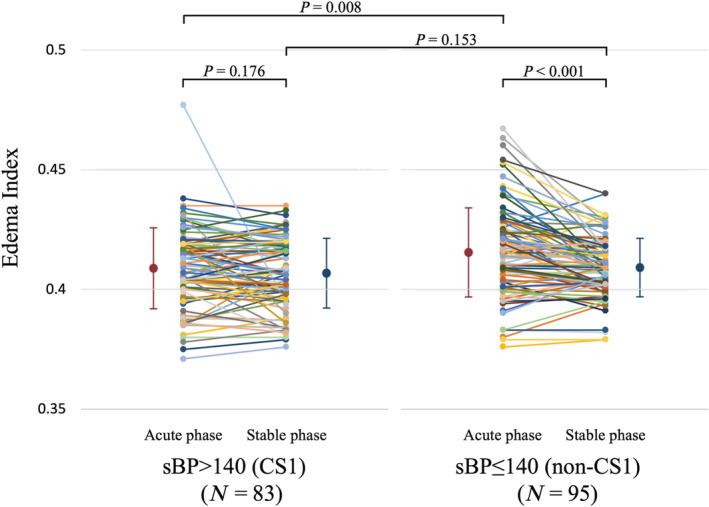
The mean age of the patients was 79.5 ± 11.1 years, and 48.9% of the patients were female. EI on admission of 83 patients in the CS1 group was lower than that of 95 patients in the non-CS1 group. The change in EI from admission to before discharge was no significant in the CS1 group but was significant in the non-CS1 group. Comparing the changes from admission to before discharge between the CS1 and the non-CS1 group, delta ECW, delta ICW, delta TBW, and delta EI of the CS1 group were significantly smaller than those of the non-CS1 group. During the 1-year follow-up period after discharge of the 178 patients, the numbers of deaths and re-admissions due to acute HF were 26 (15%) and 49 (28%), respectively. Patients with high EI before discharge [>0.408 (median)] had significantly more cardiac events than patients with low EI [hazard ratio (HR): 2.15, 95% confidence interval (CI): 1.30-3.55]. Cox regression analysis revealed that higher EI as a continuous variable was significantly associated with worse outcome in non-CS1 group (HR: 1.46, 95% CI: 1.13-1.87), but not significantly associated with worse outcome in CS1 group (HR: 1.29, 95% CI: 0.98-1.69).
CONCLUSIONS
EI on admission in patients with high sBP was not elevated, and changes in ECW, ICW, TBW, and EI in patients with high sBP were smaller than those in patients without high sBP. EI measured by BIA could distinguish AHF with interstitial or intravascular congestion.
目的
一些报告表明,高血压急性心力衰竭(AHF)是由血管内充血引起的,而不是间质充血。我们评估了生物电阻抗分析(BIA)评估的细胞外液体积在伴有和不伴有高收缩压(sBP)的 AHF 患者之间的差异。
方法
这是一项前瞻性单中心研究(UMIN000030266),纳入了 2017 年 9 月至 2018 年 8 月因 AHF 住院的 178 名患者。我们通过 BIA 计算细胞外液(ECW)、细胞内液(ICW)、总体水(TBW)和 ECW 与 TBW 的比值(水肿指数:EI),并评估以下常规参数:入院时和出院前的体重、N-末端脑利钠肽前体值和超声心动图参数。1 年的预后结果包括全因死亡和因心力衰竭再次入院。我们比较了入院时 sBP>140mmHg 的患者[临床情况 1(CS1)组]和入院时 sBP≤140mmHg 的患者(非 CS1 组)。
结果
患者的平均年龄为 79.5±11.1 岁,48.9%为女性。CS1 组 83 名患者入院时的 EI 低于非 CS1 组 95 名患者。CS1 组入院至出院前 EI 的变化不显著,但非 CS1 组的变化显著。比较 CS1 组和非 CS1 组入院至出院前的变化,CS1 组的 delta ECW、delta ICW、delta TBW 和 delta EI 明显小于非 CS1 组。在 178 名患者出院后的 1 年随访期间,死亡和因急性 HF 再次入院的人数分别为 26 例(15%)和 49 例(28%)。出院前 EI 较高[>0.408(中位数)]的患者心脏事件明显多于 EI 较低的患者[风险比(HR):2.15,95%置信区间(CI):1.30-3.55]。Cox 回归分析显示,非 CS1 组中较高的 EI 作为连续变量与预后不良显著相关(HR:1.46,95%CI:1.13-1.87),但与 CS1 组的预后不良无显著相关性(HR:1.29,95%CI:0.98-1.69)。
结论
高 sBP 患者入院时 EI 并未升高,高 sBP 患者的 ECW、ICW、TBW 和 EI 变化小于无高 sBP 患者。BIA 测量的 EI 可区分伴有间质或血管内充血的 AHF。


 Zotero 插件