
南非城市中年成年人的身体行为及其与 2 型糖尿病风险标志物的关系:一种等时替代方法。
Physical behaviors and their association with type 2 diabetes mellitus risk markers in urban South African middle-aged adults: an isotemporal substitutionapproach.
机构信息
Department of Paediatrics, Faculty of Health Sciences University of the Witwatersrand, Johannesburg, Gauteng, South Africa
Epidemiology and Surveillance Section, National Institute for Occupational Health (NIOH), National Health Laboratory Service (NHLS), Johannesburg, Gauteng, South Africa.
出版信息
BMJ Open Diabetes Res Care. 2022 Jul;10(4). doi: 10.1136/bmjdrc-2022-002815.
INTRODUCTION
To examine the associations between physical behaviors and type 2 diabetes mellitus (T2DM) risk markers in middle-aged South African men and women.
RESEARCH DESIGN AND METHODS
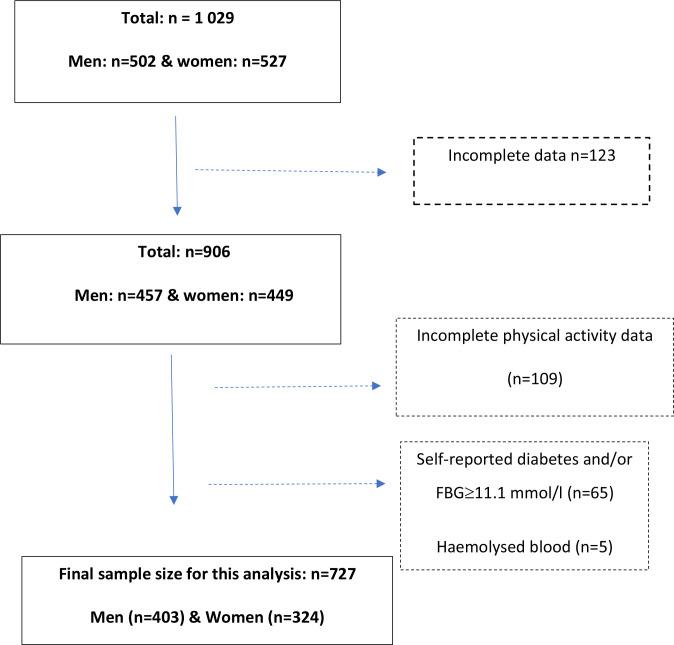
This cross-sectional study included middle-aged men (n=403; age: median (IQR), 53.0 (47.8-58.8) years) and women (n=324; 53.4 (49.1-58.1) years) from Soweto, South Africa. Total movement volume (average movement in milli-g) and time (minutes/day) spent in different physical behaviors, including awake sitting/lying, standing, light intensity physical activity (LPA) and moderate-to-vigorous intensity physical activity (MVPA), were determined by combining the signals from two triaxial accelerometers worn simultaneously on the hip and thigh. All participants completed an oral glucose tolerance test, from which indicators of diabetes risk were derived. Associations between physical behaviors and T2DM risk were adjusted for sociodemographic factors and body composition.
RESULTS
Total movement volume was inversely associated with measures of fasting and 2-hour glucose and directly associated with insulin sensitivity, basal insulin clearance, and beta-cell function, but these associations were not independent of fat mass, except for basal insulin clearance in women. In men, replacing 30 min of sitting/lying, standing or LPA with the same amount of MVPA time was associated with 1.2-1.4 mmol/L lower fasting glucose and 12.3-13.4 mgl/mUmin higher insulin sensitivity. In women, substituting sitting/lying with the same amount of standing time or LPA was associated with 0.5-0.8 mmol/L lower fasting glucose. Substituting 30 min sitting/lying with the same amount of standing time was also associated with 3.2 mgl/mUmin higher insulin sensitivity, and substituting 30 min of sitting/lying, standing or LPA with the same amount of MVPA time was associated with 0.25-0.29 ng/mIU higher basal insulin clearance in women.
CONCLUSION
MVPA is important in reducing T2DM risk in men and women, but LPA appears to be important in women only. Longitudinal and intervention studies warranted to provide more specific PA recommendations.
简介
本研究旨在探讨南非中年男性和女性的身体活动与 2 型糖尿病(T2DM)风险标志物之间的关系。
研究设计和方法
这项横断面研究纳入了来自南非索韦托的中年男性(n=403;年龄中位数(IQR):53.0(47.8-58.8)岁)和女性(n=324;53.4(49.1-58.1)岁)。通过同时佩戴在臀部和大腿上的两个三轴加速度计的信号组合,确定总运动量(平均运动量,以毫高斯为单位)和不同身体活动(清醒坐姿/躺姿、站立、低强度体力活动(LPA)和中高强度体力活动(MVPA))的时间。所有参与者完成口服葡萄糖耐量试验,从该试验中得出糖尿病风险指标。在调整社会人口统计学因素和身体成分后,分析身体活动与 T2DM 风险之间的关系。
结果
总运动量与空腹和 2 小时血糖呈负相关,与胰岛素敏感性、基础胰岛素清除率和β细胞功能呈正相关,但这些关联不受脂肪量影响,除了女性的基础胰岛素清除率。在男性中,将 30 分钟的坐姿/躺姿、站立或 LPA 替换为相同量的 MVPA 时间,与空腹血糖降低 1.2-1.4mmol/L 和胰岛素敏感性提高 12.3-13.4mgl/mUmin 有关。在女性中,将坐姿/躺姿替换为相同量的站立时间或 LPA,与空腹血糖降低 0.5-0.8mmol/L 有关。用相同量的站立时间替换 30 分钟的坐姿/躺姿也与胰岛素敏感性提高 3.2mgl/mUmin 有关,而用相同量的 30 分钟坐姿/躺姿、站立或 LPA 替换 MVPA 时间,与女性基础胰岛素清除率提高 0.25-0.29ng/mIU 有关。
结论
MVPA 对降低男性和女性的 T2DM 风险很重要,但 LPA 似乎对女性尤为重要。需要进行纵向和干预研究,以提供更具体的 PA 建议。
 Zotero 插件