
炎症标志物在预测甲状腺乳头状癌患者复发方面具有重要价值:一项长期随访的回顾性研究。
Inflammation Markers Have Important Value in Predicting Relapse in Patients with papillary thyroid carcinoma: A Long-Term Follow-Up Retrospective Study.
机构信息
Department of Thyroid Surgery, 196534Second Affiliated Hospital of Nanchang University, Nanchang, China.
The Second Clinical Medicine College, Medical Department, Nanchang University, Nanchang, China.
出版信息
Cancer Control. 2022 Jan-Dec;29:10732748221115236. doi: 10.1177/10732748221115236.
PURPOSE
Many markers of inflammation are increasingly found to have prognostic significance in some cancers. This study investigated the prognostic value of albumin/globulin (AGR), lymphocyte/monocyte ratio (LMR), and other inflammatory markers, including neutrophil/lymphocyte ratio (NLR) and platelet/lymphocyte ratio (PLR), in patients with papillary thyroid carcinoma (PTC).
METHODS
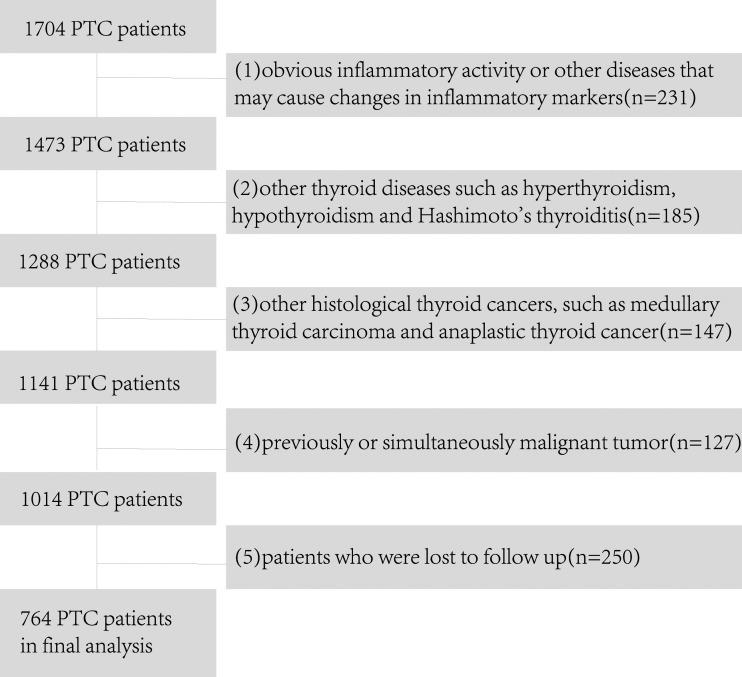
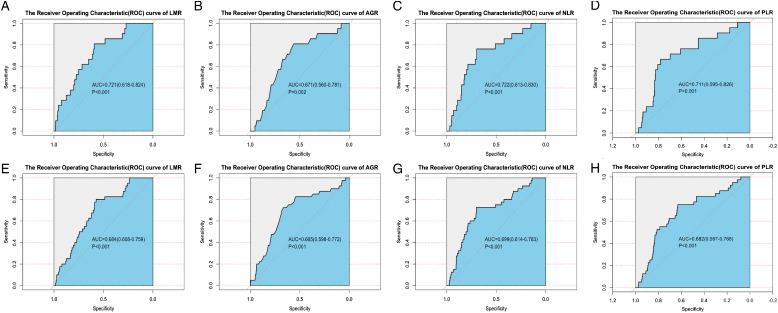
We retrospectively analyzed the data of 764 patients newly diagnosed with PTC (608 women, 156 men) aged 10-83 years. Univariate and multivariate analyses were used to analyze recurrence rates and assess potential prognostic factors. Furthermore, we used random survival forests to construct a random survival forest score (RSFscore). The correlations between various inflammatory factors and traditional prognostic factors were analyzed. We also compared the areas under the curve (AUCs) of the RSFscore and 4 inflammation-based markers.
RESULTS
AGR, NLR, PLR, and LMR were strongly associated with invasive clinicopathological features (tumor size, lesions, lymph node metastasis, and lymph node metastasis rate) and postoperative recurrence. In the multivariate analysis, AGR and LMR were independent prognostic markers for recurrent PTC. Higher NLR and PLR values indicated a higher risk of recurrence, while higher LMR and AGR values suggested a lower recurrence risk. The predictive power of the combined indicators was stronger than that of single indicators alone.
CONCLUSION
Compared to the analysis of a single indicator, the combination of inflammatory markers was more helpful in determining the risk of PTC recurrence, which has an important impact on predicting patients' cancer-free survival and quality of life.
目的
越来越多的炎症标志物被发现与某些癌症的预后有关。本研究探讨了白蛋白/球蛋白(AGR)、淋巴细胞/单核细胞比值(LMR)和其他炎症标志物,包括中性粒细胞/淋巴细胞比值(NLR)和血小板/淋巴细胞比值(PLR)在甲状腺乳头状癌(PTC)患者中的预后价值。
方法
我们回顾性分析了 764 例新诊断为 PTC(608 例女性,156 例男性)的患者数据,年龄 10-83 岁。使用单因素和多因素分析来分析复发率,并评估潜在的预后因素。此外,我们使用随机生存森林构建随机生存森林评分(RSFscore)。分析了各种炎症因子与传统预后因素之间的相关性。我们还比较了 RSFscore 和 4 种炎症标志物的曲线下面积(AUC)。
结果
AGR、NLR、PLR 和 LMR 与侵袭性临床病理特征(肿瘤大小、病变、淋巴结转移和淋巴结转移率)和术后复发密切相关。多因素分析显示,AGR 和 LMR 是 PTC 复发的独立预后标志物。较高的 NLR 和 PLR 值提示复发风险较高,而较高的 LMR 和 AGR 值提示复发风险较低。联合指标的预测能力强于单一指标。
结论
与单一指标分析相比,炎症标志物的组合更有助于确定 PTC 复发的风险,对预测患者无癌生存和生活质量有重要影响。





 Zotero 插件