
可生物降解镁基生物材料腐蚀的建模:建模方法、验证及未来展望
modelling of the corrosion of biodegradable magnesium-based biomaterials: modelling approaches, validation and future perspectives.
作者信息
Joshi Aditya, Dias George, Staiger Mark P
机构信息
Department of Mechanical Engineering, University of Canterbury, Christchurch, New Zealand.
Department of Anatomy, University of Otago, Dunedin, New Zealand.
出版信息
Biomater Transl. 2021 Sep 28;2(3):257-271. doi: 10.12336/biomatertransl.2021.03.008. eCollection 2021.
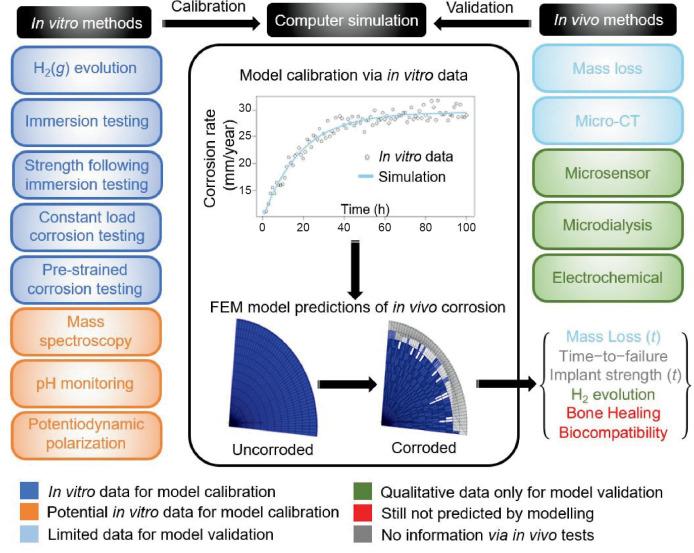
Metallic biomedical implants based on magnesium, zinc and iron alloys have emerged as bioresorbable alternatives to permanent orthopaedic implants over the last two decades. The corrosion rate of biodegradable metals plays a critical role in controlling the compatibility and functionality of the device in vivo. The broader adoption of biodegradable metals in orthopaedic applications depends on developing in vitro methods that accurately predict the biodegradation behaviour in vivo. However, the physiological environment is a highly complex corrosion environment to replicate in the laboratory, making the in vitro-to-in vivo translation of results very challenging. Accordingly, the results from in vitro corrosion tests fail to provide a complete schema of the biodegradation behaviour of the metal in vivo. In silico approach based on computer simulations aim to bridge the observed differences between experiments performed in vitro and vivo. A critical review of the state-of-the-art of computational modelling techniques for predicting the corrosion behaviour of magnesium alloy as a biodegradable metal is presented.
在过去二十年中,基于镁、锌和铁合金的金属生物医学植入物已成为永久性骨科植入物的可生物降解替代品。可生物降解金属的腐蚀速率在控制体内装置的兼容性和功能方面起着关键作用。可生物降解金属在骨科应用中的更广泛采用取决于开发能够准确预测体内生物降解行为的体外方法。然而,生理环境是一个在实验室中极难复制的高度复杂的腐蚀环境,这使得体外结果到体内的转化极具挑战性。因此,体外腐蚀试验的结果无法提供金属在体内生物降解行为的完整模式。基于计算机模拟的计算机方法旨在弥合体外和体内实验之间观察到的差异。本文对预测镁合金作为可生物降解金属的腐蚀行为的计算建模技术的最新进展进行了批判性综述。
 Zotero 插件