
在日本晚期实体瘤患者中进行不可逆成纤维细胞生长因子受体 1-4 抑制剂 futibatinib 的 I 期研究。
Phase I study of the irreversible fibroblast growth factor receptor 1-4 inhibitor futibatinib in Japanese patients with advanced solid tumors.
机构信息
Department of Experimental Therapeutics, National Cancer Center Hospital East, Kashiwa, Japan.
Department of Gastrointestinal Oncology, National Cancer Center Hospital East, Kashiwa, Japan.
出版信息
Cancer Sci. 2023 Feb;114(2):574-585. doi: 10.1111/cas.15486. Epub 2022 Dec 4.
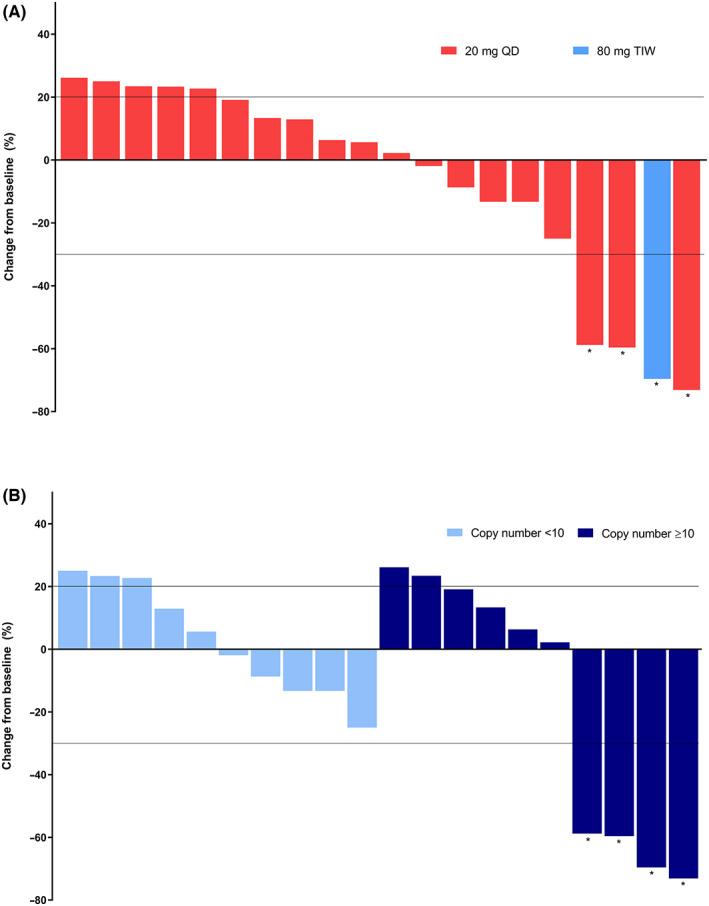
This phase I study was designed to: (1) determine the maximum tolerated dose (MTD) and recommended dose (RD) of the fibroblast growth factor receptor (FGFR) inhibitor futibatinib in Japanese patients with advanced solid tumors, and (2) examine the antitumor activity of the RD in patients with gastric cancer (GC) or other advanced solid tumors who have FGFR or FGF/FGFR abnormalities, respectively. In the dose-escalation phase, patients were assigned to 21-day cycles of oral futibatinib 8-160 mg three times a week (TIW) or 16 or 20 mg once daily (QD). In the expansion phase, patients received oral futibatinib 56, 80, or 120 mg TIW, or 16 or 20 mg QD. Eighty-three patients received futibatinib TIW (n = 40) or QD (n = 43). No dose-limiting toxicities were observed according to the final study protocol definition, and the MTD was not reached. The most common adverse events with both regimens were hyperphosphatemia (TIW, 82.5%; QD, 100.0%) and decreased appetite (TIW, 40.0%; QD, 58.1%). Hyperphosphatemia was asymptomatic, not leading to futibatinib discontinuation. The overall response rate (ORR) was 11.5% in patients with FGF/FGFR abnormalities. Notably, in GC patients harboring FGFR2 copy number (CN) ≥10, the ORR was 36.4% versus 0 in patients with CN <10. Therefore, futibatinib had a generally predictable and manageable safety profile in patients with advanced solid tumors. Antitumor activity was seen in patients with FGF/FGFR abnormalities, particularly those with GC and high FGFR2 CNs. Thus, futibatinib 20 mg QD was chosen as the RD for phase II studies.
这项 I 期研究旨在:(1)确定晚期实体瘤日本患者中成纤维细胞生长因子受体(FGFR)抑制剂futibatinib 的最大耐受剂量(MTD)和推荐剂量(RD),以及(2)分别检查具有 FGFR 或 FGF/FGFR 异常的胃癌(GC)或其他晚期实体瘤患者中 RD 的抗肿瘤活性。在剂量递增阶段,患者被分配到为期 21 天的口服 futibatinib 8-160mg 每周三次(TIW)或 16 或 20mg 每日一次(QD)周期。在扩展阶段,患者接受口服 futibatinib 56、80 或 120mg TIW,或 16 或 20mg QD。83 名患者接受 futibatinib TIW(n=40)或 QD(n=43)。根据最终研究方案的定义,未观察到剂量限制毒性,且未达到 MTD。两种方案最常见的不良反应均为高磷血症(TIW,82.5%;QD,100.0%)和食欲下降(TIW,40.0%;QD,58.1%)。高磷血症为无症状,未导致 futibatinib 停药。具有 FGF/FGFR 异常的患者的总缓解率(ORR)为 11.5%。值得注意的是,在 FGFR2 拷贝数(CN)≥10 的 GC 患者中,ORR 为 36.4%,而 CN<10 的患者则为 0。因此,futibatinib 在晚期实体瘤患者中具有可预测且可控的安全性。在具有 FGF/FGFR 异常的患者中观察到抗肿瘤活性,特别是那些具有高 FGFR2 CN 的 GC 患者。因此,选择 futibatinib 20mg QD 作为 II 期研究的 RD。

 Zotero 插件