
一项系统评价和荟萃分析:成人血液恶性肿瘤患者对 SARS-CoV-2 疫苗首剂和第 2 剂的免疫应答。
A systematic review and meta-analysis of immune response against first and second doses of SARS-CoV-2 vaccines in adult patients with hematological malignancies.
机构信息
Student Research Committee, School of Medicine, Iran University of Medical Sciences, Tehran, Iran; Urology Research Center, Tehran University of Medical Sciences, Tehran, Iran.
Student Research Committee, School of Medicine, Iran University of Medical Sciences, Tehran, Iran.
出版信息
Int Immunopharmacol. 2022 Sep;110:109046. doi: 10.1016/j.intimp.2022.109046. Epub 2022 Jul 12.
BACKGROUND
Cancer patients particularly those with hematological malignancies are at higher risk of affecting by severe coronavirus disease 2019 (COVID-19). Due to the immunocompromised nature of the disease and the immunosuppressive treatments, they are more likely to develop less antibody protection; therefore, we aimed to evaluate the immunogenicity of COVID-19 vaccines in patients with hematological malignancies.
METHODS
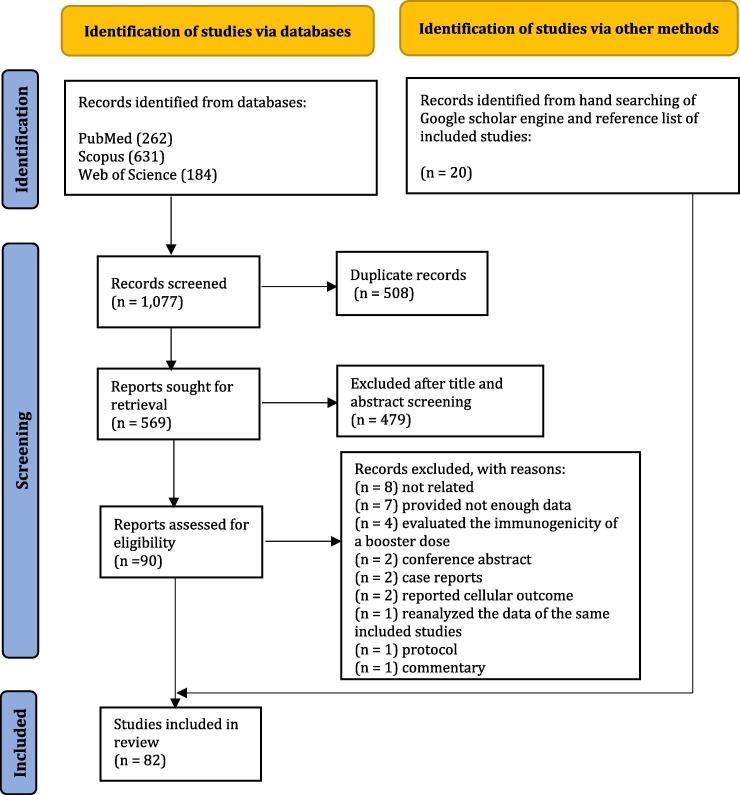
A comprehensive systematic search was conducted in PubMed, Scopus, and Web of Science databases, as well as Google scholar search engine as of December 10, 2021. Our primary outcomes of interest comprised of estimating the antibody seropositive rate following COVID-19 vaccination in patients with hematological malignancies and to compare it with those who were affected by solid tumors or healthy subjects. The secondary outcomes were to assess the vaccine's immunogenicity based on different treatments, status of the disease, and type of vaccine. After the two-step screening, the data were extracted and the summary measures were calculated using a random-effect model.
RESULTS
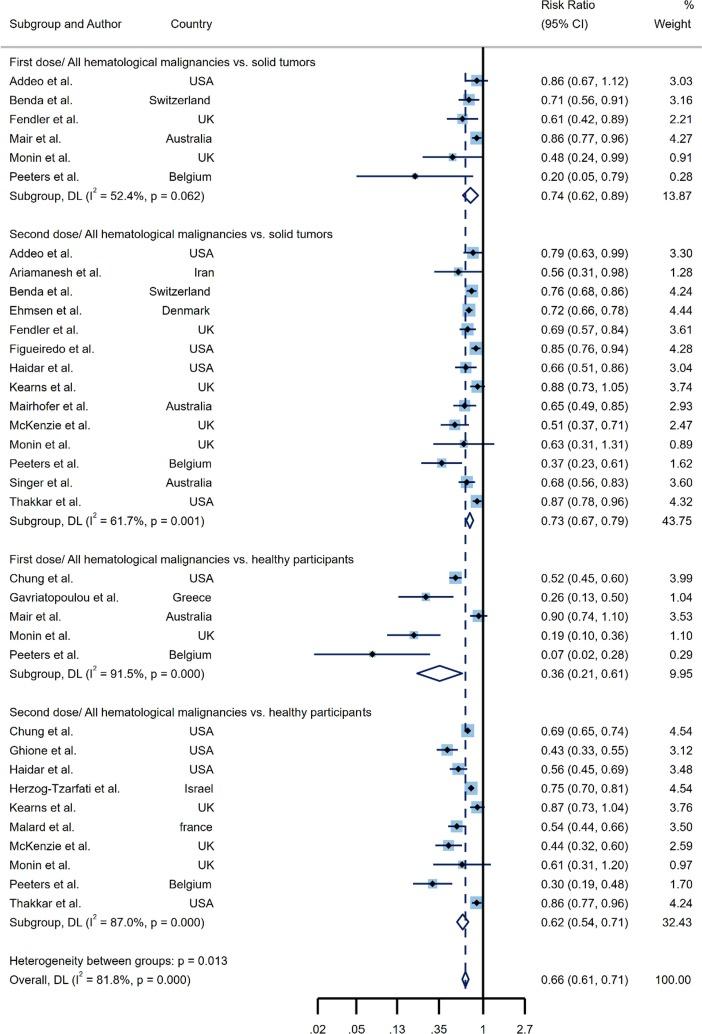
A total of 82 articles recording 13,804 patients with a diagnosis of malignancy were included in the present review. The seropositive rates in patients with hematological malignancies after first and second vaccine doses were 30.0% (95% confidence interval (95%CI): 11.9-52.0) and 62.3% (95%CI 56.0-68.5), respectively. These patients were less likely to develop antibody response as compared to cases with solid tumors (RR 0.73, 95%CI 0.67-0.79) and healthy subjects (RR 0.62, 95%CI 0.54-0.71) following complete immunization. Chronic lymphocytic leukemia (CLL) patients had the lowest response rate among all subtypes of hematological malignancies (first dose: 22.0%, 95%CI 13.5-31.8 and second dose: 47.8%, 95%CI 41.2-54.4). Besides, anti-CD20 therapies (5.7%, 95%CI 2.0-10.6) and bruton's tyrosine kinase inhibitors (26.8%, 95%CI 16.9-37.8) represented the lowest seropositiveness post first and second doses, respectively. Notably, patients who were in active status of disease showed lower antibody detection rate compared to those on remission status (RR 0.87, 95%CI 0.76-0.99). Furthermore, lower rate of seropositivity was found in patients received BNT162.b2 compared to ones who received mRNA-1273 (RR 0.89, 95%CI 0.79-0.99).
CONCLUSION
Our findings highlight the substantially low rate of seroprotection in patients with hematological malignancies with a wide range of rates among disease subgroups and different treatments; further highlighting the fact that booster doses might be acquired for these patients to improve immunity against SARS-CoV-2.
背景
癌症患者,尤其是患有血液恶性肿瘤的患者,感染严重的 2019 年冠状病毒病(COVID-19)的风险更高。由于疾病的免疫功能低下和免疫抑制治疗,他们更有可能产生较少的抗体保护;因此,我们旨在评估 COVID-19 疫苗在血液恶性肿瘤患者中的免疫原性。
方法
我们在 PubMed、Scopus 和 Web of Science 数据库以及 Google Scholar 搜索引擎中进行了全面的系统搜索,截至 2021 年 12 月 10 日。我们主要的研究结果包括估计血液恶性肿瘤患者接种 COVID-19 疫苗后的抗体血清阳性率,并将其与患有实体瘤或健康受试者进行比较。次要结果是根据不同的治疗、疾病状态和疫苗类型评估疫苗的免疫原性。经过两步筛选,提取数据并使用随机效应模型计算汇总措施。
结果
共有 82 篇记录有恶性肿瘤诊断的患者的文章纳入了本综述。血液恶性肿瘤患者接种第一剂和第二剂疫苗后的血清阳性率分别为 30.0%(95%置信区间(95%CI):11.9-52.0)和 62.3%(95%CI 56.0-68.5)。与实体瘤(RR 0.73,95%CI 0.67-0.79)和健康受试者(RR 0.62,95%CI 0.54-0.71)相比,这些患者在完全免疫接种后产生抗体反应的可能性较小。在所有血液恶性肿瘤亚型中,慢性淋巴细胞白血病(CLL)患者的反应率最低(第一剂:22.0%,95%CI 13.5-31.8;第二剂:47.8%,95%CI 41.2-54.4)。此外,抗 CD20 治疗(5.7%,95%CI 2.0-10.6)和布鲁顿酪氨酸激酶抑制剂(26.8%,95%CI 16.9-37.8)在第一剂和第二剂后分别代表最低的血清阳性率。值得注意的是,处于疾病活动状态的患者与处于缓解状态的患者相比,抗体检测率较低(RR 0.87,95%CI 0.76-0.99)。此外,与接受 mRNA-1273 的患者相比,接受 BNT162.b2 的患者的血清阳性率较低(RR 0.89,95%CI 0.79-0.99)。
结论
我们的研究结果强调了血液恶性肿瘤患者的血清保护率普遍较低,疾病亚组和不同治疗之间的血清保护率差异很大;进一步强调了这些患者可能需要接种加强针以提高对 SARS-CoV-2 的免疫力。

 Zotero 插件