
人群水平的饮酒量、地理位置、年龄、性别和年份风险:2020 年全球疾病负担研究的系统分析。
Population-level risks of alcohol consumption by amount, geography, age, sex, and year: a systematic analysis for the Global Burden of Disease Study 2020.
出版信息
Lancet. 2022 Jul 16;400(10347):185-235. doi: 10.1016/S0140-6736(22)00847-9.
BACKGROUND
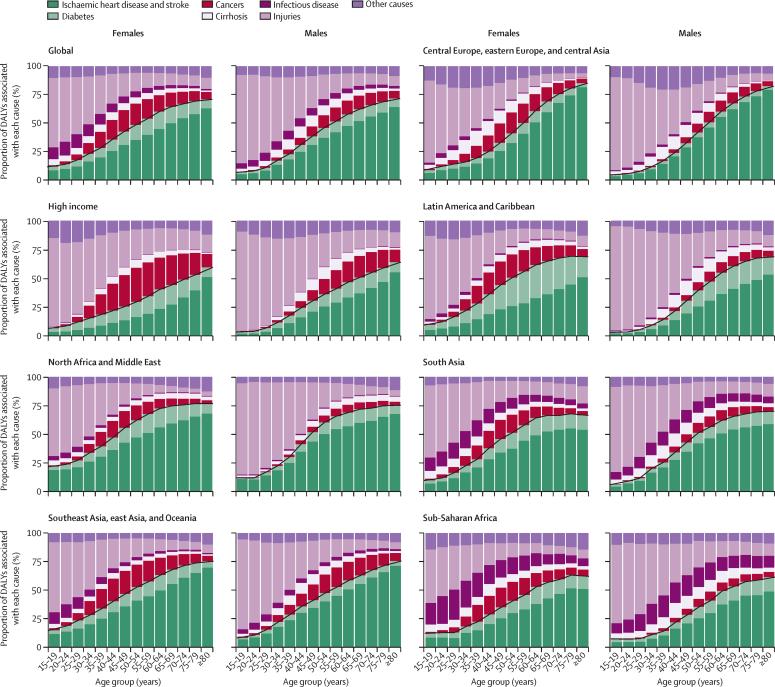
The health risks associated with moderate alcohol consumption continue to be debated. Small amounts of alcohol might lower the risk of some health outcomes but increase the risk of others, suggesting that the overall risk depends, in part, on background disease rates, which vary by region, age, sex, and year.
METHODS
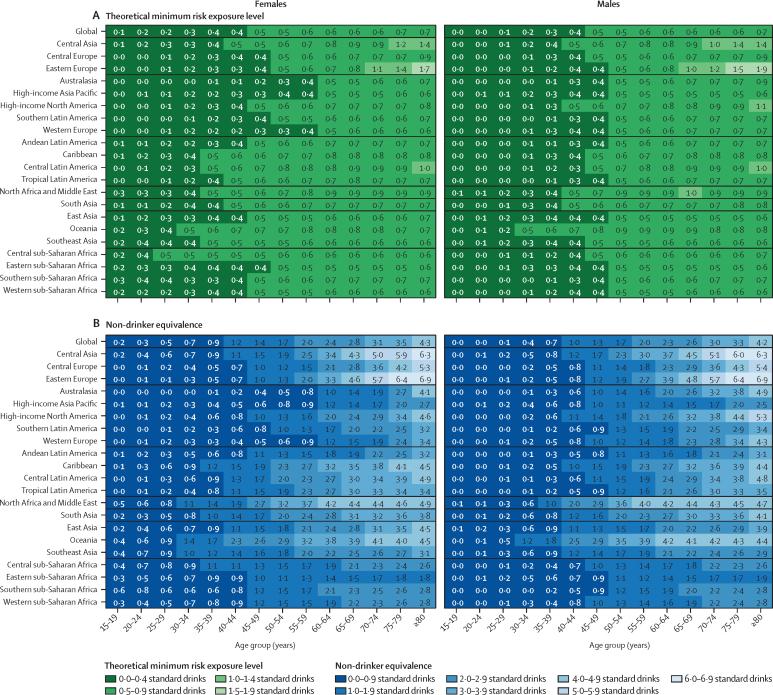
For this analysis, we constructed burden-weighted dose-response relative risk curves across 22 health outcomes to estimate the theoretical minimum risk exposure level (TMREL) and non-drinker equivalence (NDE), the consumption level at which the health risk is equivalent to that of a non-drinker, using disease rates from the Global Burden of Diseases, Injuries, and Risk Factors Study (GBD) 2020 for 21 regions, including 204 countries and territories, by 5-year age group, sex, and year for individuals aged 15-95 years and older from 1990 to 2020. Based on the NDE, we quantified the population consuming harmful amounts of alcohol.
FINDINGS
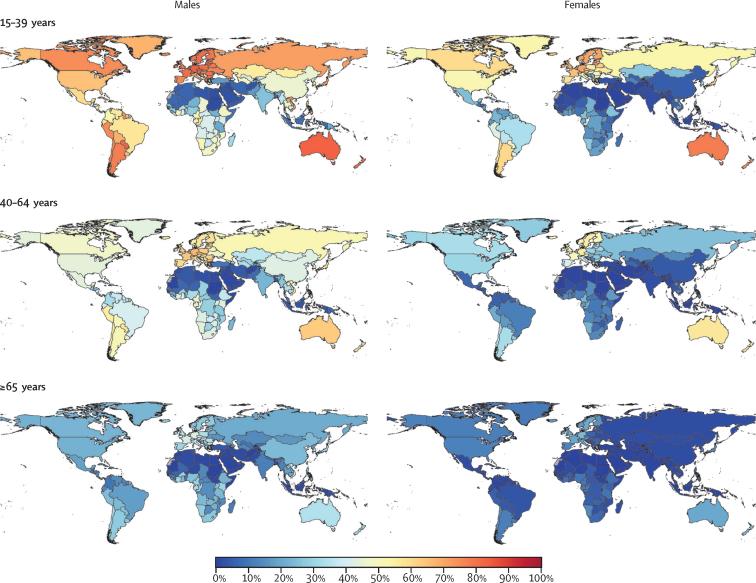
The burden-weighted relative risk curves for alcohol use varied by region and age. Among individuals aged 15-39 years in 2020, the TMREL varied between 0 (95% uncertainty interval 0-0) and 0·603 (0·400-1·00) standard drinks per day, and the NDE varied between 0·002 (0-0) and 1·75 (0·698-4·30) standard drinks per day. Among individuals aged 40 years and older, the burden-weighted relative risk curve was J-shaped for all regions, with a 2020 TMREL that ranged from 0·114 (0-0·403) to 1·87 (0·500-3·30) standard drinks per day and an NDE that ranged between 0·193 (0-0·900) and 6·94 (3·40-8·30) standard drinks per day. Among individuals consuming harmful amounts of alcohol in 2020, 59·1% (54·3-65·4) were aged 15-39 years and 76·9% (73·0-81·3) were male.
INTERPRETATION
There is strong evidence to support recommendations on alcohol consumption varying by age and location. Stronger interventions, particularly those tailored towards younger individuals, are needed to reduce the substantial global health loss attributable to alcohol.
FUNDING
Bill & Melinda Gates Foundation.
背景
与适度饮酒相关的健康风险仍存在争议。少量饮酒可能会降低某些健康结果的风险,但会增加其他健康结果的风险,这表明总体风险部分取决于背景疾病发病率,而疾病发病率因地区、年龄、性别和年份而异。
方法
为了进行这项分析,我们构建了 22 种健康结果的负担加权剂量-反应相对风险曲线,以估计理论最小风险暴露水平 (TMREL) 和非饮酒等效值 (NDE),即健康风险等同于非饮酒者的饮酒水平。我们使用 2020 年全球疾病、伤害和危险因素研究 (GBD) 的疾病发病率,对 21 个地区、204 个国家和地区的 15-95 岁人群进行了分析,按年龄组、性别和年份进行了分析,时间跨度为 1990 年至 2020 年。基于 NDE,我们量化了摄入有害酒精量的人群。
结果
2020 年,15-39 岁人群的酒精使用负担加权相对风险曲线因地区和年龄而异。在 2020 年,15-39 岁人群中,TMREL 范围为 0(95%置信区间 0-0)至 0.603(0.400-1.00)标准饮品/天,NDE 范围为 0.002(0-0)至 1.75(0.698-4.30)标准饮品/天。在 40 岁及以上人群中,所有地区的负担加权相对风险曲线均呈 J 形,2020 年的 TMREL 范围为 0.114(0-0.403)至 1.87(0.500-3.30)标准饮品/天,NDE 范围为 0.193(0-0.900)至 6.94(3.40-8.30)标准饮品/天。在 2020 年摄入有害酒精量的人群中,59.1%(54.3-65.4)为 15-39 岁,76.9%(73.0-81.3)为男性。
结论
有强有力的证据支持针对年龄和地点的饮酒建议。需要采取更强有力的干预措施,特别是针对年轻人的干预措施,以减少全球因酒精导致的大量健康损失。
资助
比尔及梅琳达·盖茨基金会。

 Zotero 插件