
澳大利亚昆士兰州 2005-2017 年重复流感感染的流行病学。
Epidemiology of repeat influenza infection in Queensland, Australia, 2005-2017.
机构信息
WHO Collaborating Centre for Reference and Research on Influenza, Royal Melbourne Hospital, at the Peter Doherty Institute for Infection and Immunity, Melbourne, Victoria, Australia.
Communicable Diseases Branch, Department of Health, Queensland Government, Brisbane, Queensland, Australia.
出版信息
Epidemiol Infect. 2022 Jul 18;150:e144. doi: 10.1017/S0950268822001157.
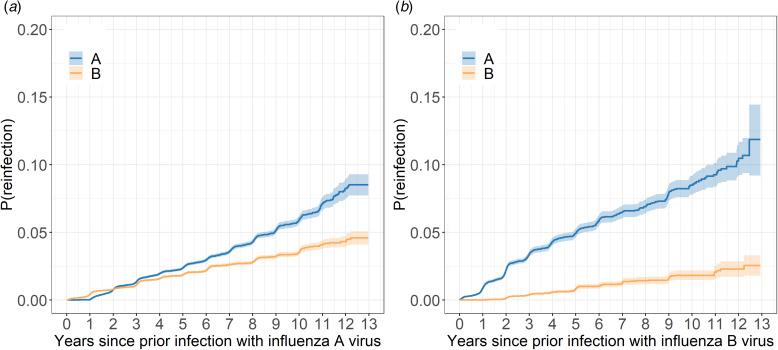
Natural infection with the influenza virus is believed to generate cross-protective immunity across both types and subtypes. However, less is known about the persistence of this immunity and thus the susceptibility of individuals to repeat infection. We used 13 years (2005-2017) of surveillance data from Queensland, Australia, to describe the incidence and distribution of repeat influenza infections. Consecutive infections that occurred within 14 days of prior infection were considered a mixed infection; those that occurred more than 14 days later were considered separate (repeat) infections. Kaplan-Meier plots were used to investigate the probability of reinfection over time and the Prentice, Williams and Peterson extension of the Cox proportional hazards model was used to assess the association of age and gender with reinfection. Among the 188 392 notifications received during 2005-2017, 6165 were consecutively notified for the same individual (3.3% of notifications), and 2958 were mixed infections (1.6%). Overall, the probability of reinfection was low: the cumulative incidence was <1% after one year, 4.6% after five years, and 9.6% after ten years. The majority of consecutive infections were the result of two type A infections (43%) and were most common among females (adjusted hazard ratio (aHR): 1.15, 95% confidence interval (CI) 1.09-1.21), children aged less than 5 years (relative to adults aged 18-64 years aHR: 1.58, 95% CI 1.47-1.70) and older adults aged at least 65 years (aHR: 1.35; 95% CI 1.24-1.47). Our study suggests consecutive infections are possible but rare. These findings have implications for our understanding of population immunity to influenza.
据信,人体自然感染流感病毒可产生针对不同类型和亚型的交叉保护免疫。然而,对于这种免疫的持久性,以及个体再次感染的易感性,人们知之甚少。我们利用澳大利亚昆士兰州 13 年(2005-2017 年)的监测数据,描述了重复流感感染的发病率和分布情况。在先前感染后 14 天内发生的连续感染被认为是混合感染;超过 14 天后发生的感染被认为是单独(重复)感染。Kaplan-Meier 图用于研究随时间推移再次感染的概率,Prentice、Williams 和 Peterson 扩展的 Cox 比例风险模型用于评估年龄和性别与再感染的关联。在 2005-2017 年期间收到的 188392 例报告中,有 6165 例是同一人连续报告的(占报告的 3.3%),有 2958 例是混合感染(占 1.6%)。总体而言,再次感染的概率较低:一年后累积发病率<1%,五年后累积发病率为 4.6%,十年后累积发病率为 9.6%。大多数连续感染是由两种 A 型感染引起的(43%),在女性中最为常见(调整后的危险比(aHR):1.15,95%置信区间(CI)1.09-1.21),5 岁以下儿童(相对于 18-64 岁成年人 aHR:1.58,95%CI 1.47-1.70)和 65 岁以上老年人(aHR:1.35;95%CI 1.24-1.47)。我们的研究表明,连续感染是可能的,但很少见。这些发现对我们理解流感对人群免疫力的影响具有重要意义。


 Zotero 插件