
关于智能家居系统改善心力衰竭患者自我管理行为的推荐功能的共识:一种改良的德尔菲法。
Consensus on Recommended Functions of a Smart Home System to Improve Self-Management Behaviors in People With Heart Failure: A Modified Delphi Approach.
作者信息
Islam Sheikh Mohammed Shariful, Nourse Rebecca, Uddin Riaz, Rawstorn Jonathan C, Maddison Ralph
机构信息
Institute for Physical Activity and Nutrition, Deakin University, Geelong, VIC, Australia.
出版信息
Front Cardiovasc Med. 2022 Jun 29;9:896249. doi: 10.3389/fcvm.2022.896249. eCollection 2022.
BACKGROUND
Smart home systems could enhance clinical and self-management of chronic heart failure by supporting health monitoring and remote support, but evidence to guide the design of smart home system functionalities is lacking.
OBJECTIVE
To identify consensus-based recommendations for functions of a smart home system that could augment clinical and self-management for people living with chronic heart failure in the community.
METHODS
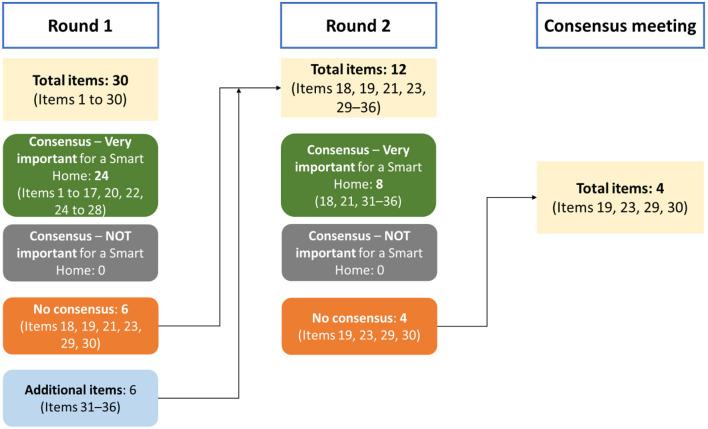
Healthcare professionals caring for people living with chronic heart failure participated in a two-round modified Delphi survey and a consensus workshop. Thirty survey items spanning eight chronic health failure categories were derived from international guidelines for the management of heart failure. In survey Round 1, participants rated the importance of all items using a 9-point Liket scale and suggested new functions to support people with chronic heart failure in their homes using a smart home system. The Likert scale scores ranged from 0 (not important) to 9 (very important) and scores were categorized into three groups: 1-3 = not important, 4-6 = important, and 7-9 = very important. Consensus agreement was defined a priori as ≥70% of respondents rating a score of ≥7 and ≤ 15% rating a score ≤ 3. In survey Round 2, panel members re-rated items where consensus was not reached, and rated the new items proposed in earlier round. Panel members were invited to an online consensus workshop to discuss items that had not reached consensus after Round 2 and agree on a set of recommendations for a smart home system.
RESULTS
In Round 1, 15 experts agreed 24/30 items were "very important", and suggested six new items. In Round 2, experts agreed 2/6 original items and 6/6 new items were "very important". During the consensus workshop, experts endorsed 2/4 remaining items. Finally, the expert panel recommended 34 items as "very important" for a smart home system including, healthy eating, body weight and fluid intake, physical activity and sedentary behavior, heart failure symptoms, tobacco cessation and alcohol reduction, medication adherence, physiological monitoring, interaction with healthcare professionals, and mental health among others.
CONCLUSION
A panel of healthcare professional experts recommended 34-item core functions in smart home systems designed to support people with chronic heart failure for self-management and clinical support. Results of this study will help researchers to co-design and protyping solutions with consumers and healthcare providers to achieve these core functions to improve self-management and clinical outcomes in people with chronic heart failure.
背景
智能家居系统可通过支持健康监测和远程支持来加强慢性心力衰竭的临床管理和自我管理,但缺乏指导智能家居系统功能设计的证据。
目的
确定基于共识的智能家居系统功能建议,以增强社区慢性心力衰竭患者的临床管理和自我管理。
方法
照顾慢性心力衰竭患者的医疗保健专业人员参与了两轮改进的德尔菲调查和一次共识研讨会。从心力衰竭管理的国际指南中得出了涵盖八个慢性健康衰竭类别的30个调查项目。在第一轮调查中,参与者使用9点李克特量表对所有项目的重要性进行评分,并建议使用智能家居系统在家中为慢性心力衰竭患者提供支持的新功能。李克特量表分数范围为0(不重要)至9(非常重要),分数分为三组:1-3 = 不重要,4-6 = 重要,7-9 = 非常重要。事先将共识定义为≥70%的受访者评分为≥7且≤15%的受访者评分为≤3。在第二轮调查中,专家小组对未达成共识的项目重新评分,并对第一轮提出的新项目进行评分。专家小组成员被邀请参加在线共识研讨会,讨论第二轮后仍未达成共识的项目,并就一套智能家居系统的建议达成一致。
结果
在第一轮中,15位专家认为24/30个项目“非常重要”,并提出了6个新项目。在第二轮中,专家们认为2/6个原始项目和6/6个新项目“非常重要”。在共识研讨会上,专家们认可了4个剩余项目中的2个。最后,专家小组推荐了34个项目作为智能家居系统“非常重要”的项目,包括健康饮食、体重和液体摄入量、身体活动和久坐行为、心力衰竭症状、戒烟和减少饮酒、药物依从性、生理监测、与医疗保健专业人员的互动以及心理健康等。
结论
一个医疗保健专业专家小组推荐了智能家居系统中的34项核心功能,旨在支持慢性心力衰竭患者进行自我管理和临床支持。本研究结果将帮助研究人员与消费者和医疗保健提供者共同设计和制作解决方案,以实现这些核心功能,从而改善慢性心力衰竭患者的自我管理和临床结果。
 Zotero 插件