
依伐卡托联合泰比卡托和艾维卡托可改善青少年囊性纤维化患者的运动能力。
Elexacaftor-Tezacaftor-Ivacaftor improves exercise capacity in adolescents with cystic fibrosis.
机构信息
School of Sport, Health and Exercise Science, Faculty of Science and Health, University of Portsmouth, Portsmouth, UK.
Cystic Fibrosis Unit, University Hospital Southampton NHS Foundation Trust, Southampton, UK.
出版信息
Pediatr Pulmonol. 2022 Nov;57(11):2652-2658. doi: 10.1002/ppul.26078. Epub 2022 Jul 22.
OBJECTIVE
Elexacaftor/Tezacaftor/Ivacaftor is a cystic fibrosis transmembrane conductance regulator (CFTR) modulator with the potential to improve exercise capacity. This case series of three adolescents with CF aimed to investigate whether 6 weeks treatment with Elexacaftor/Tezacaftor/Ivacaftor could improve exercise capacity in CFTR modulator naive adolescents with CF.
METHODS
Three adolescents (14.0 ± 1.4 years) with CF (FEV % predicted: 62.5 ± 17.1; F508del/F508del genotype) completed an exhaustive maximal cardiopulmonary exercise test on a cycle ergometer to determine peak oxygen uptake ( O ) and measure changes in gas exchange and ventilation during exercise at 6 weeks. We also analyzed wrist-worn device-based physical activity (PA) data in two of the three cases. Validated acceleration thresholds were used to quantify time spent in each PA intensity category.
RESULTS
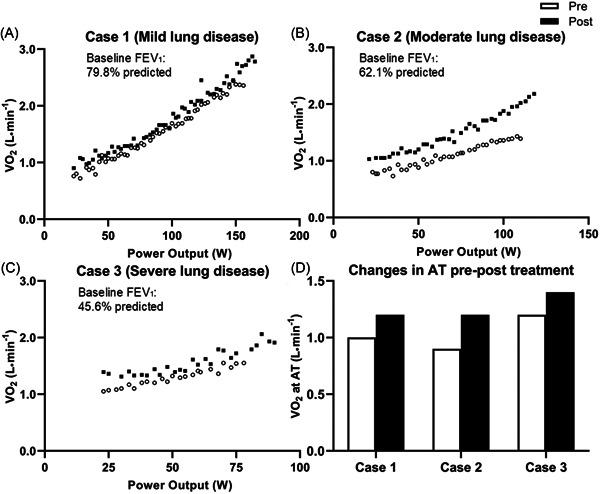
Clinically meaningful improvements in O were observed in all three cases (+17.6%, +52.4%, and +32.9%, respectively), with improvements greatest in those with more severe lung disease and lower fitness at baseline. Although lung function increased in all cases, inconsistent changes in markers of ventilatory and peripheral muscle efficiency likely suggest different mechanisms of improvement in this case group of adolescents with CF. Device-based analysis of PA was variable, with one case increasing and one case decreasing.
CONCLUSION
In this case series, we have observed, for the first time, improvements in exercise capacity following 6 weeks of treatment with Elexacaftor/Tezacaftor/Ivacaftor. Improvements were greatest in the presence of more severe CF lung disease and lower aerobic fitness at baseline. The mechanism(s) responsible for these changes warrant further investigation in larger trials.
目的
依伐卡托与泰比卡托和艾氟康唑联合应用是一种囊性纤维化跨膜电导调节因子(CFTR)调节剂,有可能改善运动能力。本研究通过对 3 例 CF 青少年患者的病例系列研究,旨在探讨 CFTR 调节剂初治 CF 青少年患者在应用依伐卡托与泰比卡托和艾氟康唑治疗 6 周后,其运动能力是否会得到改善。
方法
3 例 CF 青少年(年龄 14.0±1.4 岁;FEV %预测值:62.5±17.1;F508del/F508del 基因型)在功率自行车上进行了全面的最大心肺运动测试,以确定峰值摄氧量( O ),并在 6 周时测量运动期间气体交换和通气的变化。我们还分析了其中 2 例青少年的基于手腕佩戴设备的体力活动(PA)数据。使用验证过的加速度阈值来量化每个 PA 强度类别的时间。
结果
所有 3 例患者的 O 均有临床意义的改善(分别增加了 17.6%、52.4%和 32.9%),其中肺疾病更严重和基线时运动能力更低的患者改善更为明显。尽管所有病例的肺功能均有所增加,但通气和外周肌肉效率标志物的变化不一致,这可能提示在该 CF 青少年患者组中存在不同的改善机制。基于设备的 PA 分析结果不一,其中 1 例患者增加,1 例患者减少。
结论
在本病例系列研究中,我们首次观察到依伐卡托与泰比卡托和艾氟康唑治疗 6 周后运动能力的改善。在基线时 CF 肺部疾病更严重和有氧运动能力更低的患者中,改善最为明显。这些变化的机制尚需进一步的大型临床试验来证实。
 Zotero 插件