
线粒体外膜转位酶复合物的结构概述。
Structural overview of the translocase of the mitochondrial outer membrane complex.
作者信息
Araiso Yuhei, Endo Toshiya
机构信息
Department of Clinical Laboratory Science, Division of Health Sciences, Graduate School of Medical Science, Kanazawa University, Kanazawa, Ishikawa 920-0942, Japan.
Faculty of Life Sciences, Kyoto Sangyo University, Kyoto 603-8555, Japan.
出版信息
Biophys Physicobiol. 2022 Jun 7;19:e190022. doi: 10.2142/biophysico.bppb-v19.0022. eCollection 2022.
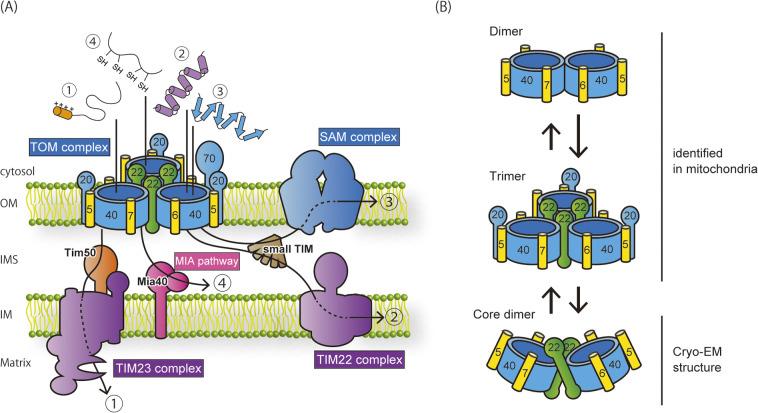
Most mitochondrial proteins are synthesized as precursor proteins (preproteins) in the cytosol and imported into mitochondria. The translocator of the outer membrane (TOM) complex functions as a main entry gate for the import of mitochondrial proteins. The TOM complex is a multi-subunit membrane protein complex composed of a β-barrel channel Tom40 and six single-pass membrane proteins. Recent cryo-EM studies have revealed high-resolution structures of the yeast and human TOM complexes, which enabled us to discuss the mechanism of protein import at an amino-acid residue level. The cryo-EM structures show that two Tom40 β-barrels are surrounded by two sets of small Tom subunits to form a dimeric structure. The intermembrane space (IMS) domains of Tom40, Tom22, and Tom7 form a binding site for presequence-containing preproteins in the middle of the dimer to achieve their efficient transfer of to the downstream translocase, the TIM23 complex. The N-terminal segment of Tom40 spans the channel from the cytosol to the IMS to interact with Tom5 at the periphery of the dimer, where downstream components of presequence-lacking preproteins are recruited. Structure-based biochemical analyses together with crosslinking experiments revealed that each Tom40 channel possesses two distinct paths and exit sites for protein translocation of different sets of mitochondrial preproteins. Here we summarize the current knowledge on the structural features, protein translocation mechanisms, and remaining questions for the TOM complexes, with particular emphasis on their determined cryo-EM structures. This article is an extended version of the Japanese article, Structural basis for protein translocation by the translocase of the outer mitochondrial membrane, published in SEIBUTSU BUTSURI Vol. 60, p. 280-283 (2020).
大多数线粒体蛋白在细胞质中以前体蛋白(前蛋白)的形式合成,然后导入线粒体。外膜转位酶(TOM)复合体作为线粒体蛋白导入的主要入口。TOM复合体是一种多亚基膜蛋白复合体,由一个β-桶状通道Tom40和六个单次跨膜蛋白组成。最近的冷冻电镜研究揭示了酵母和人类TOM复合体的高分辨率结构,这使我们能够在氨基酸残基水平上讨论蛋白质导入的机制。冷冻电镜结构表明,两个Tom40β-桶被两组小Tom亚基包围,形成二聚体结构。Tom40、Tom22和Tom7的膜间隙(IMS)结构域在二聚体中间形成一个与含前导序列的前蛋白结合的位点,以实现它们向下游转位酶TIM23复合体的有效转移。Tom40的N端片段从细胞质跨通道到IMS,与二聚体周边的Tom5相互作用,在那里招募缺乏前导序列的前蛋白的下游组分。基于结构的生化分析以及交联实验表明,每个Tom40通道拥有两条不同的蛋白质转运路径和出口位点,用于不同组线粒体前蛋白的转运。在这里,我们总结了关于TOM复合体的结构特征、蛋白质转运机制和遗留问题的当前知识,特别强调了它们已确定的冷冻电镜结构。本文是发表于《生物物理》第60卷第280 - 283页(2020年)的日文文章《线粒体外膜转位酶蛋白质转运的结构基础》的扩展版本。



 Zotero 插件