
乙型肝炎功能性治愈后复发患者再治疗、结局和复发潜在预测因素的研究。
Study on the Retreatment, Outcome, and Potential Predictors of Recurrence in Patients With Recurrence of Hepatitis B After Functional Cure.
机构信息
First Department of Liver Disease Center, Beijing Youan Hospital, Capital Medical University, Beijing, China.
Third Department of Liver Disease Center, Beijing Youan Hospital, Capital Medical University, Beijing, China.
出版信息
Front Immunol. 2022 Jul 4;13:879835. doi: 10.3389/fimmu.2022.879835. eCollection 2022.
BACKGROUND
Studies about the retreatment and predictors for patients with hepatitis B recurrence after functional cure are rare. This study aimed to evaluate the effect of retreatment, outcome, and potential predictors of recurrence in patients with recurrence after functional cure.
METHODS
A long-term follow-up was conducted with 32 cumulatively obtained patients who relapsed after cessation of pegylated interferon (Peg-IFN)-based antiviral treatment. The decision of whether to treatment or which therapeutic method to use [Peg-IFN or nucleos(t)ide analogs (NAs)] was based on the patient's preferences and wishes. The rate of achieving functional cure and the clinical outcomes of different therapeutic methods were analyzed. Hepatitis B surface antibody (anti-HBs) and hepatitis B core antibody (anti-HBc) levels were detected in patients with blood samples during follow-up to evaluate the predictive ability of recurrence.
RESULTS
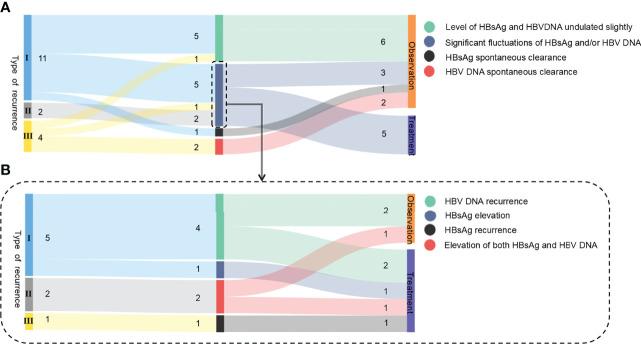
The follow-up time of 32 recurrence cases was 42-532 weeks after recurrence (median 226 weeks). In the 20 patients who received retreatment (15 received Peg-IFN and 5 received NAs only), the rate of functional cure was 65.0% (13/20); it was 86.7% (13/15) in the patients retreated with Peg-IFN. Three cases experienced recurrence again. Five patients received NA treatment, and no functional cure was achieved. No drug intervention was administered for 12 patients, 2 of them with hepatitis B virus (HBV) DNA spontaneous clearance, and one patient achieved spontaneous hepatitis B surface antigen (HBsAg) clearance during follow-up. Patients who relapsed after functional cure with Peg-IFN treatment did not have liver cirrhosis or hepatocellular carcinoma during the follow-up, regardless of whether they received retreatment. Anti-HBs and anti-HBc levels at the end of therapy were predictors of recurrence (p < 0.001, p = 0.023). The value of combining the above two indicators in predicting recurrence was further improved, the areas under the receiver operating characteristic curves were 0.833, at combining predictors >-0.386, the predictive sensitivity and specificity for recurrence were 86.67% and 90.62%.
CONCLUSION
The functional cure rate was above 80% for patients with recurrence treated by Peg-IFN. During the follow-up, liver cirrhosis and hepatocellular carcinoma were not observed in all recurrence cases. High levels of anti-HBs and anti-HBc at the time of drug discontinuation are less likely to relapse.
背景
关于乙型肝炎病毒(HBV)功能性治愈后复发患者的再治疗和预测因素的研究很少。本研究旨在评估复发后功能性治愈患者再治疗的效果、结局和复发的潜在预测因素。
方法
对 32 例因停止聚乙二醇干扰素(Peg-IFN)治疗后复发的患者进行长期随访。是否治疗以及使用何种治疗方法[Peg-IFN 或核苷(酸)类似物(NAs)]的决定基于患者的偏好和意愿。分析不同治疗方法的功能性治愈率和临床结局。在随访期间,通过检测患者的血液样本中的乙型肝炎表面抗体(抗-HBs)和乙型肝炎核心抗体(抗-HBc)水平,评估复发的预测能力。
结果
32 例复发患者的随访时间为复发后 42-532 周(中位数 226 周)。在 20 例接受再治疗的患者中(15 例接受 Peg-IFN 治疗,5 例仅接受 NAs 治疗),功能性治愈率为 65.0%(13/20);接受 Peg-IFN 治疗的患者中,功能性治愈率为 86.7%(13/15)。3 例患者再次复发。5 例患者接受 NAs 治疗,均未达到功能性治愈。12 例患者未接受药物干预,其中 2 例患者 HBV DNA 自发清除,1 例患者在随访过程中自发清除 HBsAg。接受 Peg-IFN 治疗后功能性治愈的患者在随访期间均未发生肝硬化或肝细胞癌,无论是否接受再治疗。治疗结束时的抗-HBs 和抗-HBc 水平是复发的预测因素(p<0.001,p=0.023)。将上述两个指标结合起来预测复发的价值进一步提高,受试者工作特征曲线下面积为 0.833,在结合预测指标>-0.386 时,对复发的预测敏感性和特异性分别为 86.67%和 90.62%。
结论
接受 Peg-IFN 治疗的复发患者的功能性治愈率超过 80%。在随访期间,所有复发患者均未出现肝硬化和肝细胞癌。停药时抗-HBs 和抗-HBc 水平较高的患者复发的可能性较小。


 Zotero 插件