
利用快速浅呼吸指数轨迹识别机械通气时间延长患者的新集群。
Identifying Novel Clusters of Patients With Prolonged Mechanical Ventilation Using Trajectories of Rapid Shallow Breathing Index.
作者信息
Yang Tsung-Ming, Chen Lin, Lin Chieh-Mo, Lin Hui-Ling, Fang Tien-Pei, Ge Huiqing, Cai Huabo, Hong Yucai, Zhang Zhongheng
机构信息
Division of Pulmonary and Critical Care Medicine, Chiayi Chang Gung Memorial Hospital, Chiayi, Taiwan.
School of Traditional Chinese Medicine, Chang Gung University, Taoyuan, Taiwan.
出版信息
Front Med (Lausanne). 2022 Jul 4;9:880896. doi: 10.3389/fmed.2022.880896. eCollection 2022.
OBJECTIVE
Patients with prolonged mechanical ventilation (PMV) are comprised of a heterogeneous population, creating great challenges for clinical management and study design. The study aimed to identify subclusters of PMV patients based on trajectories of rapid shallow breathing index (RSBI), and to develop a machine learning model to predict the cluster membership based on baseline variables.
METHODS
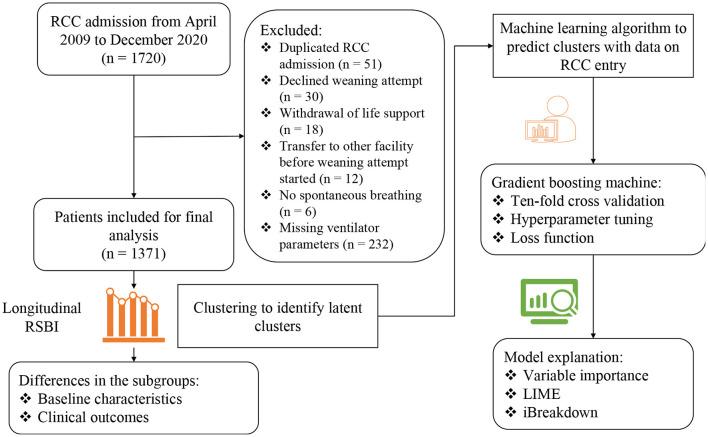
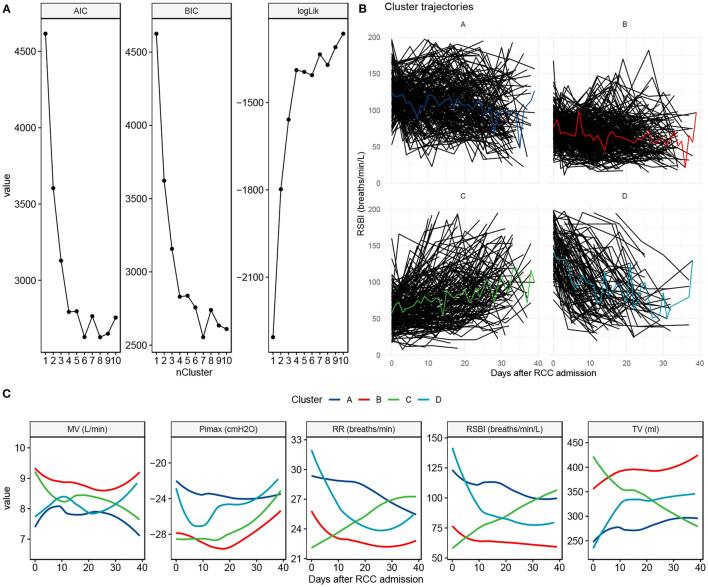
This was a retrospective cohort study conducted in respiratory care center (RCC) at a tertiary academic medical center. The RCC referral criteria were patients with mechanical ventilation for at least 21 days with stable hemodynamic and oxygenation status. Patients admitted to the RCC from April 2009 to December 2020 were screened. Two-step clustering through linear regression modeling and k-means was employed to find clusters of the trajectories of RSBI. The number of clusters was chosen by statistical metrics and domain expertise. A gradient boosting machine (GBM) was trained, exploiting variables on RCC admission, to predict cluster membership.
RESULTS
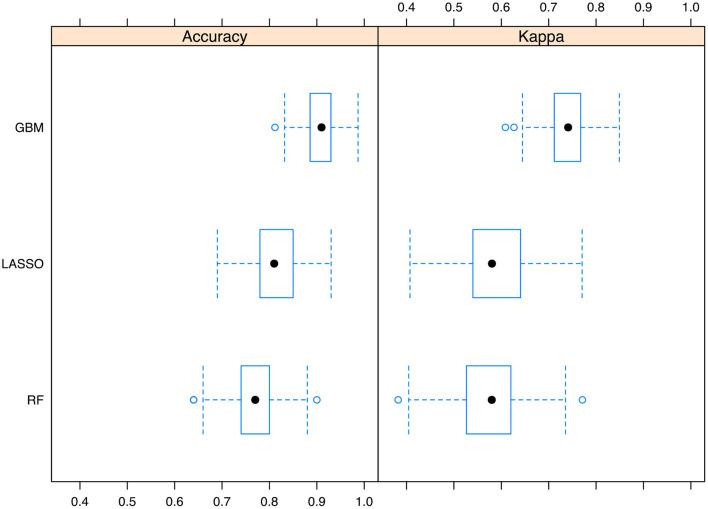
A total of 1371 subjects were included in the study. Four clusters were identified: cluster A showed persistently high RSBI; cluster B was characterized by a constant low RSBI over time; Cluster C was characterized by increasing RSBI; and cluster D showed a declining RSBI. Cluster A showed the highest mortality rate (72%), followed by cluster D (63%), C (62%) and B (61%; p = 0.005 for comparison between 4 clusters). GBM was able to predict cluster membership with an accuracy of > 0.95 in ten-fold cross validation. Highly ranked variables for the prediction of clusters included thyroid-stimulating hormone (TSH), cortisol, platelet, free thyroxine (T4) and serum magnesium.
CONCLUSIONS
Patients with PMV are composed of a heterogeneous population that can be classified into four clusters by using trajectories of RSBI. These clusters can be easily predicted with baseline clinical variables.
目的
长时间机械通气(PMV)患者群体异质性强,给临床管理和研究设计带来巨大挑战。本研究旨在基于快速浅呼吸指数(RSBI)轨迹识别PMV患者的亚组,并开发一种基于基线变量预测亚组成员的机器学习模型。
方法
这是一项在三级学术医疗中心的呼吸护理中心(RCC)进行的回顾性队列研究。RCC的转诊标准是机械通气至少21天且血流动力学和氧合状态稳定的患者。对2009年4月至2020年12月入住RCC的患者进行筛选。采用线性回归建模和k均值的两步聚类法来寻找RSBI轨迹的亚组。通过统计指标和专业领域知识选择亚组数量。利用RCC入院时的变量训练梯度提升机(GBM)以预测亚组成员。
结果
本研究共纳入1371名受试者。识别出四个亚组:A组RSBI持续较高;B组特点是RSBI随时间持续较低;C组特点是RSBI升高;D组RSBI下降。A组死亡率最高(72%),其次是D组(63%)、C组(62%)和B组(61%;四组间比较p = 0.005)。在十折交叉验证中,GBM预测亚组成员的准确率> 0.95。预测亚组的高排名变量包括促甲状腺激素(TSH)、皮质醇、血小板、游离甲状腺素(T4)和血清镁。
结论
PMV患者群体异质性强,可通过RSBI轨迹分为四个亚组。利用基线临床变量可轻松预测这些亚组。

 Zotero 插件