
一氧化氮的化学:机理与反应动力学
The Chemistry of HNO: Mechanisms and Reaction Kinetics.
作者信息
Michalski Radosław, Smulik-Izydorczyk Renata, Pięta Jakub, Rola Monika, Artelska Angelika, Pierzchała Karolina, Zielonka Jacek, Kalyanaraman Balaraman, Sikora Adam Bartłomiej
机构信息
Institute of Applied Radiation Chemistry, Lodz University of Technology, Lodz, Poland.
Department of Biophysics, Medical College of Wisconsin, Milwaukee, WI, United States.
出版信息
Front Chem. 2022 Jul 5;10:930657. doi: 10.3389/fchem.2022.930657. eCollection 2022.
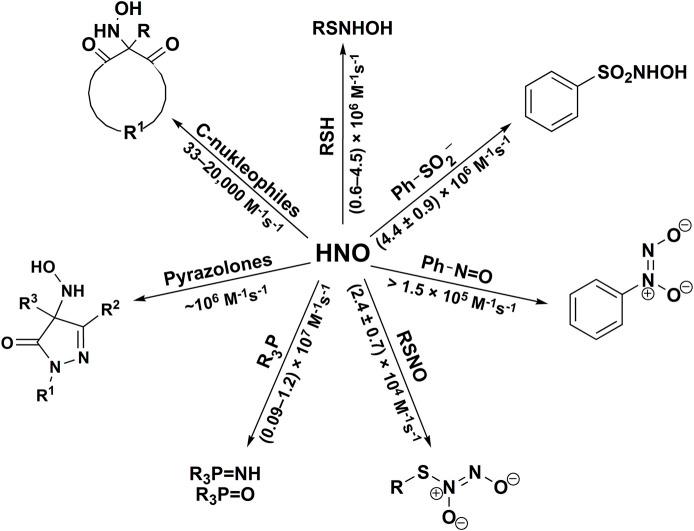
Azanone (HNO, also known as nitroxyl) is the protonated form of the product of one-electron reduction of nitric oxide (NO), and an elusive electrophilic reactive nitrogen species of increasing pharmacological significance. Over the past 20 years, the interest in the biological chemistry of HNO has increased significantly due to the numerous beneficial pharmacological effects of its donors. Increased availability of various HNO donors was accompanied by great progress in the understanding of HNO chemistry and chemical biology. This review is focused on the chemistry of HNO, with emphasis on reaction kinetics and mechanisms in aqueous solutions.
氮杂环丁烷酮(HNO,也称为硝酰)是一氧化氮(NO)单电子还原产物的质子化形式,是一种难以捉摸但具有越来越重要药理学意义的亲电活性氮物种。在过去20年里,由于HNO供体具有众多有益的药理作用,人们对HNO生物化学的兴趣显著增加。各种HNO供体可用性的提高伴随着对HNO化学和化学生物学理解的巨大进步。本综述聚焦于HNO的化学,重点关注其在水溶液中的反应动力学和机制。


 Zotero 插件