
2型糖尿病队列中血清肌肽酶浓度与活性和肾功能损害之间的关联
Association Between Serum Carnosinase Concentration and Activity and Renal Function Impairment in a Type-2 Diabetes Cohort.
作者信息
Qiu Jiedong, Yard Benito A, Krämer Bernhard K, van Goor Harry, van Dijk Peter, Kannt Aimo
机构信息
5th Medical Department, University Hospital Mannheim, Heidelberg University, Mannheim, Germany.
Department of Pathology and Medical Biology, University Medical Centre Groningen and University of Groningen, Groningen, Netherlands.
出版信息
Front Pharmacol. 2022 Jul 8;13:899057. doi: 10.3389/fphar.2022.899057. eCollection 2022.
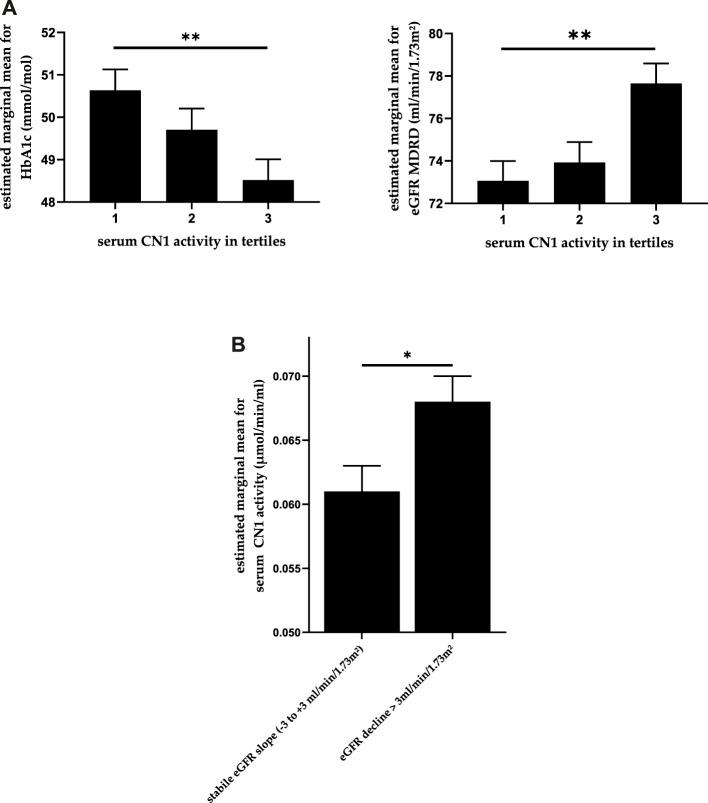
Genetic studies have identified associations of carnosinase 1 (CN1) polymorphisms with diabetic kidney disease (DKD). However, CN1 levels and activities have not been assessed as diagnostic or prognostic markers of DKD in cohorts of patients with type 2 diabetes (T2D). We established high-throughput, automated CN1 activity and concentration assays using robotic systems. Using these methods, we determined baseline serum CN1 levels and activity in a T2D cohort with 970 patients with no or only mild renal impairment. The patients were followed for a mean of 1.2 years. Baseline serum CN1 concentration and activity were assessed as predictors of renal function impairment and incident albuminuria during follow up. CN1 concentration was significantly associated with age, gender and estimated glomerular filtration rate (eGFR) at baseline. CN1 activity was significantly associated with glycated hemoglobin A1c (HbA1c) and eGFR. Serum CN1 at baseline was associated with eGFR decline and predicted renal function impairment and incident albuminuria during the follow-up. Baseline serum CN1 levels were associated with presence and progression of renal function decline in a cohort of T2D patients. Confirmation in larger cohorts with longer follow-up observation periods will be required to fully establish CN1 as a biomarker of DKD.
基因研究已确定肌肽酶1(CN1)多态性与糖尿病肾病(DKD)之间存在关联。然而,在2型糖尿病(T2D)患者队列中,尚未评估CN1水平和活性作为DKD的诊断或预后标志物。我们使用机器人系统建立了高通量、自动化的CN1活性和浓度测定方法。使用这些方法,我们测定了一个有970例无或仅有轻度肾功能损害患者的T2D队列中的基线血清CN1水平和活性。患者平均随访1.2年。评估基线血清CN1浓度和活性作为随访期间肾功能损害和新发蛋白尿的预测指标。CN1浓度在基线时与年龄、性别和估计肾小球滤过率(eGFR)显著相关。CN1活性与糖化血红蛋白A1c(HbA1c)和eGFR显著相关。基线时的血清CN1与eGFR下降相关,并预测随访期间的肾功能损害和新发蛋白尿。在一组T2D患者中,基线血清CN1水平与肾功能下降的存在和进展相关。需要在更大队列中进行更长随访观察期的验证,以充分确立CN1作为DKD的生物标志物。

 Zotero 插件