
慢性非癌性疼痛患者长期使用阿片类药物与死亡率:2010年至2019年韩国的十年随访研究。
Long-term opioid use and mortality in patients with chronic non-cancer pain: Ten-year follow-up study in South Korea from 2010 through 2019.
作者信息
Song In-Ae, Choi Hey-Ran, Oh Tak Kyu
机构信息
Department of Anesthesiology and Pain Medicine, Seoul National University Bundang Hospital, Seongnam, Republic of Korea.
Department of Anesthesiology and Pain Medicine, College of Medicine, Seoul National University, Seoul, Republic of Korea.
出版信息
EClinicalMedicine. 2022 Jul 18;51:101558. doi: 10.1016/j.eclinm.2022.101558. eCollection 2022 Sep.
BACKGROUND
We aimed to investigate the prevalence and factors associated with long-term opioid use among patients with chronic non-cancer pain (CNCP).
METHODS
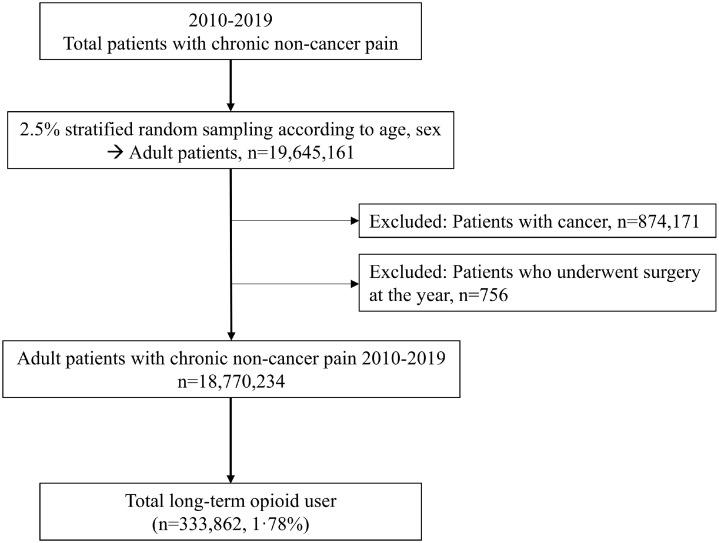
We extracted data from the National Health Insurance Service (NHIS) database in South Korea. As a nationwide database, the NHIS database contains information regarding all disease diagnoses and prescriptions for any drug and/or procedures. A total of 2.5% of adult patients (≥20 years of age) who were diagnosed with musculoskeletal diseases and CNCP from 2010 to 2019 were selected using a stratified random sampling technique and included in the analysis. Patients who were prescribed opioids continuously for ≥90 days were classified as long-term opioid users.
FINDINGS
A total of 19,645,161 patients with CNCP were included in the final analysis. The prevalence of long-term opioid use was 0.47% (95% confidence interval [CI]: 0.46%, 0.48%; 8421/1,808,043) in 2010, which gradually increased to 2.63% (95% CI: 2.61%, 2.66%; 49,846/1,892,913) in 2019. Among the 2010 cohort ( = 1,804,019), in multivariable logistic regression: old age, underlying disability, increased Charlson comorbidity index, use of benzodiazepine or Z-drug, rheumatoid arthritis, osteoarthritis, and low back pain were associated with an increased prevalence of long-term opioid use among patients with CNCP. In a multivariable Cox regression, the 10-year all-cause mortality in long-term opioid users was found to be 1·21-fold (hazard ratio: 1.21, 95% CI: 1.13, 1.31; <0·001) higher than that in opioid-naive patients with CNCP.
INTERPRETATION
Long-term opioid use increased in patients with CNCP in South Korea from 2010 to 2019. Certain factors were potential risk factors for long-term opioid use. Moreover, long-term opioid use was associated with increased 10-year all-cause mortality among patients with CNCP.
FUNDING
None.
背景
我们旨在调查慢性非癌性疼痛(CNCP)患者长期使用阿片类药物的患病率及相关因素。
方法
我们从韩国国民健康保险服务(NHIS)数据库中提取数据。作为一个全国性数据库,NHIS数据库包含所有疾病诊断以及任何药物和/或程序的处方信息。采用分层随机抽样技术,选取了2010年至2019年期间被诊断患有肌肉骨骼疾病和CNCP的成年患者(≥20岁)总数的2.5%纳入分析。连续服用阿片类药物≥90天的患者被归类为长期阿片类药物使用者。
研究结果
最终分析纳入了总共19,645,161例CNCP患者。2010年长期使用阿片类药物的患病率为0.47%(95%置信区间[CI]:0.46%,0.48%;8421/1,808,043),到2019年逐渐增至2.63%(95%CI:2.61%,2.66%;49,846/1,892,913)。在2010年队列(n = 1,804,019)中,多变量逻辑回归分析显示:老年、潜在残疾、查尔森合并症指数增加、使用苯二氮䓬类药物或Z类药物、类风湿关节炎、骨关节炎和腰痛与CNCP患者长期使用阿片类药物的患病率增加相关。在多变量Cox回归分析中,发现长期阿片类药物使用者的10年全因死亡率比未使用阿片类药物的CNCP患者高1.21倍(风险比:1.21,95%CI:1.13,1.31;P<0.001)。
解读
2010年至2019年期间,韩国CNCP患者长期使用阿片类药物的情况有所增加。某些因素是长期使用阿片类药物的潜在风险因素。此外,长期使用阿片类药物与CNCP患者10年全因死亡率增加相关。
资金来源
无。

 Zotero 插件