
探索间充质干细胞在治疗严重冠状病毒病 19 方面的免疫调节作用。
Exploring the Immunomodulatory Aspect of Mesenchymal Stem Cells for Treatment of Severe Coronavirus Disease 19.
机构信息
School of Life Sciences, Jawaharlal Nehru University, New Delhi 110067, India.
Department of Zoology, Shivaji College, University of Delhi, New Delhi 110027, India.
出版信息
Cells. 2022 Jul 12;11(14):2175. doi: 10.3390/cells11142175.
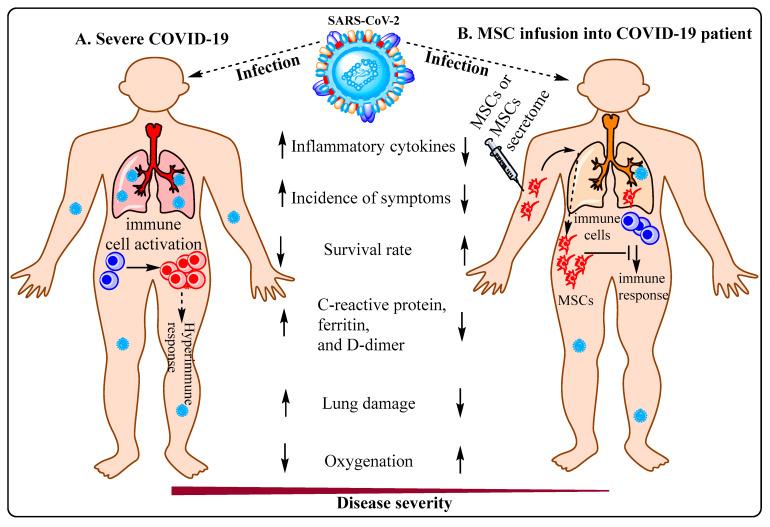
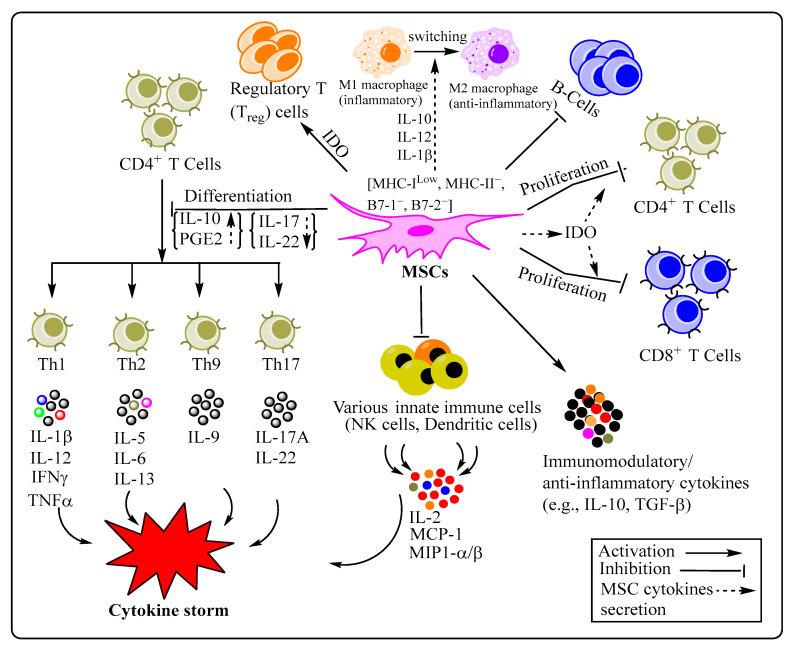
Severe Acute Respiratory Syndrome Coronavirus 2 (SARS-CoV-2) is an enveloped, positive sense, single stranded RNA (+ssRNA) virus, belonging to the genus Betacoronavirus and family Coronaviridae. It is primarily transmitted from infected persons to healthy ones through inhalation of virus-laden respiratory droplets. After an average incubation period of 2-14 days, the majority of infected individuals remain asymptomatic and/or mildly symptomatic, whereas the remaining individuals manifest a myriad of clinical symptoms, including fever, sore throat, dry cough, fatigue, chest pain, and breathlessness. SARS-CoV-2 exploits the angiotensin converting enzyme 2 (ACE-2) receptor for cellular invasion, and lungs are amongst the most adversely affected organs in the body. Thereupon, immune responses are elicited, which may devolve into a cytokine storm characterized by enhanced secretion of multitude of inflammatory cytokines/chemokines and growth factors, such as interleukin (IL)-2, IL-6, IL-7, IL-8, IL-9, tumor necrosis factor alpha (TNF-α), granulocyte colony-stimulating factor (GCSF), basic fibroblast growth factor 2 (bFGF2), monocyte chemotactic protein-1 (MCP1), interferon-inducible protein 10 (IP10), macrophage inflammatory protein 1A (MIP1A), platelet-derived growth factor subunit B (PDGFB), and vascular endothelial factor (VEGF)-A. The systemic persistence of inflammatory molecules causes widespread histological injury, leading to functional deterioration of the infected organ(s). Although multiple treatment modalities with varying effectiveness are being employed, nevertheless, there is no curative COVID-19 therapy available to date. In this regard, one plausible supportive therapeutic modality may involve administration of mesenchymal stem cells (MSCs) and/or MSC-derived bioactive factors-based secretome to critically ill COVID-19 patients with the intention of accomplishing better clinical outcome owing to their empirically established beneficial effects. MSCs are well established adult stem cells (ASCs) with respect to their immunomodulatory, anti-inflammatory, anti-oxidative, anti-apoptotic, pro-angiogenic, and pro-regenerative properties. The immunomodulatory capabilities of MSCs are not constitutive but rather are highly dependent on a holistic niche. Following intravenous infusion, MSCs are known to undergo considerable histological trapping in the lungs and, therefore, become well positioned to directly engage with lung infiltrating immune cells, and thereby mitigate excessive inflammation and reverse/regenerate damaged alveolar epithelial cells and associated tissue post SARS-CoV-2 infection. Considering the myriad of abovementioned biologically beneficial properties and emerging translational insights, MSCs may be used as potential supportive therapy to counteract cytokine storms and reduce disease severity, thereby facilitating speedy recovery and health restoration.
严重急性呼吸系统综合症冠状病毒 2(SARS-CoV-2)是一种包膜、正链、单股 RNA(+ssRNA)病毒,属于β冠状病毒属和冠状病毒科。它主要通过吸入含有病毒的飞沫从受感染的人传播到健康的人。在平均 2-14 天的潜伏期后,大多数受感染的人仍然无症状和/或症状轻微,而其余的人则表现出多种临床症状,包括发热、喉咙痛、干咳、疲劳、胸痛和呼吸困难。SARS-CoV-2 利用血管紧张素转换酶 2(ACE-2)受体进行细胞入侵,而肺部是身体受影响最严重的器官之一。随后,会引发免疫反应,可能会演变成以多种炎症细胞因子/趋化因子和生长因子(如白细胞介素(IL)-2、IL-6、IL-7、IL-8、IL-9、肿瘤坏死因子-α(TNF-α)、粒细胞集落刺激因子(GCSF)、碱性成纤维细胞生长因子 2(bFGF2)、单核细胞趋化蛋白-1(MCP1)、干扰素诱导蛋白 10(IP10)、巨噬细胞炎症蛋白 1A(MIP1A)、血小板衍生生长因子亚基 B(PDGFB)和血管内皮生长因子(VEGF)-A 大量分泌为特征的细胞因子风暴。炎症分子的全身持续存在导致广泛的组织学损伤,导致受感染器官的功能恶化。尽管目前正在使用多种具有不同效果的治疗方法,但迄今为止,尚无有效的 COVID-19 治疗方法。在这方面,一种合理的支持性治疗方法可能涉及向患有严重 COVID-19 的患者施用间充质干细胞(MSCs)和/或 MSC 衍生的生物活性因子分泌组,以实现更好的临床结果,因为它们具有经验证的有益作用。MSCs 是具有免疫调节、抗炎、抗氧化、抗凋亡、促血管生成和促再生特性的成熟的成体干细胞(ASCs)。MSCs 的免疫调节能力不是组成性的,而是高度依赖于整体生态位。静脉输注后,MSCs 已知在肺部经历大量组织学捕获,因此能够很好地与肺部浸润免疫细胞直接接触,从而减轻过度炎症并逆转/再生感染 SARS-CoV-2 后的受损肺泡上皮细胞和相关组织。考虑到上述众多有益的生物学特性和新兴的转化研究结果,MSCs 可用作潜在的支持性治疗方法,以对抗细胞因子风暴并降低疾病严重程度,从而促进快速康复和健康恢复。
 Zotero 插件