
扰动诱发的保护性手臂反应:年龄、扰动强度的影响及其与步态稳定性的关系:一项初步研究
Perturbation-Induced Protective Arm Responses: Effect of Age, Perturbation-Intensity, and Relationship with Stepping Stability: A Pilot Study.
作者信息
Jeon Woohyoung, Wang Shuaijie, Bhatt Tanvi, Westlake Kelly P
机构信息
Department of Physical Therapy and Rehabilitation Science, University of Maryland School of Medicine, Baltimore, MD 21201, USA.
Department of Physical Therapy, University of Illinois at Chicago, Chicago, IL 60612, USA.
出版信息
Brain Sci. 2022 Jul 20;12(7):953. doi: 10.3390/brainsci12070953.
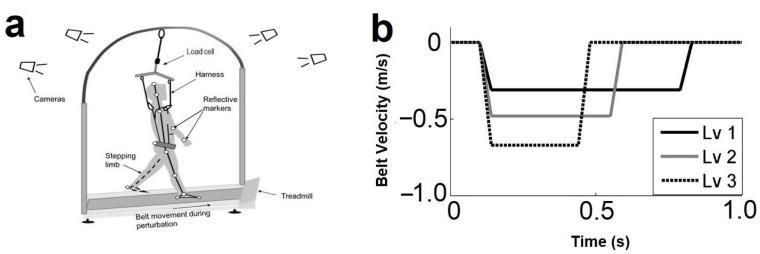
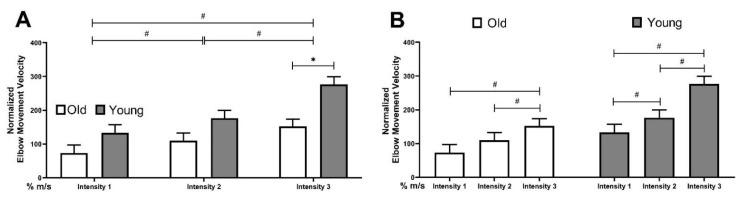
During balance recovery from slip perturbations, forward flexion (elevation) of the arms serves to counterbalance the posteriorly displaced center of mass (CoM). We aimed to investigate whether aging affects modulation of arm responses to various intensities of unpredictable slip perturbations and whether arm responses are related to compensatory stepping stability. Ten healthy young adults and ten healthy older adults participated. Participants were asked to react naturally to three randomly administered levels of slip-like surface perturbations (intensity 1 (7.75 m/s), intensity 2 (12.00 m/s) and intensity 3 (16.75 m/s), which occurred by means of forward acceleration of the treadmill belt while standing. Kinematic data were collected using a motion capture system. Outcomes included arm elevation displacement, velocity, and margin of stability (MoS) of compensatory stepping. The results reveal no modulation of arm elevation velocity in older adults from perturbation intensity 1 to 2, whereas younger adults demonstrated progressive increases from intensity 1 to 2 to 3. At intensity 3, older adults demonstrated reduced maximal arm elevation velocity compared to younger adults ( = 0.02). The results in both groups combined reveal a positive correlation between maximal arm elevation velocity and first compensatory step MoS at intensity 3 ( = 0.01). Together, these findings indicate age-related decreases in arm response modulation and the association of arm elevation response with protective stepping stability, suggesting that fall prevention interventions may benefit from an emphasis on arm elevation velocity control in response to greater perturbation intensities.
在从滑倒扰动中恢复平衡的过程中,手臂向前屈曲(抬起)有助于平衡向后移位的质心(CoM)。我们旨在研究衰老是否会影响手臂对各种强度不可预测滑倒扰动的反应调节,以及手臂反应是否与代偿性步幅稳定性相关。十名健康的年轻成年人和十名健康的老年人参与了研究。参与者被要求对三种随机施加的类似滑倒的表面扰动水平(强度1(7.75米/秒)、强度2(12.00米/秒)和强度3(16.75米/秒))自然做出反应,这些扰动是在站立时通过跑步机皮带向前加速产生的。使用运动捕捉系统收集运动学数据。结果包括手臂抬起位移、速度和代偿性步幅的稳定裕度(MoS)。结果显示,从扰动强度1到2,老年人的手臂抬起速度没有调节,而年轻人从强度1到2再到3则表现出逐渐增加。在强度3时,与年轻人相比,老年人的最大手臂抬起速度降低( = 0.02)。两组的综合结果显示,在强度3时,最大手臂抬起速度与第一个代偿性步幅的MoS之间存在正相关( = 0.01)。总之,这些发现表明与年龄相关的手臂反应调节下降以及手臂抬起反应与保护性步幅稳定性的关联,这表明预防跌倒干预措施可能受益于强调针对更大扰动强度的手臂抬起速度控制。


 Zotero 插件