
自噬在癌症发生、发展及治疗中的分子机制
Molecular Mechanisms of Autophagy in Cancer Development, Progression, and Therapy.
作者信息
Vitto Veronica Angela Maria, Bianchin Silvia, Zolondick Alicia Ann, Pellielo Giulia, Rimessi Alessandro, Chianese Diego, Yang Haining, Carbone Michele, Pinton Paolo, Giorgi Carlotta, Patergnani Simone
机构信息
Laboratory for Technologies of Advanced Therapies (LTTA), Department of Medical Science, University of Ferrara, 44121 Ferrara, Italy.
Thoracic Oncology, University of Hawaii Cancer Center, Honolulu, HI 96816, USA.
出版信息
Biomedicines. 2022 Jul 5;10(7):1596. doi: 10.3390/biomedicines10071596.
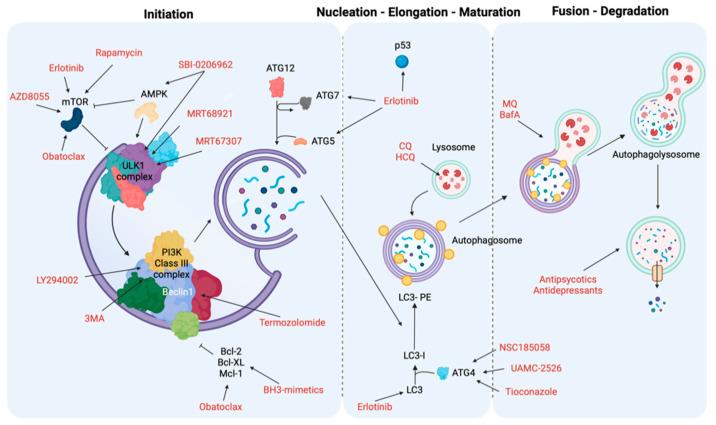
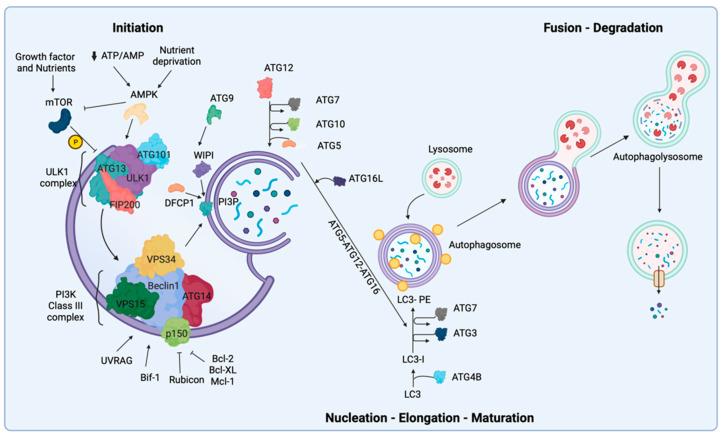
Autophagy is an evolutionarily conserved and tightly regulated process that plays an important role in maintaining cellular homeostasis. It involves regulation of various genes that function to degrade unnecessary or dysfunctional cellular components, and to recycle metabolic substrates. Autophagy is modulated by many factors, such as nutritional status, energy level, hypoxic conditions, endoplasmic reticulum stress, hormonal stimulation and drugs, and these factors can regulate autophagy both upstream and downstream of the pathway. In cancer, autophagy acts as a double-edged sword depending on the tissue type and stage of tumorigenesis. On the one hand, autophagy promotes tumor progression in advanced stages by stimulating tumor growth. On the other hand, autophagy inhibits tumor development in the early stages by enhancing its tumor suppressor activity. Moreover, autophagy drives resistance to anticancer therapy, even though in some tumor types, its activation induces lethal effects on cancer cells. In this review, we summarize the biological mechanisms of autophagy and its dual role in cancer. In addition, we report the current understanding of autophagy in some cancer types with markedly high incidence and/or lethality, and the existing therapeutic strategies targeting autophagy for the treatment of cancer.
自噬是一个进化上保守且受到严格调控的过程,在维持细胞稳态中发挥着重要作用。它涉及对各种基因的调控,这些基因的功能是降解不必要或功能失调的细胞成分,并回收代谢底物。自噬受多种因素调节,如营养状况、能量水平、缺氧条件、内质网应激、激素刺激和药物等,这些因素可在该途径的上游和下游调节自噬。在癌症中,根据肿瘤发生的组织类型和阶段,自噬起着双刃剑的作用。一方面,自噬在晚期通过刺激肿瘤生长促进肿瘤进展。另一方面,自噬在早期通过增强其肿瘤抑制活性抑制肿瘤发展。此外,自噬会导致对抗癌治疗产生耐药性,尽管在某些肿瘤类型中,其激活会对癌细胞产生致死效应。在本综述中,我们总结了自噬的生物学机制及其在癌症中的双重作用。此外,我们报告了目前对一些发病率和/或致死率明显较高的癌症类型中自噬的认识,以及现有的针对自噬治疗癌症的策略。
 Zotero 插件