
使用高分辨率超声评估面瘫后联动——面部外科医生的仪器设置及技术要点
Using High-Resolution Ultrasound to Assess Post-Facial Paralysis Synkinesis-Machine Settings and Technical Aspects for Facial Surgeons.
作者信息
Kehrer Andreas, Ruewe Marc, Platz Batista da Silva Natascha, Lonic Daniel, Heidekrueger Paul Immanuel, Knoedler Samuel, Jung Ernst Michael, Prantl Lukas, Knoedler Leonard
机构信息
Department of Plastic, Hand and Reconstructive Surgery, University Hospital Regensburg, 93053 Regensburg, Germany.
Department of Radiology, University Hospital Regensburg, 93053 Regensburg, Germany.
出版信息
Diagnostics (Basel). 2022 Jul 7;12(7):1650. doi: 10.3390/diagnostics12071650.
BACKGROUND
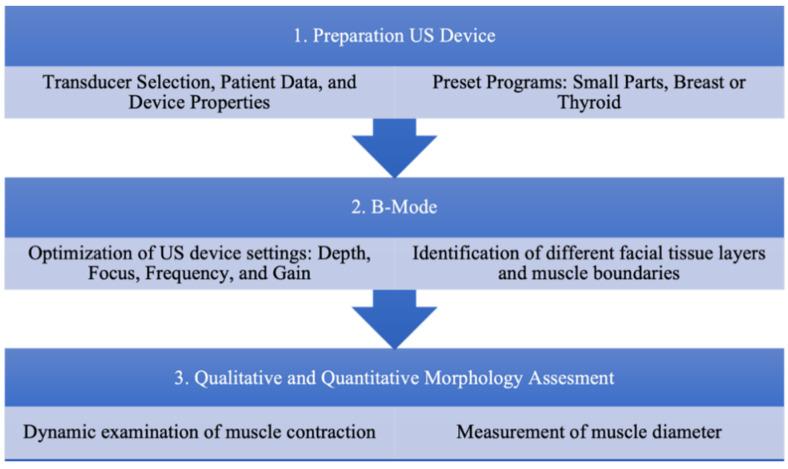
Synkinesis of the facial musculature is a detrimental sequalae in post-paralytic facial palsy (PPFP) patients. Detailed knowledge on the technical requirements and device properties in a high-resolution ultrasound (HRUS) examination is mandatory for a reliable facial muscle assessment in PPFP patients. We therefore aimed to outline the key steps in a HRUS examination and extract an optimized workflow schema.
METHODS
From December 2020 to April 2021, 20 patients with unilateral synkinesis underwent HRUS. All HRUS examinations were performed by the first author using US devices with linear multifrequency transducers of 4-18 MHz, including a LOGIQ E9 and a LOGIQ S7 XDclear (GE Healthcare; Milwaukee, WI, USA), as well as Philips Affinity 50G (Philips Health Systems; Eindhoven, the Netherlands).
RESULTS
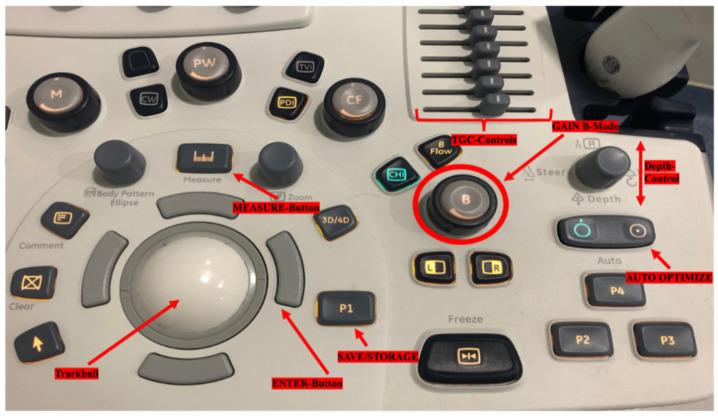
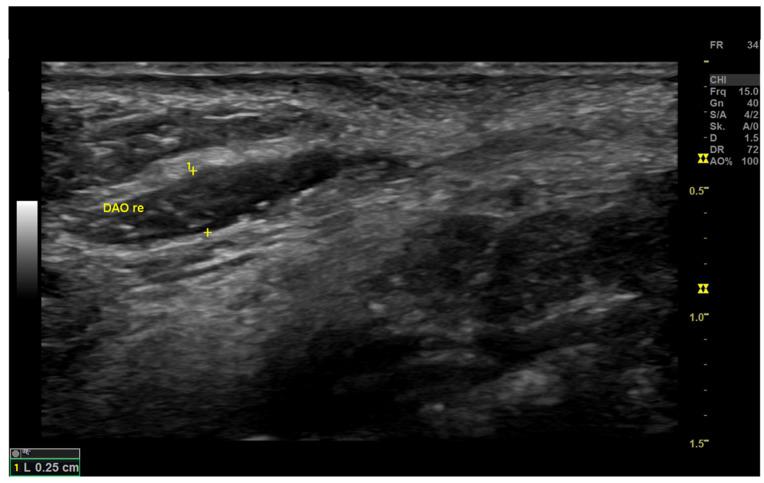
Higher-frequency and multifrequency linear probes ≥15 MHz provided superior imaging qualities. The selection of the preset program Small Parts, Breast or Thyroid was linked with a more detailed contrast of the imaging morphology of facial tissue layers. Frequency (Frq) = 15 MHz, Gain (Gn) = 25-35 db, Depth (D) = 1-1.5 cm, and Focus (F) = 0.5 cm enhanced the image quality and assessability.
CONCLUSIONS
An optimized HRUS examination protocol for quantitative and qualitative facial muscle assessments was proposed.
背景
面部肌肉联动是面瘫后患者(PPFP)的一种有害后遗症。对于PPFP患者进行可靠的面部肌肉评估,详细了解高分辨率超声(HRUS)检查的技术要求和设备特性是必不可少的。因此,我们旨在概述HRUS检查的关键步骤,并提取优化的工作流程方案。
方法
2020年12月至2021年4月,对20例单侧面部肌肉联动患者进行了HRUS检查。所有HRUS检查均由第一作者使用配备4-18MHz线性多频探头的超声设备进行,包括LOGIQ E9和LOGIQ S7 XDclear(通用电气医疗集团;美国威斯康星州密尔沃基),以及飞利浦Affinity 50G(飞利浦医疗系统;荷兰埃因霍温)。
结果
频率≥15MHz的高频和多频线性探头提供了更好的成像质量。选择预设程序“小部件”“乳腺”或“甲状腺”与面部组织层成像形态的更详细对比相关。频率(Frq)=15MHz、增益(Gn)=25-35dB、深度(D)=1-1.5cm和焦点(F)=0.5cm可提高图像质量和可评估性。
结论
提出了一种用于面部肌肉定量和定性评估的优化HRUS检查方案。
 Zotero 插件