
一项旨在了解老年人在养成服药习惯过程中所面临问题的参与式传感研究。
A Participatory Sensing Study to Understand the Problems Older Adults Faced in Developing Medication-Taking Habits.
作者信息
Valenzuela-Beltrán Maribel, Andrade Ángel G, Stawarz Katarzyna, Rodríguez Marcela D
机构信息
Facultad de Ingeniería, Universidad Autónoma de Baja California (UABC), Mexicali 21100, Mexico.
School of Computer Science and Informatics, Cardiff University, Cardiff CF24 4AG, UK.
出版信息
Healthcare (Basel). 2022 Jul 2;10(7):1238. doi: 10.3390/healthcare10071238.
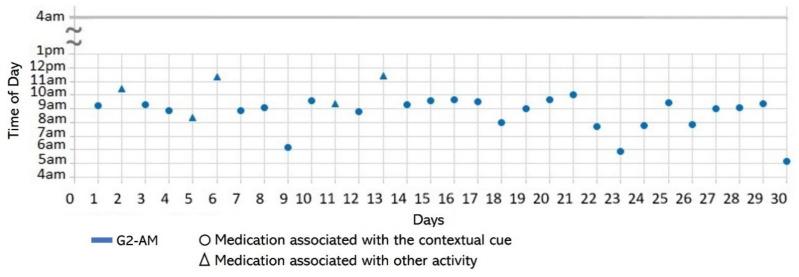
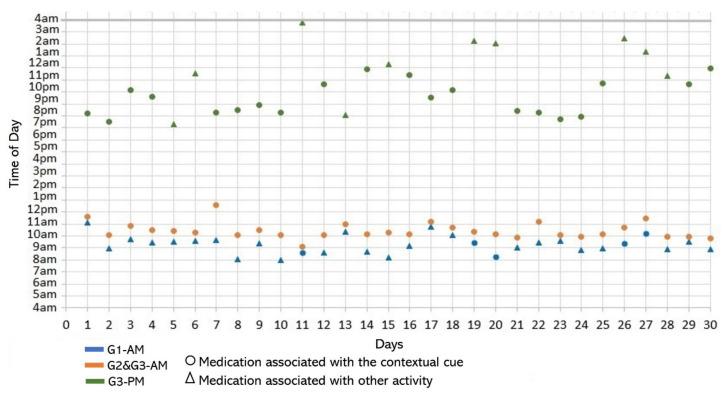
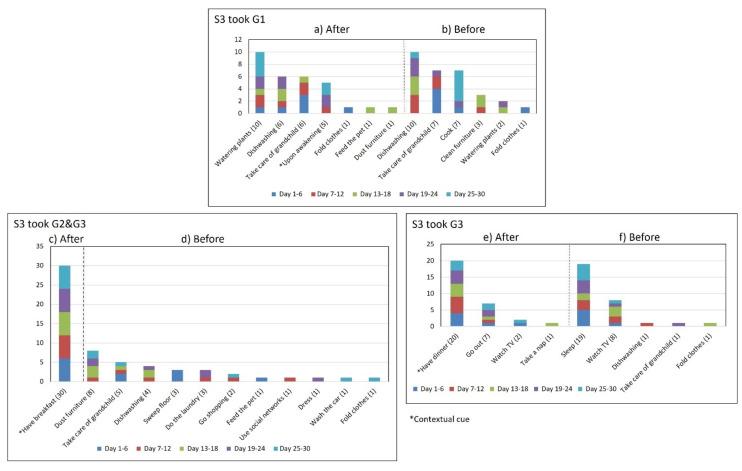
Past research has demonstrated that older adults tend to use daily activities as cues to remember to take medications. However, they may still experience medication non-adherence because they did not select adequate contextual cues or face situations that interfere with their medication routines. This work addresses two research questions: (1) How does the association that older adults establish between their daily routines and their medication taking enable them to perform it consistently? (2) What problems do they face in associating daily routines with medication taking? For 30 days, using a mixed-methods approach, we collected quantitative and qualitative data from four participants aged 70-73 years old about their medication taking. We confirm that older adults who matched their medication regimens to their habitual routines obtained better results on time-based consistency measures. The main constraints for using daily routines as contextual cues were the insertion of medication taking into broad daily routines, the association of multiple daily routines with medication taking, the lack of strict daily routines, and the disruption of daily routines. We argue that the strategies proposed by the literature for forming medication-taking habits should support their formulation by measuring patients' dosage patterns and generating logs of their daily activities.
过去的研究表明,老年人倾向于将日常活动作为提醒自己服药的线索。然而,他们仍可能出现用药依从性差的情况,因为他们没有选择适当的情境线索,或者面临干扰其用药习惯的情况。这项研究解决了两个研究问题:(1)老年人在日常活动和服药之间建立的关联是如何使他们能够持续服药的?(2)他们在将日常活动与服药联系起来时面临哪些问题?我们采用混合方法,对4名70至73岁的参与者进行了30天的用药情况定量和定性数据收集。我们证实,将用药方案与习惯日常活动相匹配的老年人在基于时间的一致性测量方面取得了更好的结果。将日常活动用作情境线索的主要限制因素包括:将服药纳入广泛的日常活动中、多种日常活动与服药相关联、缺乏严格的日常活动以及日常活动的中断。我们认为,文献中提出的形成服药习惯的策略应通过测量患者的用药模式并生成其日常活动记录来支持习惯的形成。



 Zotero 插件