
基于高效多尺度卷积神经网络的 SaMD 多类脑 MRI 分类
An Efficient Multi-Scale Convolutional Neural Network Based Multi-Class Brain MRI Classification for SaMD.
机构信息
Department of Computer Science, Attock Campus, COMSATS University Islamabad, Attock 43600, Pakistan.
Big Data Research Center, Jeju National University, Jeju 63243, Korea.
出版信息
Tomography. 2022 Jul 26;8(4):1905-1927. doi: 10.3390/tomography8040161.
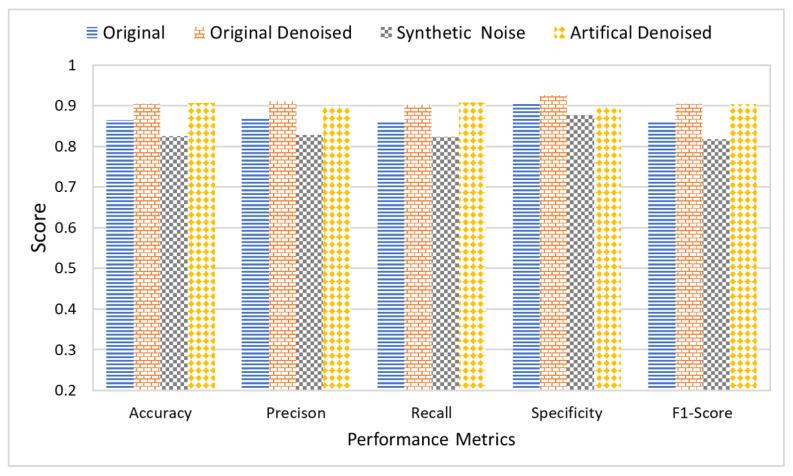
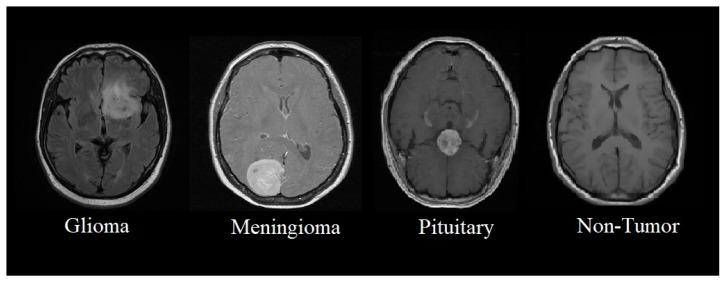
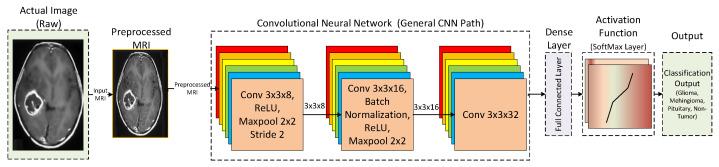
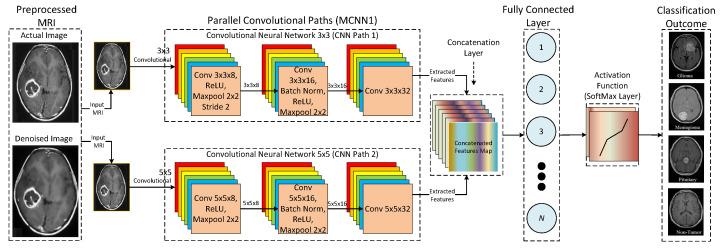
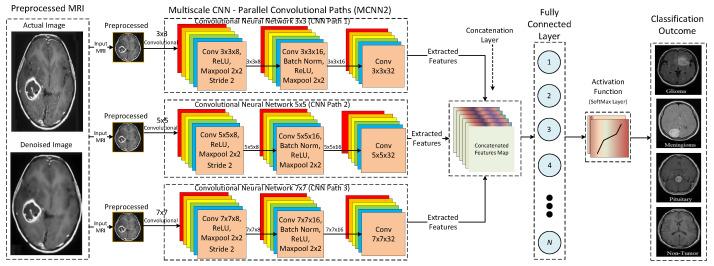
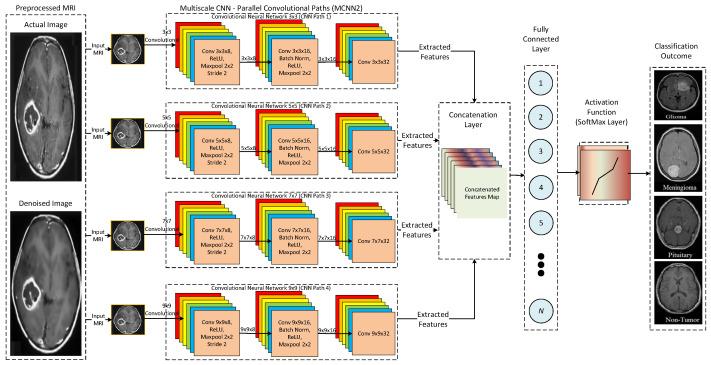
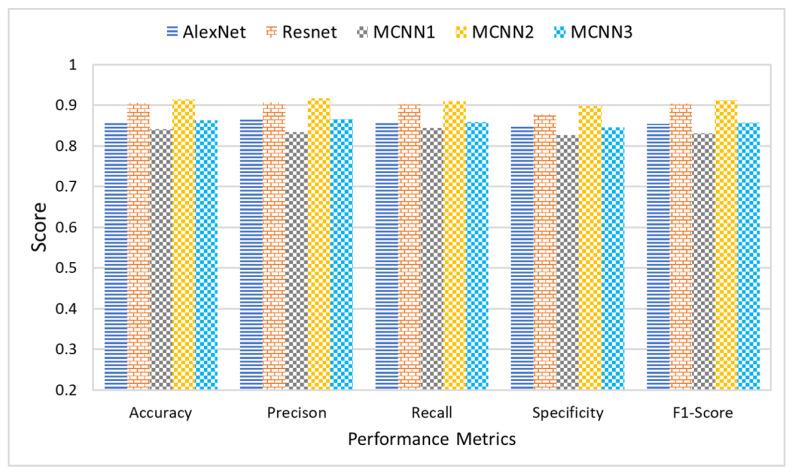
A brain tumor is the growth of abnormal cells in certain brain tissues with a high mortality rate; therefore, it requires high precision in diagnosis, as a minor human judgment can eventually cause severe consequences. Magnetic Resonance Image (MRI) serves as a non-invasive tool to detect the presence of a tumor. However, Rician noise is inevitably instilled during the image acquisition process, which leads to poor observation and interferes with the treatment. Computer-Aided Diagnosis (CAD) systems can perform early diagnosis of the disease, potentially increasing the chances of survival, and lessening the need for an expert to analyze the MRIs. Convolutional Neural Networks (CNN) have proven to be very effective in tumor detection in brain MRIs. There have been multiple studies dedicated to brain tumor classification; however, these techniques lack the evaluation of the impact of the Rician noise on state-of-the-art deep learning techniques and the consideration of the scaling impact on the performance of the deep learning as the size and location of tumors vary from image to image with irregular shape and boundaries. Moreover, transfer learning-based pre-trained models such as AlexNet and ResNet have been used for brain tumor detection. However, these architectures have many trainable parameters and hence have a high computational cost. This study proposes a two-fold solution: (a) Multi-Scale CNN (MSCNN) architecture to develop a robust classification model for brain tumor diagnosis, and (b) minimizing the impact of Rician noise on the performance of the MSCNN. The proposed model is a multi-class classification solution that classifies MRIs into glioma, meningioma, pituitary, and non-tumor. The core objective is to develop a robust model for enhancing the performance of the existing tumor detection systems in terms of accuracy and efficiency. Furthermore, MRIs are denoised using a Fuzzy Similarity-based Non-Local Means (FSNLM) filter to improve the classification results. Different evaluation metrics are employed, such as accuracy, precision, recall, specificity, and F1-score, to evaluate and compare the performance of the proposed multi-scale CNN and other state-of-the-art techniques, such as AlexNet and ResNet. In addition, trainable and non-trainable parameters of the proposed model and the existing techniques are also compared to evaluate the computational efficiency. The experimental results show that the proposed multi-scale CNN model outperforms AlexNet and ResNet in terms of accuracy and efficiency at a lower computational cost. Based on experimental results, it is found that our proposed MCNN2 achieved accuracy and F1-score of 91.2% and 91%, respectively, which is significantly higher than the existing AlexNet and ResNet techniques. Moreover, our findings suggest that the proposed model is more effective and efficient in facilitating clinical research and practice for MRI classification.
脑肿瘤是指某些脑组织中异常细胞的生长,死亡率很高;因此,它需要高度精确的诊断,因为人类的微小判断最终可能会导致严重后果。磁共振成像(MRI)是一种用于检测肿瘤存在的非侵入性工具。然而,在图像采集过程中不可避免地会产生瑞利噪声,这导致观察效果不佳,并干扰了治疗。计算机辅助诊断(CAD)系统可以对疾病进行早期诊断,从而提高生存机会,并减少对专家分析 MRI 的需求。卷积神经网络(CNN)已被证明在脑 MRI 中的肿瘤检测非常有效。已经有多项研究致力于脑肿瘤分类;然而,这些技术缺乏对瑞利噪声对最先进的深度学习技术的影响的评估,也没有考虑到随着肿瘤的大小和位置从图像到图像的变化,以及肿瘤形状和边界的不规则性,对深度学习性能的扩展影响。此外,基于迁移学习的预训练模型,如 AlexNet 和 ResNet,已被用于脑肿瘤检测。然而,这些架构有许多可训练参数,因此计算成本很高。本研究提出了一种双重解决方案:(a)多尺度卷积神经网络(MSCNN)架构,用于开发用于脑肿瘤诊断的稳健分类模型,以及(b)最小化瑞利噪声对 MSCNN 性能的影响。所提出的模型是一种多类分类解决方案,将 MRI 分为胶质瘤、脑膜瘤、垂体瘤和非肿瘤。核心目标是开发一种稳健的模型,以提高现有肿瘤检测系统在准确性和效率方面的性能。此外,使用基于模糊相似性的非局部均值(FSNLM)滤波器对 MRI 进行去噪,以改善分类结果。使用不同的评估指标,如准确性、精度、召回率、特异性和 F1 分数,来评估和比较所提出的多尺度 CNN 与其他最先进技术(如 AlexNet 和 ResNet)的性能。此外,还比较了所提出模型和现有技术的可训练和不可训练参数,以评估计算效率。实验结果表明,所提出的多尺度 CNN 模型在准确性和效率方面优于 AlexNet 和 ResNet,同时计算成本更低。基于实验结果,发现我们提出的 MCNN2 在准确性和 F1 分数方面分别达到了 91.2%和 91%,明显高于现有的 AlexNet 和 ResNet 技术。此外,我们的研究结果表明,所提出的模型在促进 MRI 分类的临床研究和实践方面更加有效和高效。


 Zotero 插件