
中期磁共振成像(MRI)评估显示,嗅觉丧失的新冠肺炎完全康复患者存在微观结构的白质改变。
Mid-term MRI evaluation reveals microstructural white matter alterations in COVID-19 fully recovered subjects with anosmia presentation.
作者信息
Pelizzari Laura, Cazzoli Marta, Lipari Susanna, Laganà Maria Marcella, Cabinio Monia, Isernia Sara, Pirastru Alice, Clerici Mario, Baglio Francesca
机构信息
IRCCS Fondazione Don Carlo Gnocchi ONLUS, Milan, Italy.
IRCCS Fondazione Don Carlo Gnocchi ONLUS, Via Capecelatro 66, 20148, Milano, Italy.
出版信息
Ther Adv Neurol Disord. 2022 Jul 23;15:17562864221111995. doi: 10.1177/17562864221111995. eCollection 2022.
BACKGROUND
Little is still known about the mid/long-term effects of coronavirus disease 2019 (COVID-19) on the brain, especially in subjects who have never been hospitalized due to the infection. In this neuroimaging exploratory study, we analyzed the medium-term effect of COVID-19 on the brain of people who recovered from COVID-19, experienced anosmia during the acute phase of the disease, and have never been hospitalized due to SARS-Co-V-2 infection.
METHODS
Forty-three individuals who had (COV+, = 22) or had not (COV-, = 21) been infected with SARS-Co-V-2 were included in the study; the two groups were age- and sex-matched and were investigated using 3T magnetic resonance imaging (MRI). Gray matter (GM) volume, white matter (WM) hyperintensity volume, WM microstrutural integrity (i.e. fractional anisotropy [FA], mean diffusivity [MD], axial diffusivity [AD], radial diffusivity [RD]) and cerebral blood flow (CBF) differences between the two groups were tested with either analysis of covariance or voxel-wise analyses. Results were family wise error (FWE) corrected.
RESULTS
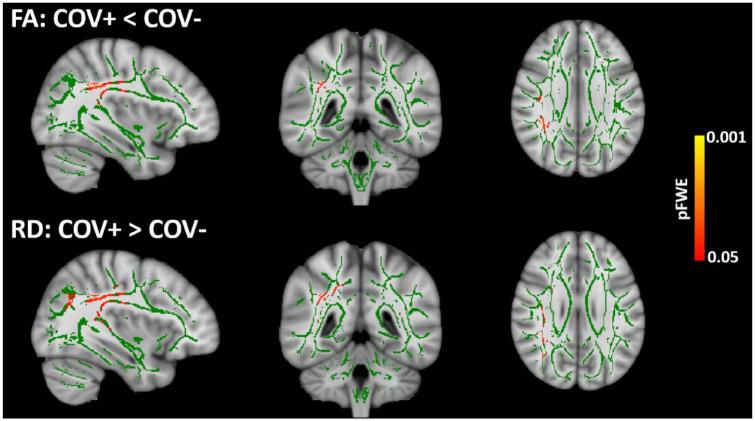
No significant differences between COV+ and COV- groups were observed in terms of GM volume, WM hyperintensity volume, and CBF. Conversely, local WM microstructural alterations were detected in COV+ when compared with COV- with tract-based spatial statistics. Specifically, COV+ showed lower FA (pFWE-peak = 0.035) and higher RD (pFWE-peak = 0.038) than COV- in several WM regions.
CONCLUSION
COVID-19 may produce mid/long-term microstructural effect on the brain, even in case of mild-to-moderate disease not requiring hospitalization. Further investigation and additional follow-ups are warranted to assess if the alterations reported in this study totally recover over time. As brain alterations could increase the risk of cognitive decline, greater knowledge of their trajectories is crucial to aid neurorehabilitation treatments.
背景
关于2019冠状病毒病(COVID-19)对大脑的中长期影响,我们仍知之甚少,尤其是在那些从未因感染而住院的患者中。在这项神经影像学探索性研究中,我们分析了COVID-19对从COVID-19中康复、在疾病急性期出现嗅觉丧失且从未因严重急性呼吸综合征冠状病毒2(SARS-CoV-2)感染而住院的人群大脑的中期影响。
方法
本研究纳入了43名曾感染(COV+,n = 22)或未感染(COV-,n = 21)SARS-CoV-2的个体;两组在年龄和性别上匹配,并使用3T磁共振成像(MRI)进行检查。通过协方差分析或体素分析测试两组之间的灰质(GM)体积、白质(WM)高信号体积、WM微结构完整性(即分数各向异性[FA]、平均扩散率[MD]、轴向扩散率[AD]、径向扩散率[RD])和脑血流量(CBF)差异。结果采用家族性错误率(FWE)校正。
结果
在GM体积、WM高信号体积和CBF方面,COV+组和COV-组之间未观察到显著差异。相反,与COV-组相比,通过基于束的空间统计学方法在COV+组中检测到局部WM微结构改变。具体而言,在几个WM区域中,COV+组的FA低于COV-组(pFWE峰值 = 0.035),RD高于COV-组(pFWE峰值 = 0.038)。
结论
即使是轻度至中度疾病且无需住院治疗的情况下,COVID-19也可能对大脑产生中长期微结构影响。有必要进行进一步的研究和额外的随访,以评估本研究中报告的改变是否会随时间完全恢复。由于大脑改变可能增加认知衰退的风险,深入了解其发展轨迹对于辅助神经康复治疗至关重要。
 Zotero 插件