
术中用大量生理盐水冲洗切口可降低腹部感染的手术部位感染率。
Intraoperative incision irrigation with high-volume saline reduces surgical site infection for abdominal infections.
作者信息
Wang Jin, Lv Wen, Xu Shihai, Yang Chao, Du Bo, Zhong Yuanbo, Shi Fei, Shan Aijun
机构信息
Emergency Department, Shenzhen People's Hospital (The Second Clinical Medical College, Jinan University; The First Affiliated Hospital, Southern University of Science and Technology), Shenzhen, China.
出版信息
Front Surg. 2022 Jul 12;9:927896. doi: 10.3389/fsurg.2022.927896. eCollection 2022.
PURPOSE
Surgical site infection (SSI) remains one of the most common postoperative complications for patients with abdominal infections. This study aimed at investigating the effectiveness of high-volume normal saline (NS) irrigation in preventing postoperative SSI for patients with abdominal infections.
METHODS
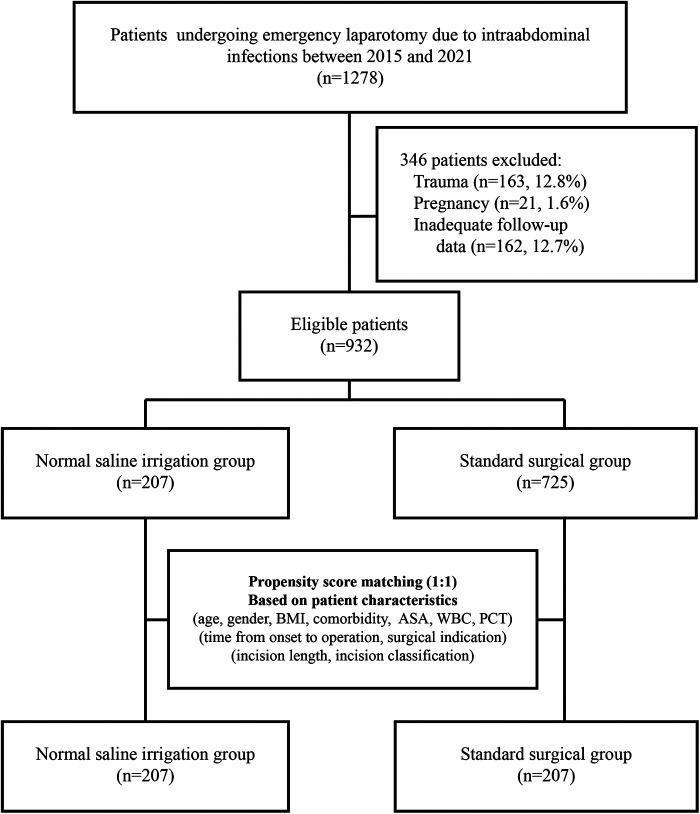
In this retrospective before-after clinical study, patients who underwent emergency laparotomy due to abdominal infections between Jan 2015 and Dec 2021 were included consecutively. A cohort of 207 patients with NS irrigation was compared to historical controls. A propensity score matching (PSM) with a 1:1 ratio was performed to reduce potential bias. The primary outcome was the 30-day SSI rate.
RESULTS
Irrigation (207) and control (207) matched patients were statistically identical on baseline characteristics, perioperative, and intraoperative parameters. Irrigation patients had lower overall SSI rates (10.6% vs. 26.1%, < 0.001), mainly due to reduction in superficial (4.3% vs. 17.9%) and deep (1.4% vs. 3.9%) SSIs, rather than space/organ SSIs (4.8% vs. 4.3%). Irrigation patients also had lower rates of incision seroma (4.8% vs. 11.6%, = 0.012), shorter duration of antibiotics use (5.2 ± 1.7 d vs. 7.2 ± 2.0 d, < 0.001), and unplanned readmission (1.0% vs. 8.7%, < 0.001). Length of hospital stay showed a declining trend with irrigation intervention, while no significant difference was observed. Moreoever, logistic regression revealed that NS irrigationwas an independent protector against SSI ( 0.309; 0.207-0.462; < 0.001).
CONCLUSION
Intraoperative incision irrigation with high-volume NS is associated with a lower rate of SSI for patients with abdominal infections.
目的
手术部位感染(SSI)仍然是腹部感染患者最常见的术后并发症之一。本研究旨在探讨大量生理盐水(NS)冲洗在预防腹部感染患者术后SSI中的有效性。
方法
在这项回顾性前后对照临床研究中,连续纳入了2015年1月至2021年12月因腹部感染接受急诊剖腹手术的患者。将207例接受NS冲洗的患者队列与历史对照组进行比较。采用1:1比例的倾向评分匹配(PSM)以减少潜在偏倚。主要结局是30天SSI发生率。
结果
冲洗组(207例)和对照组(207例)匹配患者在基线特征、围手术期和术中参数方面在统计学上无差异。冲洗组患者的总体SSI发生率较低(10.6%对26.1%,<0.001),主要是由于表浅SSI(4.3%对17.9%)和深部SSI(1.4%对3.9%)减少,而非腔隙/器官SSI(4.8%对4.3%)。冲洗组患者的切口血清肿发生率也较低(4.8%对11.6%,=0.012),抗生素使用时间较短(5.2±1.7天对7.2±2.0天,<0.001),以及非计划再入院率较低(1.0%对8.7%,<0.001)。住院时间随着冲洗干预呈下降趋势,但未观察到显著差异。此外,逻辑回归显示NS冲洗是预防SSI的独立保护因素(=0.309;95%CI:0.207 - 0.462;<0.001)。
结论
术中用大量NS冲洗切口与腹部感染患者较低的SSI发生率相关。

 Zotero 插件