
微波消融与射频消融治疗肝细胞癌的疗效与安全性:系统评价与荟萃分析。
Efficacy and safety of microwave ablation and radiofrequency ablation in the treatment of hepatocellular carcinoma: A systematic review and meta-analysis.
机构信息
The First Clinical Medical College of Lanzhou University, Lanzhou, China.
The Department of Critical Care Medicine of The First Hospital of Lanzhou University, Lanzhou, China.
出版信息
Medicine (Baltimore). 2022 Jul 29;101(30):e29321. doi: 10.1097/MD.0000000000029321.
BACKGROUND
Hepatocellular carcinoma (HCC) is one of the most common malignant tumors. Surgical resection is often only possible in the early stages of HCC and among those with limited cirrhosis. Radiofrequency ablation and Microwave ablation are 2 main types of percutaneous thermal ablation for the treatment of HCC. The efficacy and safety between these 2 therapy methods are still under a debate.
OBJECTIVE
To compare the efficacy and safety of Radiofrequency ablation and Microwave ablation in treating HCC.
METHODS
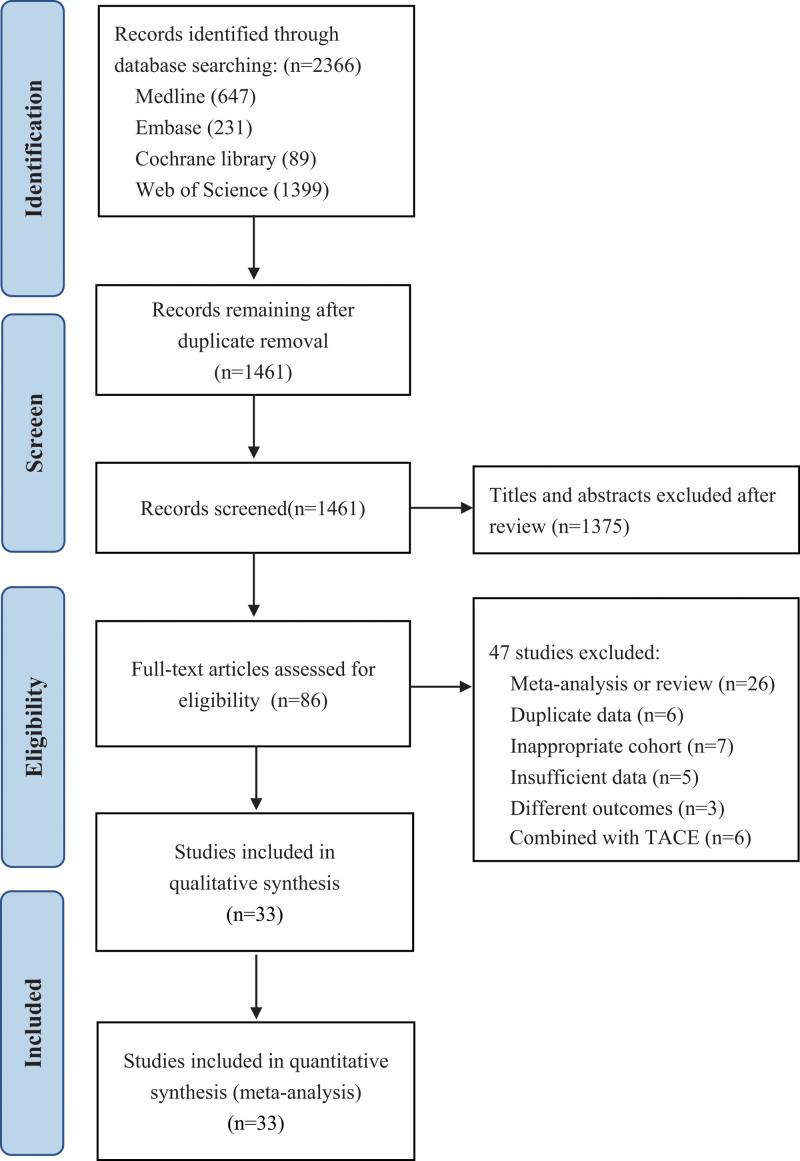
PubMed, EMBASE, the Cochrane databases and Web of Science were systematically searched. We included randomized controlled trials and cohort studies comparing the efficacy and safety of Radiofrequency ablation and Microwave ablation in HCC patients. Outcome measures on local tumor progression, complete ablation, disease-free survival, overall survival, or major complications were compared between the 2 groups. The random effect model was used when there was significant heterogeneity between studies, otherwise the fixed effect model was used.
RESULTS
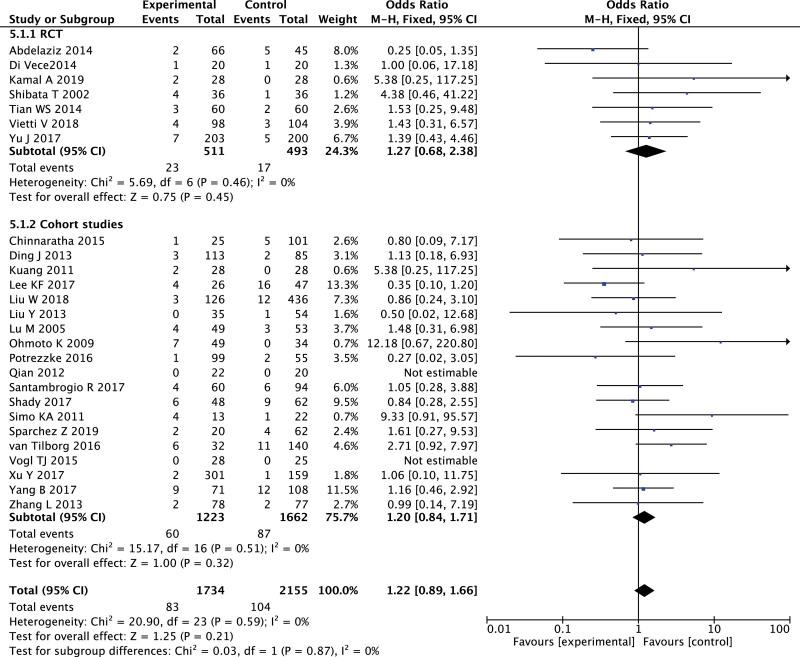
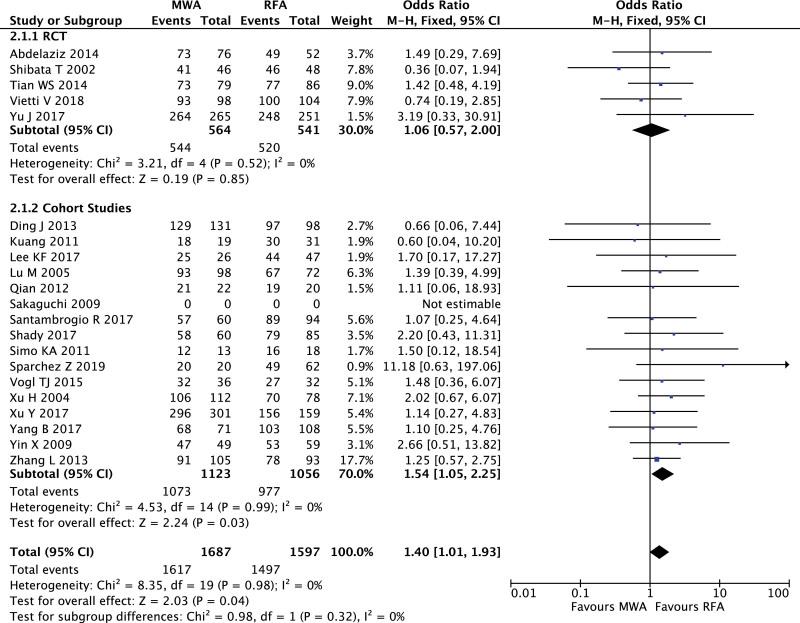
A total of 33 studies, involving a total of 4589 patients were identified, which included studies comprised 7 RCTs, 24 retrospective observational trials, and 2 prospective observational trial. Microwave ablation had a lower local tumor progression than Radiofrequency ablation in cohort studies (OR = 0.78, 95% CI 0.64-0.96, P = .02). Complete ablation rate of Microwave ablation was higher than that of Radiofrequency ablation in cohort studies (OR = 1.54, 95% CI 1.05-2.25, P = .03). There was no significant difference in overall survival and disease-free survival between the 2 groups. Meta-analysis showed that there was no significant difference in the main complications between Microwave ablation and Radiofrequency ablation.
CONCLUSIONS
Microwave ablation has higher complete ablation and lower local tumor progression than Radiofrequency ablation in the ablation treatment of HCC nodules. There was no significant difference in overall survival between the 2 therapy methods.
背景
肝细胞癌(HCC)是最常见的恶性肿瘤之一。手术切除通常仅适用于 HCC 的早期和那些有限的肝硬化患者。射频消融和微波消融是治疗 HCC 的两种主要经皮热消融类型。这两种治疗方法的疗效和安全性仍存在争议。
目的
比较射频消融和微波消融治疗 HCC 的疗效和安全性。
方法
系统检索 PubMed、EMBASE、Cochrane 数据库和 Web of Science。我们纳入了比较射频消融和微波消融治疗 HCC 患者疗效和安全性的随机对照试验和队列研究。比较两组之间局部肿瘤进展、完全消融、无病生存率、总生存率或主要并发症的结局指标。当研究之间存在显著异质性时使用随机效应模型,否则使用固定效应模型。
结果
共纳入 33 项研究,共 4589 例患者,包括 7 项 RCT、24 项回顾性观察性研究和 2 项前瞻性观察性研究。在队列研究中,微波消融的局部肿瘤进展率低于射频消融(OR = 0.78,95%CI 0.64-0.96,P =.02)。在队列研究中,微波消融的完全消融率高于射频消融(OR = 1.54,95%CI 1.05-2.25,P =.03)。两组患者的总生存率和无病生存率无显著差异。Meta 分析显示,微波消融与射频消融的主要并发症发生率无显著差异。
结论
在 HCC 结节消融治疗中,微波消融的完全消融率高于射频消融,局部肿瘤进展率低于射频消融。两种治疗方法的总生存率无显著差异。

 Zotero 插件