
虚拟现实及其在腹腔镜术后疼痛中的应用:一项可行性研究。
Virtual reality and its use in post-operative pain following laparoscopy: a feasibility study.
机构信息
Department of Obstetrics and Gynaecology, Monash University, 246 Clayton Road, Clayton, VIC, 3168, Australia.
Biorithm Pte Ltd, 81 Ayer Rajah Crescent 03-53, Singapore, 139967, Singapore.
出版信息
Sci Rep. 2022 Jul 30;12(1):13137. doi: 10.1038/s41598-022-17183-2.
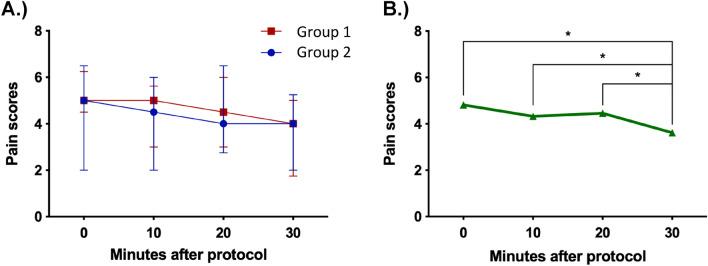
Pain following laparoscopic surgery remains a neglected healthcare issue. Virtual reality-mediated therapy's (VRT) analgesic potential could address this. However, its effect in this setting remains unexplored. We aimed to establish the feasibility and safety of VRT as an adjunct analgesic following gynaecological laparoscopy and explore differences between active distraction and passive meditation content. 35 women were enrolled into an open crossover pilot and randomised to either intervention group 1 (active then passive content) or intervention group 2 (passive then active content) following surgery. VRT was administered in two 10-min segments with a 10-min washout period in between. Pain scores, opioid requirements and side effects were recorded before and after each segment whilst questionnaires evaluated acceptability. We observed a significant reduction in pain over time for the entire study population (F = 8.63, p < 0.0005) but no differences between intervention groups, in contrast to many studies demonstrating an increase in pain during this time. During segment one, intervention group 1 (n = 18) were administered significantly less opioid than intervention group 2 (n = 17) [0.0 (0.0-7.5) vs. 3.0(0.0-10.0), p = 0.04]. Intervention group 1 rated the VRT experience significantly higher than intervention group 2 (7.97 vs. 6.62. p = 0.017). 97.1% (n = 34) would recommend VRT to a friend and use it as the standard-of-care in future procedures. These results demonstrate that post-operative VRT is feasible and safe. However, adequately powered studies are needed to appropriately determine its efficacy.
腹腔镜手术后的疼痛仍然是一个被忽视的医疗保健问题。虚拟现实介导的治疗(VRT)的镇痛潜力可以解决这个问题。然而,其在这种情况下的效果仍未得到探索。我们旨在确定 VRT 作为妇科腹腔镜手术后辅助镇痛的可行性和安全性,并探讨主动分散注意力和被动冥想内容之间的差异。35 名女性被纳入一项开放交叉试点研究,并在手术后随机分为干预组 1(主动内容后接被动内容)或干预组 2(被动内容后接主动内容)。VRT 在两次 10 分钟的分段治疗中进行,两次之间有 10 分钟的洗脱期。在每个分段治疗前后记录疼痛评分、阿片类药物需求和副作用,同时通过问卷调查评估可接受性。我们观察到整个研究人群的疼痛随时间显著减轻(F=8.63,p<0.0005),但与许多研究显示在此期间疼痛增加相反,干预组之间没有差异。在第一阶段,干预组 1(n=18)接受的阿片类药物明显少于干预组 2(n=17)[0.0(0.0-7.5)比 3.0(0.0-10.0),p=0.04]。干预组 1 对 VRT 体验的评分明显高于干预组 2(7.97 比 6.62,p=0.017)。97.1%(n=34)会向朋友推荐 VRT,并在未来的手术中使用它作为标准治疗。这些结果表明,术后 VRT 是可行和安全的。然而,需要进行足够大样本量的研究来适当确定其疗效。


 Zotero 插件